An end to the drought? Achy fingers are crossed.

I just checked the Weather Channel webpage for my little part of the world and discovered they’re predicting rain from today through – wait for it – 8 Feb.!

I know, I know. You all think I’m nuts. Rain? I’m excited about rain? Well,

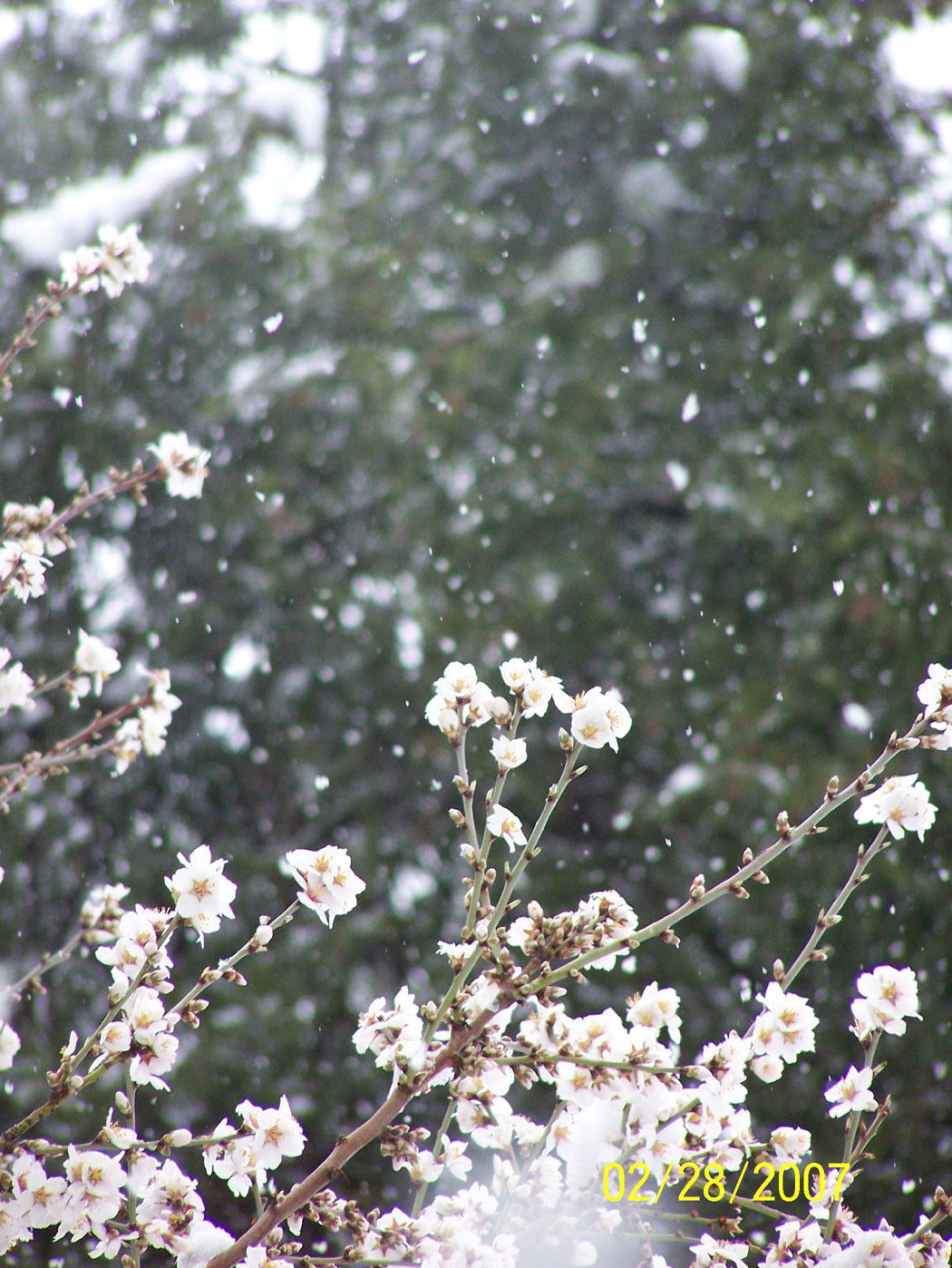
Three winters back, the almond tree in my neighbor's garden put out blossoms too early because of the strange, warmish winter. Of course, then we had some snow ...

yes, I really am. I’ve mentioned in this space before the extended drought we’ve been enduring here in California. While there have been a few significant periods of rain and snow over the last three years, “few” hardly describes the reality. I can count the number of storms on my achy fingers. Once.

The drought meant that when the rainy “season” ended, my world dried out even more and turned into a tinderbox. I’m not exaggerating. Southern and Central California had some devastating fires during the last three summers. Northern California has had a few, too, including one near Lake Tahoe, sparked by a summer lightning storm, that burned for two weeks. That’s just about 50 miles from my home.

The threat of wild fire looms every summer and fall in California, but when there’s also little snow in the high mountains, it means that everything becomes even more dry than usual. The danger, always there, heightens. Those of us who live here look ahead to summer with a certain uneasiness – and I’ve not even touched on the looming possibility of water rationing. Without these good rains – and deep snows in the high country – rationing eventually becomes vital.

It means our gardens must be allowed to dry out and die. Landscaping, flowers, vegetable gardens kaput. Farmers and ranchers are forced to let their fields and orchards go fallow. The price of food goes up all over the country; we all feel the pain.

But beyond all that, nutty as it sounds, it’s strange to live through winters that aren’t. While the changes in barometric pressure and the cold might cause me, as someone with rheumatoid arthritis, to hurt even more than I might otherwise, it’s still right and normal that it rains and snows in the wintertime. I can take it.

When winter never quite arrives, the birds get a bit confused. This is a Steller's jay, one of the many who live in the trees around my home and, in spring and summer, wake me with their shrieking and yelling to each other.

When it doesn’t rain and snow – and when the temperatures stick in the 60s through the deep of winter and flare up into the 80s in March, it just feels dreadfully wrong. The birds get confused. So do the plants and trees. They start leafing too early. The birds that overwinter here start nesting too early in the season, so when their first hatchlings arrive, there’s still not enough to feed them. Everything is just discombobulated. Off.

And people get cranky. Sure, when it’s cold and wet and icy and inconvenient, they’re cranky, too. But the reason is clear, and everyone knows that it’s just the way things are, it’s temporary, and we’d be in a fix without the damned wintertime. So when no rain ever drops out of the cloud cover and there’s rarely need for more than a sweater outdoors, humans also get confused. Irritable. Mostly we don’t know why, either.

I had some trouble sleeping last night. I tossed and turned. Normally, that would aggravate the you-know-what out of me, but last night, I didn’t mind as much. Why? I had my bedroom window open a crack for the fresh air. And it rained out there. I listened to it drum the roof and patter on the world outside and smelled the bright, watery scent of the rain and imagined that a few thousand feet higher up the mountain, my rain was falling as snow, white and silent, adding to the vital snowpack that, as it melts, waters the entire state. I imagined skiers and snowboarders tucked up in their hotel rooms, unable to sleep for excitement – fresh powder to ski on, come morning!

And I did, finally, drift off, listening to rainfall, glad that this winter, at least, is living up to expectations. Spring will come soon enough. So will the long, long, blistering-hot California summer. For now, though, let it rain.

About friends …

Like most of us who cope with rheumatoid arthritis day after day (because admit it – even when we don’t hurt, we know it’s in the wings, waiting for a cue to stride out front and center like a stage villain), I don’t like to complain all the time. Makes me feel whiney and small, and at my age, feeling like that is something I try hard to avoid. And, as Jules so beautifully points out – and practices – attitude is everything.

That said my hands are much less painful today; they’re back to their usual selves. The stormy ache has quieted to a low overcast and there are no sudden gusts of cutting pain.  The fact that they’re so much better can be attributed, I believe, in no small part to the kindness of friends.

heheheheheh

Now, I’m not talking about the friends I see or at least speak to frequently. They’re wonderful, of course, and I love them all.

I’m talking about you, the truly kindly people I’ve come to care about here, online. I suppose I could call you my “virtual” friends, but while you’re all very quiet, I’ve never heard your voices and I know what only a few of you look like because you’ve posted photos of yourselves on your blogs, “virtual” is a far from adequate description. It makes it sound as if you’re imaginary, like Christopher Robin’s dear friends Pooh and Tigger, Rabbit and Piglet. You may be as wise, bouncy, crusty, silly and kind as they were (and are, in the minds of children and ex-children everywhere), but you’re most decidedly not imaginary.

Fact is, you’re as real as I am as I sit here in Camino, California in my chilly den at my messy desk as I type these words into my laptop, my little space heater blowing warm on my freezing feet.

So this post is about you, my friends. Or rather, it’s about us. We’re widely separated by physical distance – one of you lives in a city in the Andes, another in England; a few of you live in eastern Canada; and in the U.S., Southern California, Illinois, Florida,  Arkansas, and Maryland, to name just a few. To be perfectly honest, I’m not sure where some of you hail from, and while I’m endlessly curious, it hardly matters. What does is that we all share several things in common that allow us to greet each other as friends.

The first is a connection to the World-wide Web. This is like  … well, amazing. Isn’t it?

The second is that we’re all fairly comfortable with computers – and we can type. Next is a propensity for the written word, along with the courage to actually write words down ourselves and save them rather than just say them.

Then there’s a certain talent for writing. Without it, few of us would be here as frequently as we are. Maybe not at all. There’s also the will necessary to scrape some time out of each busy day and put it aside just for writing. This is no small thing. Writing doesn’t only take the time needed to keyboard the words into the computer and hit “save” or “publish.” It’s an ongoing process, one that works quietly in the back rooms of our minds throughout the night in resting dreams and during the day while we’re dealing with more immediate issues, like stopping for a red light, participating in a meeting or putting together school lunches for the kids. Writing is time-consuming. Basically, it never stops, but it takes dedication.

Even with all that in common, we’re still separated by genders and age. We’re women and men. Some of us are teens or barely in our 20s; others are in our primes – our 30s and 40s. Still others are still going hard but starting to feel the burn – those of us in our 50s and beyond. Some of us are working at outside jobs, “bringing home the bacon.” Some of us are working at the tough and wonderful job of raising children and taking care of a home. Some of us work what used to be “outside” jobs from inside our homes, our extra rooms converted into offices. And by choice or not, some of us are unemployed at the moment, or retired.

None of it matters in any way that counts for much. We’re still friends. We’re drawn together by this wonderful technology which allows us to speak to each other, easily and quickly, no matter where in the world we are. We’re drawn together by our enjoyment of and joy in writing and by an intrinsic need to communicate. To have community.

I find this … magical.

Perhaps I’m childish, but I’m just old enough to remember when television was pretty new, and I’m not talking about color TV. Those of you in your 20s and 30s think nothing of laptops and netbooks and iPods and iPads and cell phones that double as iPods and calculators and GPS gadgets. Entire movies you can download onto your computers in minutes seem ho-hum these days, but I remember when seeing a movie meant going to a cinema on a Saturday for the double feature, clutching $1.50 in my grubby fist for my ticket, a big box of popcorn and some M&Ms. Some of us in our 40s and most of us in our 50s and 60s, while embracing all this constantly changing technology with enthusiasm, still regard it with something like awe and even a modicum of fear.

Finally, you and I share something that only a small percentage of people throughout the world share: We have rheumatoid arthritis.

When I write about my hands aching and my fingers hurting, there isn’t one person among you who hasn’t also felt my pain. When you write about being fatigued, I know just what you mean. Stiffness and pain that makes you lay weeping in bed in the mornings, willing your joints to stop hurting and move, because you need to get up and get on with your day? I’ve been there.

When you write about your frustration with a well-meaning friend or acquaintance who says, “You have arthritis? Oh, I have that too, in my knee. I take a couple Tylenols and I’m fine,” I get you. I feel it. When I write about my reluctance to tell others why I won’t go bowling or would rather not be on the office softball team, you know what I mean. You can empathize. You know just how utterly wimpy it makes me feel, because you’ve felt that way, too. And you know my reluctance to tell co-workers or an employer about my RA for fear of losing my job. You’ve broached the subject with great caution, too.

But like me, this is your reality. Perhaps not all the time: some of us have periods of respite (I don’t like the word “remission.” It promises so much, then cruelly takes it all back) that last days or weeks, months or even years. But we still get it. We remember.

When one of you writes about a rude or uncaring doctor, I get pissed off with you. I’ve dealt with doctors like that, and I didn’t like them, either.  When I write about the time my doc put a cast on my flared foot and sent me out of his office on crutches for two weeks, you can totally relate to my bemusement. When I went to him and begged for something, anything, to help me handle the pain, to please make it stop, you understand to the depths of your soul. Your hearts break for me, just as mine does for you.

Your stories of joint replacements – hips, shoulders, knees – make me cringe for you, knowing as I do the agony you must have endured and how long you probably had to endure it before your doctor decided replacement was the only answer. When I talk about the cane I have tucked away in my closet, just in case, you know why and you don’t think I’m being histrionic.

Your stories make me stronger. They make me think, and they help me prepare, mentally, for what I might need to face with the same courage you once did in my own future. You inspire me.

And when I write about how I dream that rheumatoid arthritis will be cured, once and for all, hopefully within my lifetime, I know you all agree with me wholeheartedly. I can almost hear the shouts of support, of hope, from all of you who share this incurable disease with me.

This post, then, is about all of us. About you, and how your kind thoughts and comments, your humor and sincerity, helped my hands feel better today. And about me as I return the favor to all of you, my friends.

Blue

Today’s an “OW! Damn!” day. Hands are their normal achy selves. No biggie. Used to that. Have it down. But now add on an excruciating BLAM of sharp finger-pain while 1) lifting a plate to rinse it off, or 2) grasping the edge of a pullover turtleneck to, well, pull it over. Or while stroking the cat. We won’t even talk about the language that issued forth when it was time to give said cat his pill. (He’s sweet, old, gets gold stars for being so cuddly from the techs at the vet’s office, has a kidney infection, and has to take an antibiotic for the next two weeks).

The language I’m using as I’m typing this isn’t pretty, either. I find cussing helps. Do you?

So. This seems like a wonderful day to pull those rheuma gloves on, curl up by the fire and enjoy my Kindle. I’m reading Steven King’s new book, “Under the Dome,” and just like all his best stories, I both can’t stop reading and wish I could…

In the running …

Yeah, I'm grinnin'...

Oh my gosh! Rheumablog is a finalist for Best Patient Blog in MedGadget’s 2009 Medblog Awards!

I don’t know who nominated me, but if you’re reading this, thank you! This is wonderful! I’m so honored!

I’m not usually one to blow my own horn, but hey, go vote for me, okay? Or you could go vote for  ∞ itis — WarmSocks’ blog. Her’s is really the best, in my humble opinion.

These are the other categories:

  • Best Medical Weblog
  • Best New Medical Weblog (established in 2009)
  • Best Literary Medical Weblog
  • Best Clinical Sciences Weblog
  • Best Health Policies/Ethics Weblog
  • Best Medical Technologies/Informatics Weblog

These are a bunch of excellent blogs, all worth a few minutes of your time. Go peruse. Vote here.

Backpacking down Memory Lane

Hi all …

Thanks for all your good wishes for my better health. I’m happy to say that I’m feeling quite a lot better today, so they must have worked.  :o) I’m still a bit bleh, but I did manage to accomplish more today than sleep and shuffle around the house. I did a bit of grocery shopping and took the cat to the vet, and although I got a start on writing it, I didn’t get Part 3 of my Alpen skiing adventure done.

Instead, I’m going to re-post an old one from 2007, in which I describe a longago backpacking trip I took with Mr Wren, my daughter Cary, and my stepdaughter Heather when they were kids. I went on this trip, and several others, in the late 90s, when my rheuma was in remission. I can’t even imagine doing it with my RA active and flaring, like Raw Sierra does. Wow. Talk about BRAVE.

 I’m very grateful that I had the opportunity to hike and see places I’d never have seen otherwise. What memories …

Many years ago Mr. Wren, me, and our two daughters (aged 38, 38, 13 and 12, respectively) went backpacking in the Desolation Wilderness, a magnificent, mostly pristine alpine wilderness in the Eldorado National Forest in the Northern California Sierras. We decided to take four days – plenty of time to pack in, time to decide where to go and wander around, and time to pack out from wherever we ended up.

Mr. Wren loves hiking and fishing – he’s a true outdoorsman who should have been born 150 years ago so he could be Snowshoe Thompson. He’s hiked all over – Kilauea and Mauna Loa in Hawaii, Desolation many times, Mt. Rainier in Washington State, parts of the Bavarian Alps, countless unmarked areas around our home range, and south toward Yosemite and in the Coast Range of California. These days, because of an injury that disabled him, he can’t hike anymore, but he still spends most of his day outdoors, working in the garden. Gardening is a hobby he’s always loved, too – he’s a Master Gardener — but 12 years ago he was a hiking, fishing monster.

So off we went, the jubilant Mr. Wren and his three girls, headed up the mountain to the Twin Lakes trailhead near Wrights Lake. Us ladies shouldered packs of about 25 pounds each, including ultra-light fishing rods; Mr. Wren’s pack weighed closer to 60, and he had two rods with him, one for fly fishing, the other a casting rod. I was a bit overawed. He pooh-poohed me. “No problem,” he said.

We started right around noon, walking along a rather nice, wide dirt trail that wound through mountain meadows, under conifers and over great expanses of smooth granite, always meandering gently uphill. I’d done some hiking in the past – remind me to tell you about the time Mr. Wren talked me into climbing Pinnacles with him – but it had been many years since I’d done a long hike, and I’d never carried a full backpack before. My most recent hike, sans Mr. Wren, had been a 5-mile, fairly easy day hike with the local Sierra Club chapter to Lovers Leap (yeah, yeah, I went the back way to the top, not straight up the sheer rock face).

So this backpacking thing seemed pretty spiffy. I was striding along, warmed up, getting used to the feel of the pack on my back, enjoying the beautiful scenery, the bird-song and the fragrant, fresh air while trying to ignore my swelling fingers. (Altitude and prolonged walking always make them swell painlessly.) The girls were chattering and laughing as we followed Mr. Wren’s huge strides (he’s 6’2”) and trotted now and then to keep up.

Then the nice trail petered out. We were standing in the middle of a true wilderness, nothing but mountains in all directions, lodge pole pines and fir trees, swaths of the gray-white granite I would come to know intimately before it was all over, and the hot sun beating down on our heads from above. I was glad for that neat little ball cap I’d bought just before we left.

Mr. Wren called a break, and we all took our sweaty packs off and stretched a bit while he consulted his raggedy USGS survey map. The girls broke out the slabs of chocolate we’d brought along for energy emergencies.

“We’ll head for Grouse Lake,” he said after a few minutes. “Great fishing – rainbows, browns, maybe some goldens. It’s not too much further, but it’s a little climb. Not too bad.”

Note to self: When Mr. Wren says it’s a “little climb,” question him closely. Remember Pinnacles.

By this time, I was thinking how nice it would be to sit on a rock, fish and let my legs, which were beginning to yelp a bit and feel sort of rubbery, rest. The idea of fresh-caught trout for dinner sounded really good, though. Mr. Wren pounded off, pointing yonder at the mountain (I swear he yodeled), and the girls and I figured out how to buckle our packs back on by ourselves. This involved sitting down, skootching our butts up to the packs backside first, working our arms through the straps, standing up and then buckling everything. We did this for the practice. You know. Just in case we needed to know how or something. We took off after him.

Mr. Wren’s “little climb” was quite a dilly. There was a trail again, but now it was narrow, maybe 8 inches wide. It wound between massive boulders as it went steadily up and up. Just as dusk was falling, we’d reached a level, sort of wet meadow area but still had some way to go to make Grouse Lake. We stopped for a rest, discussing whether to keep on and if it was sensible to try to reach it in the dark. I was tipping my water bottle over my mouth – the girls had gone rather quiet – when I heard a low, building hum. A single mosquito whined past my ear.

“Time for the Skin So Soft,” said Mr. Wren cheerfully as the hum grew louder. I flapped my hand at another mosquito.

“Mom! They’re all over!” the 13-year-old squealed, and a moment later, we were all slapping madly at a huge swarm of mosquitoes and rubbing slick handfuls of Skin So Soft lotion all over every exposed surface of our bodies. Since we were wearing shorts and T-shirts, there was a lot of it to cover.

It was soon apparent that either these particular, very hungry, Desolation mosquitoes were immune to Skin So Soft – and in fact, were rather fond of the scent, which must have been the equivalent to hollandaise sauce to them – or the legendary Avon product’s mosquito-repelling power was nothing but a cruel urban myth. Either way, this was not a pleasant way to find out. And the sun was nearly gone. Rather than run, screeching up that treacherous goat trail in the dark, we whipped out the sleeping bags and ground pads, found a relatively dry spot to lay them out, I tossed everyone packets of cheese crackers and little tins of potted meat, and we all beat a hasty and cowardly retreat into our down mummy bags for the night.

We were up at dawn. There was some general grumpiness as the girls wanted to eat chocolate for breakfast rather than gorp and fruit leather. The 13-year-old grudgingly opened a tin of Vienna sausages, promptly decided she hated them and left me figuring out what to do with a full, opened tin. I ate them. We didn’t linger, in spite of everyone but Mr. Wren being rather stiff and sore. I wanted coffee desperately, but I sure didn’t want to hang around long enough for the mosquitoes to discover we were out of our protective cocoons. Soon, we were on the trail again, which started climbing even more steeply than before. I was glad we hadn’t attempted it in the dark.

About two hours later – well, an hour and half for Mr. Wren, who’d already shed his pack and was casting happily for trout – we reached Grouse Lake, which sits at 8,412 feet above sea level. It was a beautiful, secluded little lake, surrounded by forest with a shore of granite boulders and gravel. We decided to spend the day and the night there. We set up camp – basically laid the sleeping bags out and piled the packs in the little cleared campground – and I made coffee in a camp-pot over the single burner camp-stove and had my fix. Then I joined the others and wandered around the lake, attempting to catch trout on little silver Castmaster lures without luck and untangling the girls’ lines for them.

As the day progressed, more people arrived at the lake, but most were passing through on day-hikes – a feat that amazed me at the time. I was glad for the rest-day, personally. I felt good but I was tired, and I’d thought I was in fairly decent shape. But these people must have been taking that twisty little uphill trail at a trot to be able to get there and then all the way back down to their cars before nightfall. Uber-hikers.

We ended up with a trout-less dinner that night. Mr. Wren had caught scads of them, but they were all tiny things and he threw them back, laughing and telling them to be more careful next time. He loves fish as much for the fun of catching them, giving them a little talking to and throwing them back, as for eating them. We dined on Mrs. Grass’s Instant Vegetable Soup instead, with crackers, trail mix, granola bars, dried fruit and of course, hunks of chocolate. For energy.

After a blessedly mosquito-less night – I fell asleep trying to spot satellites among the (heheh) billions and billions of stars with Mr. Wren – we were up at dawn again and off to the next destination, Smith Lake.

There was more climbing. More twisty trail maneuvering. By this time, my muscles were in full-scream mode from the first day’s hike. For some reason, really sore muscles don’t hit me for about 36 hours after being insulted. But I walked through them, finding that I needed to pay more attention to where I was putting my feet so as not to go tumbling down a rocky decline than my grumpy body. We were truly moving into steep mountains. The climb was difficult. There were many fewer trees and a lot more granite.

When we reached Smith Lake, at 8,700 feet, we were ready for a decent rest. Out came the fishing rods again, but this time I turned my pack into a back-rest and stretched my legs out. Mr. Wren and the girls tried their best while I dozed, but decided that the sun was too high now and the fish – brook trout in this pretty, small lake – weren’t hungry. Must have dined well on the local mosquitos, I thought. We dined ourselves – the usual, plus chocolate (for energy) – and Mr. Wren got the map out again.

“I think Hemlock Lake is just a little way from here,” he said, studying the squiggly lines. I had no idea how he knew where anything was. Ever since we’d left that nice wide dirt trail two afternoons before, the trails were only marked by “ducks,” the little rock cairns that hikers make to tell other hikers they’re still on the “trail.” To me, the “ducks” looked like all the other piles of granite everywhere I looked. If not for Mr. Wren, I’m sure they would have had to send in a rescue party to find me.

“OK,” I said. “Hemlock Lake, here we come. Can we camp there?”

“Oh, sure,” he said. “Or we could go across the ridge to Twin Lakes.”

“Uh-huh.”

Off we went. The girls were enjoying themselves, but this backpacking expedition was no walk in the park anymore. There was some grumbling, which quickly stopped as we started climbing again. Eventually, we found ourselves in a wide clearing with a fast stream tumbling through the broken granite down the mountainside. Mr. Wren got the map out again. I wished mightily for a folding chair and caught my breath as he perused the map.

“Do you know where we are?” I asked.

“Oh, yeah. We don’t have much further to go. Just a little climb.”

Remember note to self.

I looked around. We wouldn’t be going back the way we came, which was downhill. So was the direction the stream was clattering. On the other side of it looked to be nothing much but broken granite, some wildflowers and some gently rising ground.

On the last side, some distance away – facing west – there was a sheer, straight-up-looking mountain wall.

I laughed uneasily. “You don’t mean up there, do you?” I shaded my eyes and looked toward the summit. Nothing but high, blue sky beyond it. Cue the eagle scream, I thought.

“Yep, that’s the one! Oh, don’t worry, sweetie, it’s not as bad as it looks! There’s a trail all the way up.”

It is a testament to my love for Mr. Wren that I just swallowed and said, “OK.” I didn’t want to be a party poop and ruin his first Desolation adventure with the family along. But I have to say here that I’m afraid of heights. Ever since I was a little kid, I’ve been terrified of them. Put me on a kitchen stool and tell me to jump off, and I’ll wet my pants. The very thought of climbing that granite monstrosity – with a 25-pound pack on my back and nothing but my hands and booted feet — made my blood run cold.

But he was already striding off, yodeling for the girls, a big happy grin on his sweaty face.

Well, as you might have guessed, I climbed that sucker and lived to tell about it. I did about half of it all alone, as the girls and Mr. Wren left me in their dust. There was no trail, unless you can call the 3-inch ribbon of sandy soil between the dumpster sized boulders a trail. Each step, for my short legs, was like stepping up onto the back of a flatbed truck. Sometimes I went up backwards, boosting myself up on my butt, trying not to look down between my feet. Sometimes I heaved myself up with my arms, fingers clutching rock on both sides. I rested a lot. I cussed Mr. Wren and the day I’d married him, which he was fortunately too far ahead of me to hear. I reached a point where all I wanted to do was go back down – they could find me later, sitting by that stream, communing with black bears, my swollen, aching feet in the icy water. But I was even more afraid to go down, and besides, the top had to be close, right? I even dreaded reaching the top, because it meant tomorrow morning, I would have to climb down. Somehow.

Finally, I made it. I came up over the edge of the trail, dragging myself with my hands and scrabbling for toeholds, stood up, staggered a few feet, and stopped. Ahead was a tiny blue lake – more like a tarn – in a basin formed entirely of granite slabs the size of houses. The far lip of the tarn was even high than where I stood, and beyond it, featureless, clear blue sky. There were a few fir trees here and there – they were short but ages old, twisted by wind and snow, almost like Japanese bonsai trees. A pika chattered at me from some rocks nearby. There were no birds. There was no sound but the breeze in my ears and the sound of my own heart, pounding. My arms and legs were trembling. My whole body was trembling. Barely, I could hear Mr. Wren and the girls, out of sight, talking and laughing about the wonderful fish they were going to catch. If a gust of wind came, I was sure I’d fall right over. And I was deeply, coldly furious. I could have fallen, I thought with a wild surge of self-pity. They’d never have known! I could be halfway down the mountain, broken and bleeding to death! And they’re too fucking busy fishing to even wonder where I am!

I found a boulder far enough from the edge of the drop-off for comfort and low enough to clamber up on, shrugged myself out of my pack, sat down and stretched my beaten legs out. I forced myself to calm down. After all, I’d done it, right? I’d climbed the highest thing I’d ever seen. I hadn’t fallen, hadn’t killed myself. Well, yet. There was nothing to worry about. And then I looked out, straight ahead.

My breath caught in my throat and tears sprang to my eyes all over again.

In the time it had taken me to climb my mountain, the sun had nearly dropped behind the mountains to the west, casting them in a shaded series of silhouettes, one beyond the next beyond the next until they stopped, unspeakably far away, with a gap and then a little ridge I knew must be the Coast Range on the far west side of the Sacramento Valley. Beyond them was the Pacific Ocean. I couldn’t see it, but way up on my mountain peak, looking at the blues and purples and golden-rimmed mountains falling down and down and down, I knew it was there.

It was the singular most incredibly beautiful thing I’ve ever seen in my life – and probably ever will.

I sat there, tears running down my cheeks, watching the sun go orange and the sky go salmon and pink and purple, watching as the night drew down on that high glacial tarn with its dancing small trees. After a while, I got up and made my way unsteadily over to Mr. Wren and the girls, who were splashing in the frigid shallows and deciding there must not be a single fish in that water. I wondered how in the world a fish could get up there, but I didn’t say anything. I just got the little camp-stove going behind a boulder, out of the wind, and tore open a couple more packets of vegetable soup. No fish tonight, either, but really, who cared?

The next day we climbed back down. I don’t remember a very much of it – I’m pretty sure I did most of it cautiously slipping from boulder to boulder on my ass. And we went on, all the way down, working our way out steadily with very few stops to rest, one eye always on the sun.

When we finally reached the trailhead and the parking lot, my feet felt like they were going to explode. I was sweaty, mosquito-bitten, scratched, sunburned and filthy from four days without anything that could be even jokingly called a bath, exhausted and so hungry I was sure I could tuck into a whole roasted horse, if only someone would cook one. And I was deliriously happy, still high on that one, amazing view.

We heaved the packs into the back of the van. We all climbed in.

“How about we have some dinner at St. Pauli’s?” asked Mr. Wren, tired and smiling with the sheer joy of accomplishment.

“Oh, god. Go!” I said.

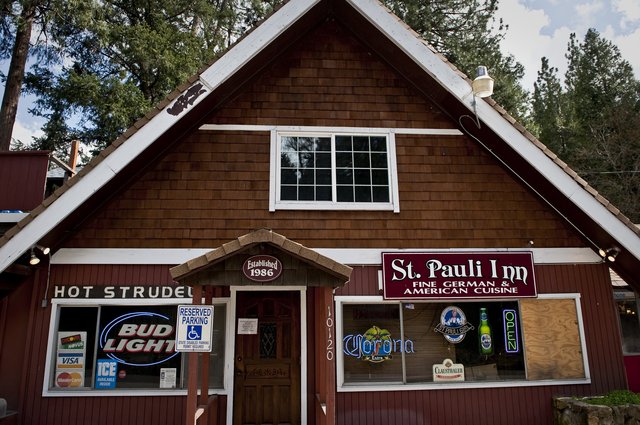
And so a half-hour later we dragged our exhausted butts into the St. Pauli Inn on Highway 50 near Strawberry, asked to sit outside on the back deck for dinner if they didn’t mind, because we were sure we stank to high heaven, and tucked into the most delicious meal of my life.

And you know what? I don’t even remember what I ate.

*The photo is one I shot of Mr. Wren on an expedition two years later into Desolation to Lake of the Woods, done in early July. Yes, he talked me into it again. He’d been walking along in his hiking shorts and boots on top of the snowpack when he suddenly broke through at the base of a tree and ended up over his knees in the snow. He laughed himself silly. I sat down and took a rest, had a little snack. It was chocolate, I believe. Energy. The other photos are ones I found on the Intertubes of other places in the Desolation Wilderness that remind me of that long ago hike, but aren’t of where we were, and the St. Pauli Inn, where we ate a huge supper of hot, savory German food rather than instant soup or chocolate … 

Under the weather

Greetings, all. I’m feeling yecch today. Foggy, headachy, weak and a bit nauseated. Fortunately, the rheuma is as always; only my hands are giving me any hell, which is a relief, actually, since yesterday I was gimping around with a mildish flare in my right ankle, too. That seems to have resolved. I rarely get sick, so I’m hoping that I’m just fighting off a bug and that I’ll emerge victorious rather shortly. To that end, I went back to bed after being up for about an hour this morning (and I’d slept in – a fairly unusual occurance!) and slept for several hours more. Now, up, I’ve had a bowl of chicken soup, a couple of glasses of water and I’m sipping at a cup of coffee (hoping that the caffeine might ease the headache. Who knows? My fingers are crossed).

I’d planned to write and post Part 3 of my ski trip adventure this morning, but I’m only just now getting a start on it. If I’m successful, I’ll post it a bit later today. If not … there’s always tomorrow.

Matt just made me laugh. We were talking about the rain (the snow has turned to a heavy, cold rain today) when his cellphone “rang” – playing the ominous Bad Emperor fanfare from Star Wars.  “It’s Cary,” he said, answering it with a sheepish grin. “The Boss.” Seems he’s set that music to play when she calls so he’ll know it’s her …

Later, friends.

Your basic gimp skis the Alps, Part 2

Hi everyone. More snow here at the Wren’s Nest. Since Thursday night we’ve had about five inches. The weather service says we’re due for some clearing today, but you could fool me. (I’m looking out my window at snowflakes falling lazily from a sky the color of old steel.)But all this white stuff reminded me that I hadn’t continued the story of my ski trip in the Alps, yet. So here’s another installment. If you haven’t read the first installment yet, this might be a good time to do it. You can read it here.

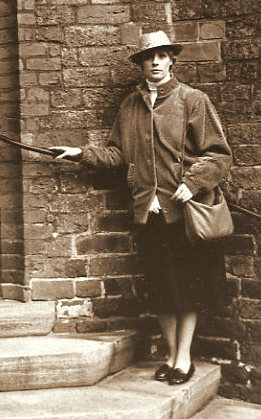
Wren in 1987, Bremen, Germany, not long after being diagnosed with RA.


Yep, you read the headline right. The “gimp” would be yours truly in the late80s, diagnosed three years earlier with rheumatoid arthritis.

Back then, along with attacking various joints all over my body, rheuma made the bottoms of both my feet ache. It was as if some malicious someone battered them with bamboo rods while I slept each night. They were painful, in varying degrees, almost all the time; it was like walking on sharp gravel barefooted. Standing for any length of time was excruciating.

But I was young and strong and, with the exception of rheuma, ridiculously healthy. I was just 34. So when the opportunity presented itself, I went skiing. In the Alps. In January. With RA.

Now, I didn’t know how to ski. My sole experience was a one-day ski trip when I was in elementary school. I spent most of that less-than-delightful day sitting in the snow, my Scotchgarded blue jeans wet through. I couldn’t seem to stay upright on my skis. When I fell down, I couldn’t figure out how to get back up without taking the skis off. It was a singularly freezing, humiliating and miserable experience. But here, in tiny, beautiful St. Veit im Pongau, Austria, I would take five days worth of ski lessons, courtesy of Siegi Baumgartner’s Red & White Ski Schule. I would soon, I thought, be one of the beautiful people, one of those fit, athletic, suntanned, sunglasses-wearing white-smiled people who zig-zagged at breakneck speeds down steep mountainsides, spraying roostertails of powdersnow from the backs of my long, skinny, stylish skis. I even had a wonderful, never-worn-before ski suit, black with bright pinks and yellows at the collar and cuffs.

St. Veit im Pongau, Austria. Our ski group stayed in this small Alpen village north of Salzburg for a week.

But first I had to learn how to get back up after falling down.

That first night, after our long journey by train, we attended Siegi’s welcome dinner in St. Veit im Pongau. This came complete with an oompah band, traditional Austrian dancers and Hans, our host’s elder brother, who demonstrated his yodeling prowess dressed in lederhosen, a pointed hat with a feather, kneesocks, silver-buckled shoes and suspenders. He did this after several toasts with the local berry liqueur, a startlingly sweet, fiery concoction which we all imbibed liberally with him, along with beer. He was wonderful – and yodeled with a completely mournful expression. Think Deputy Dawg in lederhosen. After we were all sufficiently stuffed with a nice hot, heavy, Austrian supper and desert – and plenty of booze — we all staggered, giggling, off to our respective lodgings (which were scattered throughout the village) for the night.

We set off walking down the frozen, cobbled streets again, and without too much trouble found our chalet (a private residence equipped with extra rooms – did I mention the whole village was in on this money-making ski resort scheme of Siegi’s?). A friendly, smiling Hausfrau ushered us up to our room.

I was about as tired as I’ve ever been. My feet were two hot, throbbing blocks at the ends of my legs. The room was quaint, warm and comfortable, and equipped with an en suite bathroom – a luxury, as in most smaller hotels and guesthouses in Europe, sharing a communal bathroom was the norm. The only drawback was that rather than having one of those gloriously deep bathtubs (I’d been dreaming of a steamy, hot bath since we’d made that last big train-change in Munich), there was just a small shower stall. Oh well. Can’t have everything, I thought, and dove headfirst into bed.

We met punishingly early the next morning back at Siegi’s central meeting hall on the village square. Everyone was yawning and a little hung over, but we were all in good spirits and excited about the day of skiing ahead. In the ALPS! OMG, the Alps! Surrounded with a décor of oak, lace, thick, brocaded curtains and flowery seat cushions, we filled our queasy stomachs with a hearty Austrian-style breakfast of soft-boiled eggs in wee egg-cups, crispy bread rolls with cream cheese and jam, sliced Edam cheese and cold cuts, and subtly sweet pastries. This was all followed up with several cups of thick coffee strong enough to stimulate the spontaneous growth of chest hairs. Thus well-fortified, hangovers miraculously gone, my then-husband John and I set off to the ski rental place a few blocks over. Turned out it was owned and operated by Hans, the deadpan yodeler.

Fitted with Frankenstein ski boots and provided with skis and poles, we clopped along and met our friends at the red-and-white SiegiTours bus, which trundled us four miles up a steep, winding road halfway up a monster mountain to St. Johann im Pongau, a much larger Austrian village which, along with numerous restaurants, chalet hotels and shops of all description, also boasted a big ski resort. The bus dropped us off in front of the resort’s tram building, where we bought our ski passes for the week and joined the queue for a tram ride up the mountain.

St. Johann im Pongau from the mountaintop ...

I should mention here that I have always had a rather serious fear of heights. Inside the barn-like building, trams large enough to hold 20 or 30 people a pop glided in and out through huge doorways, suspended on giant pulley cables, propelled by a monstrous set of constantly turning wheels. The mechanisms dwarfed the line of people waiting, their breath steaming in the ice-cold air. This … thing … would carry us up to the ski area. Right. My stomach flip-flopped. But I filed in with everyone else, keeping my fear to myself. After all, I didn’t want to spend the week sitting alone in Siegi’s upholstered meeting hall, nursing berry liqueur and watching the snow fall. The only other way up the mountain would be to climb it on foot. Or take a helicopter.

Oh, I think not.

The tram ride was smooth (except when the connectors bumped over the tall towers the cables were strung on). And the view. Oh, my. Suspended high in the air, hundreds of feet above the fir tree forests, the Austrian Alps spread out all around us, their jagged summits bare and crusted with never-melting snowcaps. I forgot all about being scared of heights and just gazed out the windows, mesmerized …

Stay tuned for Part 3.

Storm

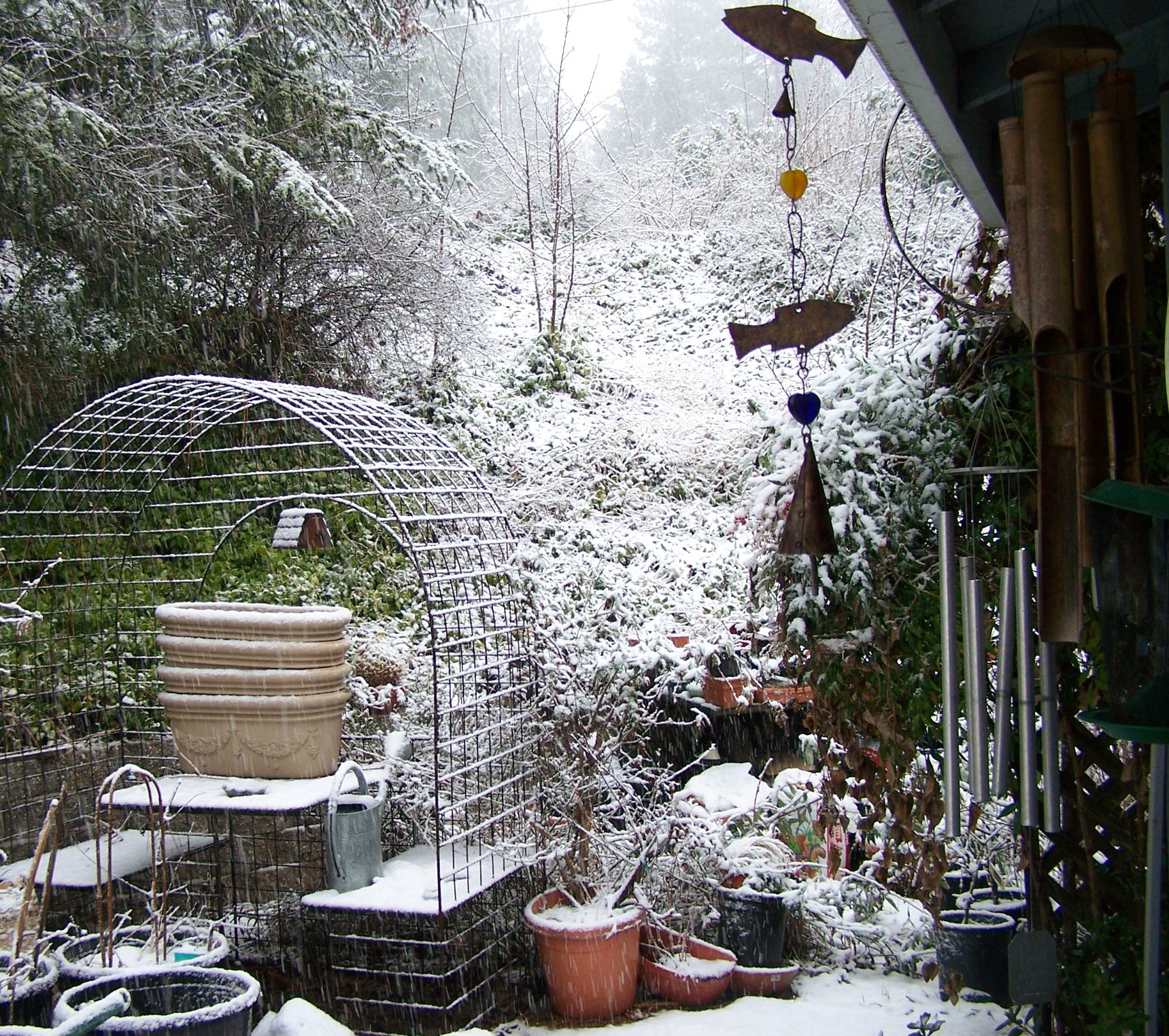
Today the third of a series of big El Nino storms is whirling over Northern California. It dropped a lot of rain and, a little while ago, the snow pictured above.

It was sudden, too. One moment it was raining, and then next these great, fat, almost cotton-ball-sized clumps of snowflakes poured from the sky and quickly coated everything in white. We had nearly an inch of snow on the ground 20 minutes later. Then it slowed down, the flakes got smaller and it stopped.

Some of it has melted a little, but as evening approaches and the temperatures start dipping again, I expect it will freeze. And there’s supposed to be more rain/snow tonight. And tomorrow. And Friday.

I have my second physical therapy appointment tomorrow afternoon. Even though I love snow, I’m hoping for rain, frankly.  I live in a rural part of a rural county, and it can take the county snowplows a good long time to get to clearing our little street after a significant snowfall.  And while I have snow chains for my Kia, putting them on and taking them off with arthritic hands while kneeling in icy slush doesn’t hold much appeal.

But I’ll worry about that when the time comes. For now, I get to watch the lovely snow. It’s a hassle, but it’s beautiful. I carted in a load of firewood this morning; the wood stove is crackling and blazing and I’m warm as toast. I have plans for a big pot of smoking hot potato soup with crusty wholegrain bread for supper tonight. Wren’s nest is cozy. Let it storm. Let these storms, and many others before spring, spin on through and end our three-year-drought.

I can hear the wind in the evergreen trees that surround my house. It makes them sway back and forth, slow as dancers, whispering among themselves. If I close my eyes, I can almost imagine that I’m listening to booming ocean breakers crashing on a rocky beach, not fir trees shushing in the wind. The sky is the color of a whale’s belly. The birds have deserted us.

Words of power

As a professional writer I’ve always had a particular fascination with words. A life-long imagination-surfer, I’ve thrilled to writing’s ability to transport me to new places, new worlds, even new planets and galaxies. I’ve gladly grabbed the opportunity to lose myself in the pages of a book and walk in someone else’s shoes, living their very different life for a little while. To me, writing is magic. The alchemy occurs when the writer scratches symbols in black ink onto a field of white paper (or upon a white digital screen, these days). Somehow the combination conjures up an ever-shifting, color-shot kaleidoscope of concepts and ideas.

Words.

For many years I’ve been aware of how powerful they are. Not just in imparting information, but in having a profound effect on our individual lives. The way we use words can shape and define us. Words give substance to our thoughts. And our thoughts are us, they’re our own, in a way so singular it’s almost indescribable. I cannot think your thoughts. You cannot think mine. The very act of putting them into words distorts and waters them down.

It’s probably a good thing.

But even so unavoidably diluted, words have incredible power. And so for a long time I fought using, or even thinking, the term “my rheuma.”  By calling it mine, I reasoned, my thinking about it was necessarily de-fanged. No longer could it be an alien, an incredibly annoying stranger shouldering into my life and laying around the living room, snorfing chips in front of a blaring television set. You see, calling it my rheuma would mean I accepted it on its own, stinking terms. I’d give in. It was as if because I couldn’t shift the nasty creature that took so much pleasure in prying my joints apart, I’d just try to make friends with it. Cuddle up. Be snuggly. Try to love it for what it was, even as it hurt me so badly.

I fought that for years. When I spoke about RA, I referred to it, gravely, as the rheuma. Oddly, I never wrote about it. Writing them down gives these concepts even more life and makes them more real. Yet in a strange paradox of logic, here I am, writing about it now.

When we have mice in the cupboards, we don’t cozy up and call them “our” mice. We try to trap them and kill them, and if we can’t kill them because our hearts are too soft, we’ll still trap them and take them a long way away before setting them loose. They are never our mice. They’re the mice. Or those mice. Sometimes we’ll even drop an expletive into the middle to make our feelings about mice totally clear. We don’t want them in our house, leaving tiny poops on the cookie sheets.

So rhetorically, at least, rheumatoid arthritis has never been mine. I forced myself not to think of it that way. I made sure I didn’t speak of it that way to others. In my mind, in my life, RA remained alien. The Other. Something to be fought at every turn. And this even though I knew, deep down in that quiet, logical, pragmatic part of my being, that I’d fight this particular enemy to the death. Rheuma and I will go down together, battling as grimly and violently as Gandolf and the Balrog.

I’ve written about this before in the pages of this blog. I go back and forth over this simple problem of rhetoric. I struggle with it because of my love for words and the life-shaping power within them.

But sometimes I get tired. I decide to call a truce with rheuma. I offer to call it mine. I tell myself I’ll be able to get close enough to file down its fangs if I do that. Maybe I’ll get a collar around its neck. Perhaps, if I’m really, really friendly, I’ll talk it into getting de-clawed. And so, for a while I’ll concede the battle and call it my rheuma. Poor thing is sick. I need to listen to it. It needs medicines. It doesn’t mean to hurt me. If I’m just gentle enough with it, good enough to it, give it the attention and stroking it craves and work as hard as I can to cure it, perhaps it won’t bite me so hard or so deep. Perhaps it will stop trying to cripple me. Or kill me.

Feh.

I’ve got to stop fooling myself. One thing about rheuma: it has no honor.

All of this bubbled up in my head again because of an email I got this morning from Tom Robinson, a chronic illness coach and the author of  the blog, “Living Your Best Possible Life When You Have a Chronic Illness.” He sends tips for living that best possible life to subscribers each week; when I signed up a few months ago I thought, hey, why not? It’ll probably be nothing but a bunch of new-agey, shallow platitudes, but maybe … maybe this guy is something special. I’d heard of life coaches, but chronic illness coaches? Wonders never cease.

Well, Mr Robinson surprised me. His tips are simple, but they’re strangely profound and useful. Perhaps it’s because he comes at his coaching from a place of experience: he has a chronic illness himself. I get the feeling he’s actually tried out his own tips – and while I could be wrong, I also get the feeling that he only shares the ones that work.

This week’s tip resonated. Here I sat in front of my laptop, a cup of morning coffee steaming gently into the chilly morning air, the cat kneading my lap and trying to get me to let him drape his warm, furry self over my forearms. (I wanted to let him, but it’s hard to type with 14 pounds of tuxedo cat weighing down your hands.) Said hands were encased in compression gloves and stiffened with wrist braces. I’d spent the day yesterday popping Tylenol and tramadol. I dipped my hands and wrists in hot paraffin four times. I read. I made soup, gritting my teeth at the pain the rheuma was causing as I chopped onions and cabbage. I did the best I could to just get on with the day and ignore the blasted pain. My rheuma? Huh-uh. No way, Jose. The rheuma. The battle continued and the storm-crows watched, croaking, waiting for me to fall …

Today’s a new day. Here’s what Tom wrote:

“My first tip is to name your illness symptoms. That may sound like a strange suggestion, but there are some very good reasons for doing it. One of them is this: when you give a symptom a name, such as Gertrude or Elmer, you separate yourself from it. When you do that, you are much less likely to identify with it, which makes it possible to step back and see ways for dealing with it and managing its effects on your life that you otherwise couldn’t.”

Yes.

Oh yes oh yes.

I understand exactly what Tom is getting at. He’s speaking my language; using rhetoric I can wrap my mind around. Not wanting to own the autoimmune disease that injures my joints and gives me constant pain by calling it mine is a difficult undertaking, particularly when I write. It’s simply harder to construct flowing sentences that feature “the rheuma” rather than “my rheuma.” I’m forever having to find new sentence structures, and often they’re not constructed nearly as well as they could be. Instead of being seamless, they look cobbled together. Awkward. Like an arched expansion bridge made of two-by-fours held together with nails. It looks sturdy, but actually stepping onto it to cross over that deep ravine is an act of sheer bravery.

Tom continues:

“A related benefit of naming your symptoms is that it allows you to communicate with them. You can write to them and tell them how they’ve affected your life, and you can tell them how you have felt, and continue to feel, with them. When you do that, you will probably find that you feel a sense of relief and very possibly a lessening of the severity of your symptoms .

“You can also have a conversation with “Sherlock” or “Agnes” (or whatever you’ve named your symptoms). When you do, besides telling them how you feel about them, you can ask them if there is anything they want you to know or to learn from them. You can ask them what are the things you do and the situations that make them worse, and you can ask them what changes you can make to lessen their severity and minimize their impact on your life.”

I like this.

I think I’ll call the rheumatoid arthritis that’s claimed squatter’s rights in my body “Mack,” as in “Mack the Knife.” Because that’s what it feels like to me when Mack’s hurting me. Like he’s slipped a knife between my joint-bones and he’s flexing it, back and forth, in rhythm with my heartbeat, forcing them further and further apart.

Mack.

I have some rather harsh things to say to Mack that probably don’t belong on a family blog. And once that’s out of the way, maybe I’ll sit down and have that talk with Mack that Tom suggests. It’s possible that Mack will ignore me. But that’s all right. See, now I know RA’s name as it manifests in my individual self. That gives me a lot more power over it and a lot more strength for the battles ahead.

Thanks, Tom Robinson. I needed that.

Reunion

An old friend found me on Facebook and got in touch recently. It’s been many, many years since we’ve talked; I’ve thought of J frequently and wished fervently we hadn’t lost contact with one another. Needless to say, I was totally delighted to hear from her.

What a lovely gift for the new year!

We chatted with Facebook’s IM function for a while, exchanged email addresses and phone numbers, and promised not to lose touch again. I came away from our short, happy conversation with a big smile on my face. She is one of the most beautiful, joyous people I’ve ever known. From the moment we met, we hit it off. J is a soulfriend. There are so few of those! She has the most wonderful laugh … and the most wonderful heart.

As we talked, I told her I write a couple of blogs. When she read the name of this one, she asked, does that mean you’re still having that awful pain?

I told her I am, but it’s not nearly as awful as it once was. I changed the subject and we talked about other things.

But later, I got to thinking about it. My old friend J is the only person, other than my daughter, who remembers the awful RA flares I used to go through when I lived in Germany. In fact, she frequently stepped in and ran my office for a day or three at a time when I couldn’t make it to work; when I was so crippled from joint pain and so out of it from pain meds that I was barely coherent.

It’s strange how isolated a person can feel with this disease. Cary remembers how I was back then, but her memories are, naturally, those of a child. Since she’s been an adult, she’s never seen me battle a flare as bad as I used to have. Mr Wren and I were married to other people back then. When we first got back together in the early 90s, he knew I limped and gimped now and then and I told him I had RA, but he’s never seen me deal with a serious, truly debilitating flare. My Mom and sister haven’t either. My fearsome memories are mine alone.

Sometimes I feel like I’m whining, like I’m a little too obsessed with the return of my RA symptoms. While they’re not as bad as they were before I went into remission, this disease is so damned sneaky. With each twinge and ache I flash back instantly to those agonizing old days. My mind cringes away from the memories and I fill with dread. I know that rheuma can ramp up at any moment. It won’t give me any warning. And the fact that I haven’t had a truly horrible flare, but just medium-sized, painful ones and little, nagging ones since the symptoms returned does not reassure me that I never will have a really bad one again.

I know better.

And yet I treasure the time I spent living and working in Germany. It was a life-changing time, a time when my mind opened, a time when I learned more than I ever thought I could. The rheuma pain is a part of that time in my life, woven deeply through it. There was so much I did in spite of the debilitating pain.

So. Am I obsessing about my RA? Am I being overwrought? Am I fearing something I have no real reason to fear anymore? I don’t know. But getting back in touch with J and having her validate my memories the way she did went a long way toward putting that niggling worry to rest. I’m not hysterical. I’m not a hypochondriac. This isn’t just in my head. My RA was and is real. I have lived through and coped with truly excruciating pain, and I did it with grace and, to the best of my ability, with a smile on my face.

I remember. And my dear friend does too.