Indecision

The morning is a schizophrenic mix of dull gray clouds and filtered sun, making me uncertain as to how I should dress for the outdoor chores I want to do. Should I cover up, protecting myself from the unseasonably cool breeze, or toss my caution to the wind and pull on cropped pants and a shirt that leaves my arms exposed? The latter requires rubbing in sunscreen. I’m reluctant. The lotion is cold; my house is cold, not yet warmed up after yet another night in the low 40s. In June. But once outside, won’t I enjoy the sun’s feeble warmth? I’ll forget about goose-bumpy arms as I move around, raking and sweeping and trimming, dead-heading and neatening up.

Won’t I?

It seems I’m never satisfied. During several recent winters I complained because winter never really arrived. There were months of days in the 60s after only brief forays into the sort of frigid temperatures that winter is supposed to bring. Spring merely continued the trend, and when summer came, it came early and with such heat and blinding sun that I swore every time I had to go out into it. Fire on the brain. Immolated skin. This, I thought darkly, is global warming. You don’t believe in it? Then live where I do, through long, moisture-less winters and flaming summers so hot and dry they crackle and crumble into dust.

Then Last Summer arrived – and settled in – with a low cloud cover and the kind of humidity I’d only before experienced in the American South and in Northern Germany, close to the sea. But here there was no rain. That wasn’t a surprise; it never rains (in any measurable way) in any part of California from April until November. But the persistent gray skies, coolish temperatures and high humidity were odd. My vegetable garden tried its best, but just couldn’t take off. The sullen summer turned into a clear and sunny fall, and then, suddenly, into a Winter that finally deserved that capital W.

Snow, a melting rain, more snow, more rain. Cold winds and iced-over mornings. Snow again, as high as my knees. It was the winter I’d been dreaming of, the possible end to a three-year drought and weather boring enough to cause madness.

Then it stayed. And stayed. And stayed, only breaking briefly now and then as it rolled right over Spring and permitted only enough sun through to convince the trees to leaf out, the flowers to open and the birds to mate and sing and nest. Capital W Winter teased me. “Prepare your garden! Dream of sun-warmed tomatoes and aubergines! Dare to consider shorts and flip-flops, and iced tea out on the patio!”

So I dreamed.

As the Northern California mountain June begins, gray, rainy May hangs on doggedly, the see-sawing barometric pressure making my hands and knees swell and ache and pulse. My mood is turning cold and gray to match what I see out my windows.

The cropped pants and short-sleeved shirt win out. I’ll bring my fleece jacket out with me, handy for cold moments, just in case. And when the chilly rain comes again this afternoon, I’ll hide indoors with a fire kindled in the woodstove, wondering what sort of meal to cook for supper. A hearty soup to warm the bones, complete with crusty bread for sopping up savory broth, or a crisp, cheerful and cooling green salad loaded with colorful vegetables imported from far away?

Maybe both. My hands will tell me.

Sun finally shows up after long absence

It’s an absolutely beautiful day here on the shoulders of the Northern California Sierra mountains.

Unlike yesterday, and last week, and the week before, and the week before that and

The Chinese lantern tree, really just a sapling still, is blooming for the first time this year.

– well, you catch my drift – the sun is out, there are no clouds, and by 10 o’clock this morning I’d opened every window in the house to let in the still-cool-but-rapidly-warming fresh air.

A walk outside with Finny filled my nose with the scent of lush greenery and, delightfully, flowers. The garden beds around the house are bursting with growth and blossoms, the earth beneath them moist from weeks of on-again, off-again rainshowers and, most recently, thunderstorms. The heather, some butter-colored daylilies, the roses andazaleas, the Chinese lantern tree and even our two Japanese maples are in bloom, along with many others that only Mr Wren, the master gardener, knows the names of.

We have two pairs of black-headed grosbeaks visiting our sunflower-seed feeders (one hanging outside the kitchen window, the other outside my den window) and, I’m guessing, nesting nearby. Both genders sing, which is a bit unusual, but fortunately they share a pretty song. And the tiny Bewick’s wrens that have made our garden their home for many years now fill the early morning and dusk hours with their exquisite singing. This sunshine must feel so good to them.

I watched a little nuthatch work sunflower seeds through openings in the bottom of

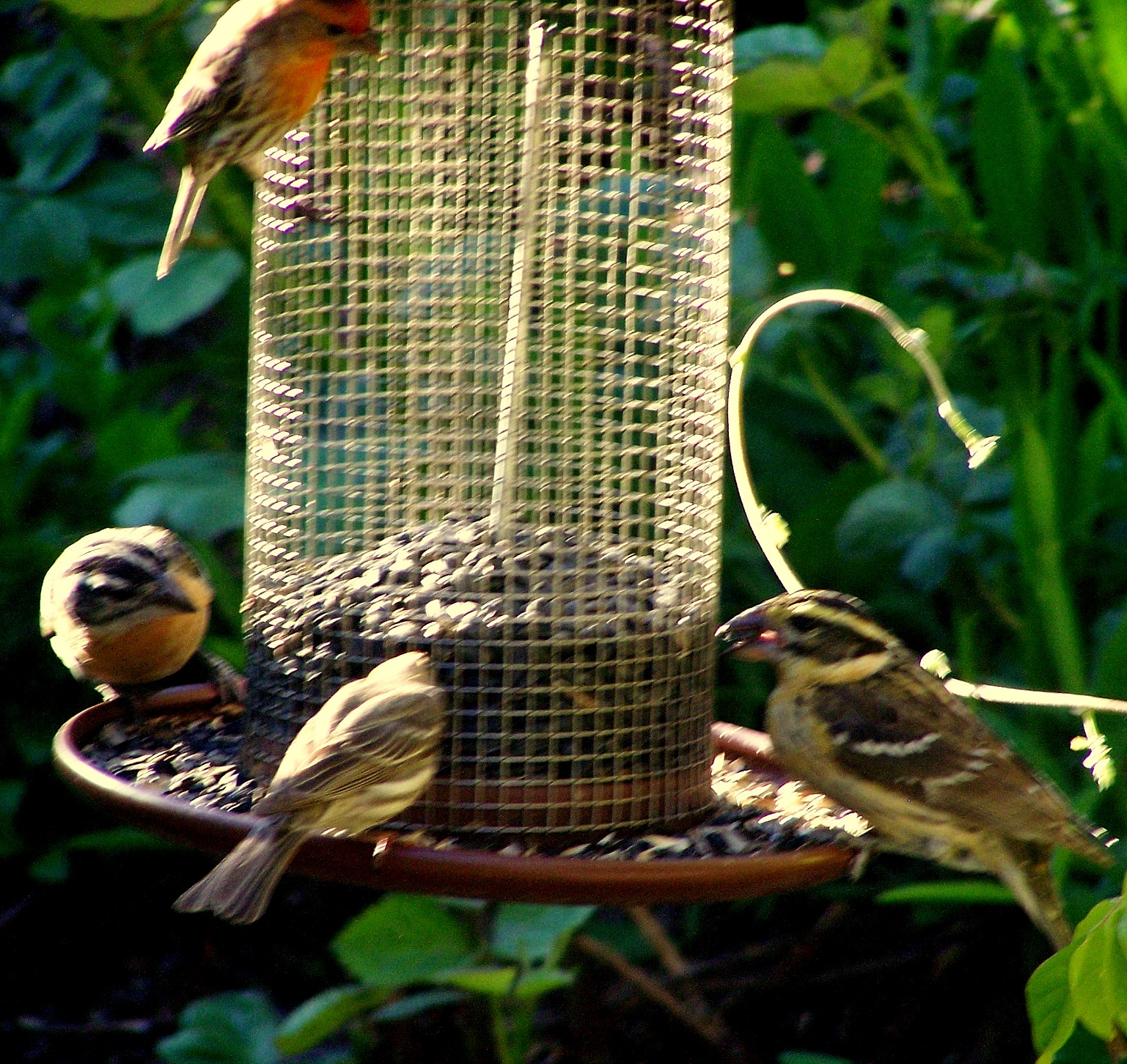
It's not a great photo, but here are one of the pairs of black-headed grosbeaks, chowing down as the sun sets. The male is on the left side of the feeder, and the female on the right. With them are a couple of house finches. Usually, the grosbeaks chase them off, so it was nice to see them sharing for a change.

the kitchen window feeder this morning; he did the job clinging upside-down, as nuthatches are wont to do. Once he had a seed in his narrow beak, he fluttered up to a wooden crosspiece on the arbor, where he went about cracking it. Nuthatches are primarily insect-eaters, so they have a short, very thin, pointy beak, perfect for sticking into cracks and hidey-holes. To eat the sunflower seed, though, this little fellow had to peck at the hard outer shell furiously until it broke. It took a number of tries, but he did it, and after eating the tender seed, he zipped back down to the feeder – and his gravity-defying position – for another. I was enthralled.

Although I’m a cool-weather person (and the rare Californian) who enjoys rain, I have to admit I’ve been getting pretty tired of it lately. We’ve had very few sunshiney days this spring. So few, in fact, that our raised beds haven’t yet been built and our vegetable gardens, which I was so looking forward to, haven’t been planted. And it’s been downright cold; yesterday I built yet another late-season fire in the woodstove to warm the house up. The last time I can remember doing that in May was in 1998, the first spring we lived in this house and, yes, another El Nino year.

Only Mr Wren knows the real name of these, but I call them "butter lilies." Fits, doesn't it?

If it stays clear and sunny, we’ll get busy on the gardens again, finally, but it means that my tomatoes, eggplants and beans (all my favorites) will produce very late in the season. Last year was also an odd growing season with lots of cool, overcast days. By the time my roma tomatoes finally started ripening, it was mid-fall and the weather was turning chilly. The plants ended up dying, still loaded with unripened, green fruit.

So while it’s had an iffy start, I hope this summer will be more normal, with plenty of bright, warm days. Even then, though, I’ll be lucky if my tomatoes ripen before autumn arrives.

Today’s sun and fresh air was so nice, I got all jazzed up and cleaned the house, reaching up to the ceilings with my broom to sweep down all those cobwebs I couldn’t see before in the gray gloom. I vacuumed and dusted and mopped and window-washed, singing along to Simon & Garfunkle’s Greatest Hits on my iTouch. It was fun – I haven’t really listened to that album in years, but I knew all the words to all the songs.  I guess I’m showing my age.

When I went up to the mailbox around noon, there was an envelope in it from the veterinarian. I opened it – and found a sympathy card for Logan’s passing, signed by the vet, her techs and the office staff, each with a short note of condolence. I was so surprised and touched, I started blubbering.

Finally, I stepped on the scale this morning and was pleased to see that I’ve dropped a couple more pounds. This was a triumph! I’ve been stuck at 170 for several weeks in spite of being very careful of what I eat, so I was getting a little frustrated. It’s funny, though. Even though I was stuck, my clothes were still getting a looser and my waist (I have a waist again!) a bit more defined. I can’t tell you how much that pleases me. It makes the effort – the daily mindfulness – so worthwhile. I’ve got a ways to go before I’ll need smaller clothing sizes again, but that’s all right. It’s just nice to know that I’m getting there. I’m really going to enjoy being slim, and as I resume walking and some resistance exercise, being more strong and fit, too.

Have a lovely Sunday, everyone.

bravehearts

Kris’s post, Inventory, on her wonderful blog Letters from the Breach, got me thinking last night.

This is a good thing. I like to think, but I don’t do it often enough. Or, at least, not with enough conscious effort and careful consideration.

In Inventory, Kris wrote about the things she used to be able to do before she was diagnosed with arthritis – things she can’t do now without difficulty, or at all. She talks about grieving the “old me,” and how listing her losses has helped her to accept the changes in her life and move on.

This struck me as very wise. Kris is doing this very early in her experience with arthritis (she’s been diagnosed for just about half a year, and her doctors still aren’t sure if it’s rheumatoid or psoriatic arthritis; both types cause awful joint pain, fatigue and disability). I’ve had RA for more than 22 years, but I’ve never really thought hard about what I’ve lost to it.

This could be because even in the beginning, I simply adapted my activities so that I could continue to get on with things. It never occurred to me to do otherwise. Honestly. No one told me about the crushing fatigue that so often goes hand-in-hand with RA; I thought I was wiped out because I was so busy! Or because I was so busy and I was hurting. I made the connection between constant, debilitating pain and being tired, but that was it.

My day started with a hot shower, often taken while shifting from foot to foot because the soles of my feet were so sore it hurt to put my full weight on them, even after sleeping all night. I’d get myself dressed, my hair done and my make-up on. I had one pair of old, black patent leather pumps with low heels that became my go-to shoes for just about everything. I’d get my small daughter, Cary, ready for school, giving her breakfast, making her a lunch to take with her, helping her gather up her schoolbooks and get everything into her backpack, and then whisking us both out the door for the day. Cary would walk to the Department of Defense elementary school two blocks away, and most days I’d walk to the bus stop to catch a German city bus for the American Army post 8 miles away. And oh –I almost forgot. We had a wire-haired dachshund, Max. He needed his walkies every morning, rain or shine, whether I was hurting or not. Before we left for the day, I’d walk him around the block, usually limping behind him on the leash and cussing my flared toe or ankle or knee with each step.

Some of my work days were spent at my desk in the office, writing, making phone calls, writing some more. Other days my job required that I go out to interview people and take photos. I was a writer-editor for the U.S. Army Public Affairs Office in Northern Germany. We wrote and published the post newspaper, and it was a big area to cover. There were many days when I did my job while limping badly from a flared ankle, or while coping with a shoulder that was so painful I couldn’t lift my arm. I took notes with fingers that screamed with pain as I held the pen and wrote – and then had to try to decipher my own hen-scratchings later on. I went out to the field with the soldiers, interviewing and writing about them as they trained for war, blowing up Claymore mines and “shooting” at each other with electronic guns. I took photos of them, hoping that they’d turn out well in spite of my awkward, painful hands.

In short, I adapted to the attacks of my rheuma-dragon. Of course, there were days when I was in far too much pain to adapt to anything, and I’d have to call in sick. I hated doing it. But I was very fortunate: my supervisor and my co-workers were extraordinarily understanding. They saw me frequently walking with a cane, or limping, or holding my right arm against my chest as I tried not to move my shoulder – and working in spite of it. Kind people. Good people. And in return for their compassion I made sure that I always got my work done, well and on deadline. Whatever it took.

This wasn’t heroism or bravery. It was no more than what anyone with RA does. We do what we can, we live as best as we can, and we fill in the blanks as we go.

I wonder, really, what I couldn’t do because of RA. I have to think hard about it. It could be that I’m blanking out the bad times, too, but I don’t think so.

There were a few times when I had to bow out of taking long bike rides on weekends with my friends. We all loved riding along the dyke that ran the length of the northern coast of Germany: the North Sea on one side, the green farmland and coastal plains on the other; the thatch-roofed houses and farmyards; the little villages that sparkled on a sunny day. Still, it was always hellaciously windy and usually cold. Sometimes I just couldn’t face it, or one of my joints was flared badly enough that peddling the bike or holding onto the handlebars would be impossible.

And there were times when long walks were off the schedule, too. I loved walking to the big city park that was a quarter-mile from my flat. It was filled with trees and paths; one could easily use up a day just wandering around it. But some days my feet or a knee or a hip was just too painful. So I stayed home. Rested. Did what I could do instead.

What I remember about those years are the things I did in spite of RA. I can only shake my head at myself – I’m not sure I’d have the same gumption, or the same courage today. Of course, I’m a lot older. My energy levels are different than they were when I was in my early 30s and still invincible. And perhaps I’m wiser, too. I’ve learned my limitations better. Or … dare I say it? I know more now about my disease and it’s effects, and that knowledge alone can dampen my spirit.

Would I take on long days on foot to explore the ancient parts of ancient cities now, if I had a flare going in my foot or knee? I did back then; I didn’t want to miss out on the experience, and if I had to do it limping, then so be it. I remember clearly walking and walking, each step painful (and being hyper-aware of it) but also soaking up the sights, the history, the thrill of being able to put my hand on the wall of a cathedral just like some other woman did, 800 years ago; to feel the cold roughness of the stone as I marveled at the dedication, skill and sheer hardheadedness it must have taken to cut that stone to fit in with all the others, to raise its tonnage even a few feet, and all to form the wall of a magnificent building that I wouldn’t even be allowed to enter if I was very poor.

I skied the Alps – while I was flaring – because I wanted to have that experience. Those ski trips form some of my fondest memories of my time overseas – they’re simply unique to me, and unrepeatable. I gimped my way across the dead-zone between West and East Germany in the months after the Wall fell. It was a very wide swath of cleared land where nothing grew, in which the soil had been salted with land mines. I walked across it with an eye on the old, empty guard tower just a short distance away, knowing that just a year prior, my presence there would have caused an East German soldier to fix his rifle sites on me – and perhaps shoot me dead. I limped, leaning on my cane, and soaked up the somber history of the consequences of war and conquest.

I visited farmer’s markets, the city zoo, shopped the city stores, attended the seasonal festivals, got on and off the crowded city busses (often forced to stand, hanging on to a hand-loop for the entire ride), and I walked. Here and there, there and here. I took my daughter to soccer practice and went to games that took place in the cold rain, and humped the family laundry four long flights down to the basement laundry room and back up at least once a week. I carried heavy grocery bags up those stairs to our flat from the car. I did it all while being in sometimes awful pain, pain that could make me cry, pain that made me take the stairs so slowly that sometimes I wondered if I’d ever reach the top. I did it, though.

After returning to the U.S., I went hiking and fishing high in the mountains while flared with RA. I once took an unexpected whitewater rafting trip while covering a story for my newspaper – while my ankle was flared, then went to a friend’s home and cooked up a mess of crappie for a big fish dinner under the stars.

So I empathize entirely with Kris’s determination not only to list and mourn the things she can no longer do (or do as well), but also to make herself aware of how she’s grown and changed because of them. And I know (because this is how we’re made, us humans) that one day she’ll look back and realize that it’s not so much what she’s lost to RA, but what she’s gained. It’s not all physical. A very great deal of it is mental. We’re tough as nails, even if we look like we’re not.

We’re all Bravehearts; all of us doing everything we can do to live our lives with joy – and astonishing accomplishment.

wren’s er adventures, part 2

I left off in the first part of this account of my visits to the ER after being bitten by my dog, Logan, with me and the stunningly handsome Dr. Melody once again sitting face-to-face over an old-fashioned typing table, my swollen, mangled hand between us. I’d been babbling  …

Setting: VA ER, Monday morning: Dr. Melody is looking at my hand again. “Let’s get this cleaned up,” he says, and the med student squeezes back into the tiny room, carrying a rolled up blue cloth. I’ll be honest: I’m not looking forward to this. I’ve seen ER. I know he’s going to pick up a syringe full of something that will numb my hand (thank the gods!) and inject it before he starts slicing and scraping, but I also know that the injections themselves won’t be a picnic. I swallow.

The student unrolls the blue cloth and lays it out. Yep. It’s full of neatly arranged and coldly glittering scalpels and forceps and syringes, oh my. “The lidocaine will burn a little,” he says, picking up a syringe with calm purpose. “It works fast, though.” He looks into my eyes as the student swabs my hand with more Betadine. “Ready?”

“Ready,” I croak. I pride myself on being tough and stoic, and to be honest, I’m really curious about what he’s going to do with my hand. But as he lowers the needle toward the ragged wound, I discover I can’t watch. “A little prick, here,” he says. I feel it. Hey, that’s not so bad! I can handle – and then the back of my hand catches fire. It’s like he just put a blowtorch to the flesh and bones to the left of the wound. I catch my breath, hold it. There’s another prick – amazing that I can feel it, considering the conflagration next to it. More flames. I can feel the blood draining from my face, but I sit as quietly as I can, not moving my hand. Breathe, I think to myself. Breath in, breath out. Breath in … Of course I want to yank my hand away and find a vat of ice water to plunge it into, but I don’t. “Holy hell,” I whisper. “That really burns.” “I’m sorry,” Dr. Melody says. I risk a glance. He’s put on some funny, thick glasses with black rims and what look like big, faceted crystals built into the lenses at the bottom, and he’s totally focused on what he’s doing with that needle. He’s still handsome anyway. I note that the student has very pretty, red-gold hair, scraped neatly into a bun at the nape of her neck, and I wonder what time she got up this morning and how long she’s been on her feet. The pain is huge. The flesh of my hand must be crackling, blackening in the blue-hot fire Dr. Melody is causing with that needle of his. I can’t look at it.

It hurt when Logan bit me. But it was so sudden, and I was so shocked, and so focused on the blood spurting out of my hand as I ran for the kitchen sink that the pain seemed almost secondary.  This is different. This is right here, right now, and my stomach flutters and rolls. There are more tiny pricks, more outrageously intense burning. “You all right?” Dr. Melody asks. “I know it hurts, and I’m really sorry. I’m almost done.” His voice is quiet; I can tell he means every word. He doesn’t like this part any more than I do.

“I’m OK,” I say. It’s the truth. The fires are dying down fast, leaving no feeling at all in their wake. I can look, now. How exceedingly strange. My hand is Betadine orange and looks just like it did before he started, the gaping wound deep, ugly and crimson, but not charred black and smoking like I expected. He sets the syringe aside. “How’s it feel?” he asks, looking across at me again.

“Wow. I can’t … I can’t feel anything.” And that’s true. The bone deep, pulsing ache, the strange coldness, the sharp twinges of pain I’d felt when I tried to flex my fingers, the horrific burning of the lidocaine, they’re all gone. Miracle.

He grins at me and my heart melts again. He could slice my fingers off, one by one, and I wouldn’t bat an eyelash. Quickly, he and the student put blue paper drapes over my hand, leaving a square open around the wound. I can’t see it very well; I expect they both know that and have arranged the folds the way they have on purpose. It wouldn’t do to have their patient faint dead away when he starts cutting. He picks up a sparkling silver scalpel and gets to work. “Feel that?” he asks me calmly. “Nope,” I say.

A new doctor sticks his head in the door, then sidles in sideways. “Hi!” he says with a big smile for me. “I’m Dr. W. I’m a hand surgeon.” Ah. This is the surgeon who’s in charge of Dr. Melody and his student. The big-wig. The top gun. He’s a little older than I am, a heavy-set, tall, balding man with a kind face who obviously smiles frequently. You can tell by the crinkles around his eyes. I greet him, feeling a bit overwhelmed now. The tiny room is packed to the walls with me and doctors.  “Your dog bit you?” he asks me, and then shifts his gaze to the work Dr. Melody is doing on my hand.

“Yeah,” I say. “That’s the pits,” he commiserates, and then starts talking to Dr. Melody about tendons and ligament involvement.  He leans over and looks closely. “Get that bit of gristle,” he says. Gristle. They’re talking about the inside of my hand, I think calmly. Some gristle that got ripped loose. There’s a part of me that wants to scream and run.

“How’re you doing?” It’s Dr. Melody again, those cool brown eyes on my face. He’s sharp, that one. “Fine,” I say. He nods and continues whatever he’s doing behind those drapes. “I’ll just trim the edges of the wound,” he says, “so it can heal up more cleanly and with less of a scar. It will scar,” he says, and looks at me again. “That’s all right,” I say. “I sorta expected that.”

He sits back, and Dr. W takes a close look with his own funny glasses on. “Nice,” he says. Is there another wound?”

“In the palm,” says Dr. Melody. He takes away the drapes and turns my hand over. “It’s not as ragged, but it’s deep. And also infected.”

They decide he needs to do some clean-up on that one, as well. Oh, joy, more fire-needles. And it begins all over again. But this time, I just close my eyes. I know what to expect. It burns like a you-know-what for 30 seconds, I bite back my cries of misery, and then it stops. Just like that. More drapes are applied. Dr. Melody sets to work, scalpel in navy-blue-gloved hand. This one doesn’t take very long. The wound is in the meat of my palm, just beneath my first two fingers. It’s less ragged than the one on the back of my hand. More gristle is sliced away. The two doctors discuss the wounds, both of them concerned about the infection. Dr. Melody is quietly pushing a long, thin ribbon of cloth deep into them. I’m watching, now. It’s rather cool – I should be screaming and hysterical with pain, but I can’t feel a thing. Amazing how deep he stuffs that ribbon into them, and with how much force. “These are wicks. They’ll allow the infection to drain. It’s best to leave the wounds open,” Dr. Melody says. “If we stitch them closed, there’s more chance that the bacteria will grow and multiply inside, because there’s no place else for it to go. The wicks give it a way out of your body.”

I just nod. I know they know what they’re talking about, and I’m just educated enough to know how dangerous infections can be. Given that I’m taking rheuma drugs that impair and slow my overactive autoimmune system, I’m also aware that my body isn’t very good at fighting infections off. I’ll go along with whatever they say.

The discussion turns to which antibiotics to use, and – to my surprise – whether or not I should be admitted to the hospital to receive them intravenously. Dr. W goes back and forth on this, weighing the options. He’s concerned about the infection because if it gets away from us, I could be in serious trouble. At the same time, though, he doesn’t want to make me have to live in the hospital for days if it’s not absolutely necessary. Finally, he says, “We’ll send you home today. But I want to see you again tomorrow morning, first thing.” I agree I’ll be back at the crack of dawn, promise-cross-my-heart. He gives me another lovely smile, wishes me luck, tells me I did just great, and disappears.

Dr. Melody explains how I should do my home care: three soaks a day in Betadine-infused water, and then I should use the pair of forceps and scissors he’s giving me to scrape and pick out any greenish-white goo that appears in the wounds. That done, I should take some of that ribbon and poke it into the wounds again, deep as I can, before covering in all back up. I tell him I will, my stomach fluttering a bit at the thought. But I can do this, I know.

He puts gauze pads over both wounds and wraps them, and my hand, lightly in a soft, cotton-like material. Then he makes a splint from a thick plank of white, reinforced, plastery stuff, dips it in warm water, and shapes it to my palm and forearm, leaving my sausage fingers free as the plaster hardens. All that gets wrapped in more soft cotton stuff, and then finally, a thick pressure bandage from palm to elbow, holding it all in place. It’s oddly warm and comfortable.

“Come back right away if you notice any red streaks moving up your hand toward your heart,” he says, “or if it becomes more painful than it is now. Good luck.”

I thank him and the med student for their kindness, compassion and excellent care. And they’re off to help someone else. An ER nurse appears and equips me with all the supplies I’ll need to care for the wounds at home, along with a bottle of fat, inch-long antibiotic pills And now I’m off too, my arm and hand looking like a short baseball bat with fingers. I’ve escaped being hospitalized, at least for now.

Setting: VA Orthopedics Clinic, Tuesdsay, 7 a.m.: The first day of home care has gone fairly well, at least up to each cleaning of the green goo out of the wounds and replacing the soiled wicks. That, I’ve discovered, hurts like the blazes. Cary offered to help me (she has a strong stomach; must have got it from me) but I found I preferred to do it myself, left-handed, because at least I could stop when the pain got too intense. I was a little concerned because, brave as I tried to be, I couldn’t stuff that wicking material into the wounds as deep as Dr. Melody had gotten them. Just plain couldn’t. The pain would overwhelm me and leave me sweating with butterflies in my stomach. The wounds, while they looked a little better to me, were still pretty nasty 18 hours later. My hand and fingers remained vastly swollen and dark, with wide patches of even darker red around the wounds themselves. Very sore, too, but thankfully, no red streaks headed up my arm toward my heart.

Mr. Wren settles down in the waiting room while I tell the receptionist that I’m here without an appointment, but that Dr. W has instructed me to come in early, before he goes to surgery. She’s pleasant, a little confused, and goes back into the clinic to check. When she returns, she smiles and tells me to sit down, and that Dr. W will be with me shortly.

He appears smiling in the doorway a couple of minutes later, beckons me back, and invites Mr Wren to come back, too. We go into his office and he unwraps my hand. Looks at it closely for a while. “It does look a little better,” Dr. W says, “but this wound on the top – I think I’d better see if I can get some of that stuff out of there for you. Hang on.” He goes into a side room, rummages around and comes back with a basin, Betadine and sterile water. “Soak it for a while for me,” he says, preparing the basin. “That’ll loosen and soften everything up. I’ll be back soon.” I lower my hand once again into the cold orange water, trying not to think of needles, lidocaine and scalpels.

Thirty minutes later, he’s back, carrying the dreaded, rolled blue cloth, which I now know is filled with the sharp instruments of his trade. He asks a passing nurse to bring some lidocaine and a syringe; she returns with astonishing swiftness and gives them to him. “I know you don’t like this,” he says kindly, “but it really is necessary.” “I know,” I say, resigned. “Let’s just do it.” He injects the numbing medication into the area around the wound on the back of my hand. It burns like fire, just like the first time. I hiss and Mr Wren shifts uncomfortably on his chair, then takes my free hand. I grip his, hard. “I’m so sorry,” Dr. W says. “Need me to stop for a moment, let you catch your breath?”

I look at him, touched. “No, go ahead and finish,” I say. “It’s not that bad.” Already, I can feel the stuff working as the fires quench themselves and numbness replaces them. He nods and injects a couple more spots. They burn, but not as much as the first two did. The lidocaine must be making the other areas a little less sensitive.

Dr. W (I can’t help but wonder where the magnificent Dr. Melody has hidden himself) puts on his own pair of crystal eyeglasses, takes up a scalpel and carefully slices, picks away the thick greenish scrim from around the edges of the wound, then digs out the jelly-like greenish stuff that has pooled in the wound’s hollow, malignant and crawling with bacteria. He explains what he’s doing, what I should be looking for when I do this myself, and how he wants the wound to look each time when I’m done – clean, glistening pink and scarlet, and with no extra gunk lurking inside.

“Surgery,”he says conversationally as he works, “is really nothing more than plumbing.” “Really?” I ask. “I’ve always thought of surgery as removing diseased or injured organs, or cleaning and stitching things that are injured back together.”

“That’s it, exactly. But everything in your body needs a way to get rid of toxins. So it’s a little like plumbing, too. We go in and clean everything up, patch things, and provide drainage so it can all heal.” He shoves the wicking material deep into the wound, back up under the skin. Once again, I feel nothing, but it’s surreal, because I know for a fact that it should hurt wildly. Mr Wren shifts in his chair again, but he keeps my free hand, rubbing the back of it gently. “Infection has to have a place to go,” continues Dr. W. “If we let it, it will go further into the body, so we try to give it another option – the wicks draining to the outside. Think of them like a highway right out of town.”

He doesn’t re-clean the palm-wound. “That one looks pretty good,” he says. I’m oddly proud of that. It is smaller than the other one, though, and it has a cleaner edge, more like a traditional puncture. It’s also not as close to my bones. I can get the gook out easier and the wicking into it deeper than I can the other one.

He mentions the low temperature I still have. “I’m still considering admitting you,” he says, turning to his computer to pull up my records and test results. “I’m concerned about your impaired autoimmune status.” He finds the results of the blood test, but nothing has come back on the culture. “That takes a few days,” he tells me. “But overall, your blood is good, considering.” For a moment he’s silent, looking from my hand, to me, to the screen, his wheels turning. “Keep taking the Augmentin,” he says finally. “Don’t miss a dose, please. Go on home, and just keep doing your home care like you have been. You’re doing just fine with it. Come back again and see me early Thursday morning, unless the wounds get worse. If that happens, or you see red streaks, go straight to the ER. Don’t waste any time.” I assure him I won’t. He wraps everything back up and sends me on my way.

Setting: VA Orthopedic Clinic, Thursday, 8 a.m.: The clinic is already stuffed with vets waiting for exams, follow-ups, and procedures. I have to wait an hour this time, but I don’t really mind. I’ve nowhere else to go. When I finally get in to see him, Dr. W is pleased with the healing procress, even though my hand is still swollen, sore and dark.

I tell him that I’m worried that I’m not getting the wounds cleaned out well enough; it seems like each time I do the wound care, they’re a little smaller, a little tighter, and I can get even less gunk out of them or wicking into them. That gunk worries me. My temperature continues to hover between 99 and 100. And while the wounds aren’t very painful (at least, not between cleanings), my right wrist has decided to flare with rheuma and is very sore.

“I was afraid that might happen,” Dr. W. says. “Keeping it immobilized doesn’t do a thing for RA. You need to be able to move it. So we’ll get rid of the splint now.” He looks for the blood culture results. They still haven’t come back, but he seems unconcerned. “No need to admit you,” he says. “You’re doing well.” He tells me to keep on with the home care – and if I can’t get the wicking into the wounds, don’t worry about it now. Unless they suddenly get worse, I don’t need to come back at all. He thinks I’m out of the woods. And finally, there’s no need for him to clean them any deeper than I’m managing on my own. I’m glad, as I was afraid he’d want to slice them open again to drain more gunk, and I wasn’t looking forward to the fires.

That appointment was two weeks ago today. My hand continues to heal. It’s still a little bit darker than my left hand, and it’s still slightly swollen. But both wounds are closed, with only a small amount of redness around them, and while they’re a bit tender and sensitive to pressure, and my first and middle fingers twinge a tiny bit when I bend them, they don’t actively hurt. The fever is long gone. I’m well, once again coping only with the “normal” rheuma pain that I have in my hands.

You know, we’ve all read a lot about Veteran’s Administration hospitals over the last several years, and a lot of the news hasn’t been very good. Until recently, government funding was low and some VA hospitals were simply unable to cope with the massive numbers of vets that needed them, particularly those which were caring for so many young, grievously hurt soldiers from the wars in Iraq and Afghanistan.

But that’s changing. The VA medical center I go to for my medical care is always busy, its clinics crowded, and while I haven’t seen them myself, I imagine that the hospital and surgery wards are full, too. Yet these doctors and nurses, medical students and surgeons, physical therapists, clerks and receptionists are all doing the very best they can under difficult conditions. I’ve received nothing but excellent care – and I appreciate it more than I can say.

If I hadn’t been a veteran (with an old, service related disability, and thus qualified for VA health care), I’d have had to have all this fantastic, competent medical care for my dog bite done through the local civilian hospital ER. I’m unemployed at the moment and cannot afford private health insurance; my income is precarious and there would have been no way I could begin to pay the medical bills that would have soon hit my mailbox. Mr Wren and I would be scrambling right now not to lose our home and everything we have. We’d have to declare bankruptcy. And all of it would have been because of a sudden, unexpected dog bite that went septic.

If that’s not an argument for health care reform, and someday, perhaps, universal health care for all Americans, I don’t know what is. My taxes and yours are used to keep the Veteran’s Administration medical centers open for the men and women who have served their country in its military services, regardless of whether they served during wartime (I never did). Those taxes pay the salaries of medical professionals like Dr. Melody and Dr. O, and Dr. W, and Nurse John. They work long hours and give their time and their expertise to vets of all services, races, genders and ages, many of whom are often non-compliant, grouchy and very, very ill or disabled. And yet these dedicated medical professionals do it with a smile and with more compassion than I’ve ever encountered before, even when I was able to go to civilian doctors when I had health care insurance through my job.

Thank you all for supporting your country’s veterans. At least one of them is deeply grateful – and I know I’m not alone.

Stress and pain

Interesting how one kind of pain can “cancel out” another.

In the weeks since the dog bite, I’ve had only very light rheuma pain in my hands, and none in any other joints. And Terry, who writes the blog, “Dual Sports Life,” writes today about his recent relaxing vacation in the sun and how his pain disappeared until he went back to work a couple of days ago. When things like this happen, I wonder (a bit uncomfortably) if my rheuma pain really is in my head.

Of course, I know it’s not. There are real, measurable, physical proofs of the existence of rheumatoid arthritis. The inflammation we all experience in our joints is a reality. It does cause stiffness. It does cause fatigue. It is, frequently, very painful. Even agonizing. When I went to a rheumatologist two years ago for help, there was no question after he examined me and got the blood test results back that I have rheumatoid arthritis.

But I also know that stress absolutely can make rheuma worse. When I was diagnosed 22-plus years ago, I was living in a foreign country, had a demanding job (that I loved), was raising my small daughter 3,000 miles away from my old support system of close friends and family, and was only recently married to a man I discovered was an alcoholic. Thinking back, I don’t recall feeling terribly stressed (at least, not all the time; there were many good times mixed in with the bad). The timing of my RA onset was probably just coincidence; I loved living and working overseas. Nevertheless, the disease was far more painful and disabling then than it is now. And after I returned to the U.S., ended the destructive relationship, and found my way back into daily American life here close to family and friends, my rheuma pain gradually eased over a period of years – and then stopped altogether without drugs.

Was stress causing my symptoms?

According to Marikje Vroomen-Durning, RN and Cynthia Hayes, MD in a short article in Everydayhealth.com,

“(R) esearch shows that stress may play a role in the actual inflammation that causes pain, inflammation in RA is partly caused by molecules called cytokines. While cytokines can be released for a variety of reasons, stress also releases them. If you’re stressed and are releasing more cytokines, you probably will develop more inflammation. This may result in more pain.”

So perhaps stress contributed to the intensity of the RA symptoms I experienced back then. But it didn’t cause them. RA itself did that.

My dog-bitten right hand is almost completely healed. There’s very little discomfort left in it, which is a blessing. But it’s also been a blessing that, while my right hand was infected and pain-full, my rheuma-dragon didn’t pile on with more pain and stiffness in that hand or elsewhere in my body. Well, let me qualify that. It did once, briefly, when it flared in my right wrist a few days after the initial bite. That, however, was likely because that wrist was being held immobile by a  splint and wrappings. Once I took them off my hand, the rheuma flare eased.

The pain and temporary disability from the dog bite was, simply, a different kind of pain than I’m used to. Puncture wounds are sharp, stingy things, and the emotional toll involved in the decision to euthanize my beloved old dog was heavy. Yet given all that stress, shouldn’t my RA have flared, big-time?

Well, it didn’t. And it’s only been the last couple of days that my hands have started feeling achy and twingy again with unmistakable rheuma pain.

“Aw, you’ve got a headache? Hold still. I’ll kick you in the knee and you’ll forget all about your head.” That’s an old joke, but maybe there’s some truth in it.

Starting a new week

Posts will be light for a few more days; my sister will be in town until Wednesday, so I’ll be spending most of my free time visiting with her and my Mom. We had a good weekend. The drive down to Santa Nella was a breeze on Saturday (which surprised me) and, while visiting Dad’s marker has always been a somber event in the past, this time we laughed a lot. My Mom brought some beautiful peach-colored roses to leave; Dad absolutely loved them when he was alive. He must have had 15 mature rose bushes in his garden, and he brought the blooms in nearly every day for Mom during the summer. There were always vases full of them in the house. Saturday was a good day, not so crushingly sad. We’ve turned a corner, I think.

In other news, the weather here is still just plain freaky. It’s barely 40 degrees this morning, and the forecast is for a high temp of 54 today. The sky is gray. More rain is coming tomorrow (with snow in the mountains at the higher elevations) and it’s supposed to continue through Friday, along with temps in the mid-50s. It’s more like early March than late May, and I’m beginning to wonder if we’ll be able to have much of a garden this season, as we haven’t been able to plant yet. To be honest, I don’t really mind the coolness, but even I’m starting to stare in disbelief at the sky as I wrap up in my sweater and pull warm socks onto my feet. What very odd weather we’re having!

The dogbite wounds have nearly healed completely. They’re still sensitive to touch, but each day brings less discomfort. I took the last antibiotic horse-pill on Thursday last week, and I’m feeling good. I’m back on my rheuma meds. And the rheuma symptoms have been mercifully faint, just a light ache in my hands now and then.

Finally, while I miss my dear ol’ Logan, Finny has stepped into the breach to make me laugh and carry me through. That wee dog is a born clown and over-the-top affectionate. I’m very lucky. So, once my sis is winging her way back to New Mexico, I’ll start walking again. Carefully. Shorter distances, and with attention to how my hips react to the exercise. I’m looking forward to it, and I know Fin is too.

Hope this finds everyone feeling good and enjoying the gifts of the day. You’re all in my thoughts.

Sunday words

Terra Incognita

When I walked in the yard

Before sunrise,

I made my way among patches of dew —

Those constellations on the darkened grass.

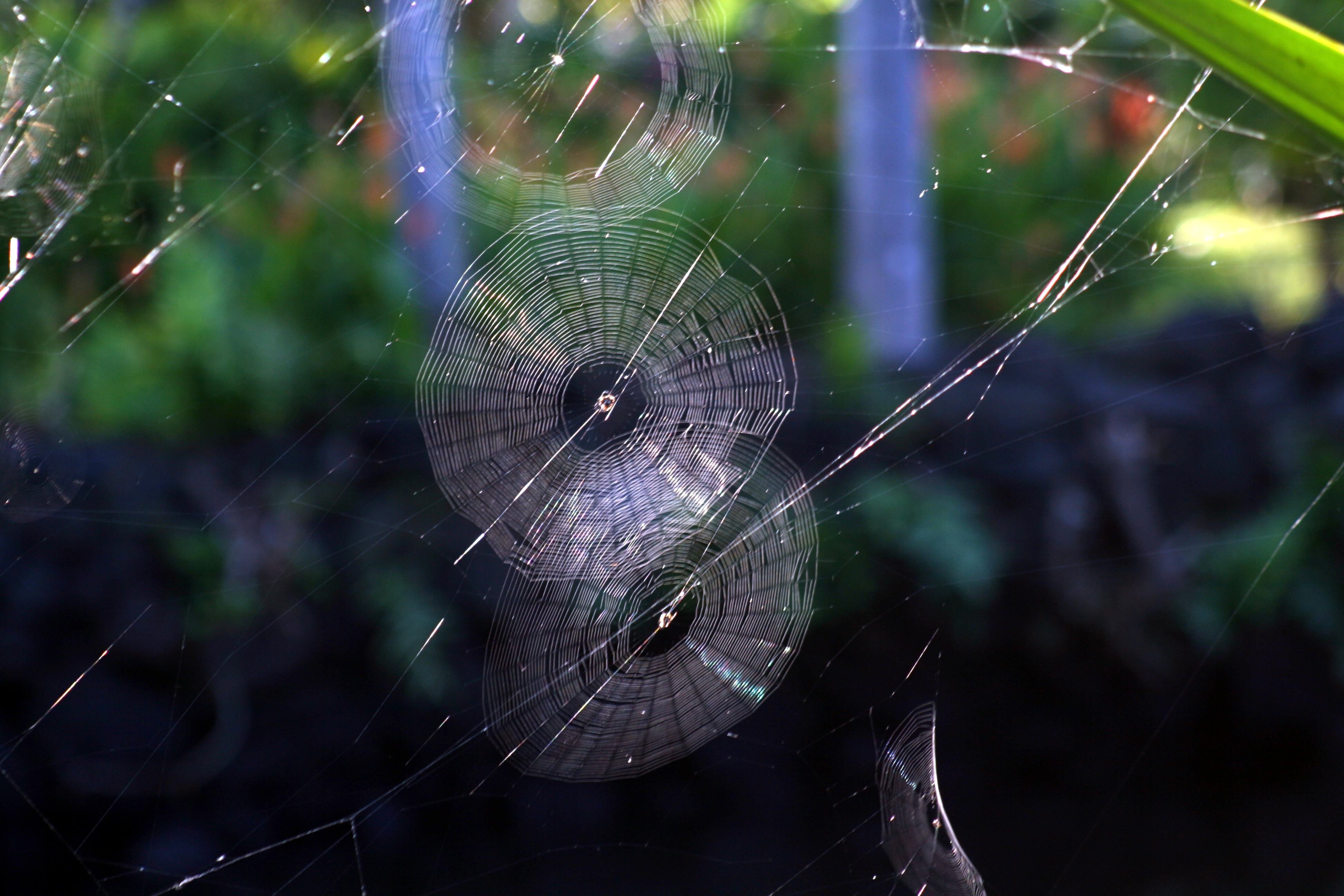
The webs drifted like anenomes,

And I thought of lifting them

As if they were skeins of brilliant yarn

That I could give to my mother

Who’d keep them

Until we knew what to make.

I pictured a shirt —

How I’d pull it over my head

And vanish in the sudden light.

— Stephen Kuusisto

Only Bread, Only Light

Off for a long weekend

I probably won’t be posting for the next couple of days; I picked my sister up at the airport yesterday. She flew in from Albuquerque and will be here for several days, staying with my Mom. So I’m getting ready to zoom down the mountain again to spend the weekend with them. Today will be spent shopping (my sister loves to shop). And tomorrow we’ll head south to Monterey to visit Dad’s grave. Tomorrow marks the fifth anniversary of his passing.

Throughout my life, he never spoke much about the time he served in the Marines,

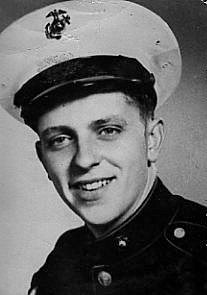
Dad at 17, a proud Marine. He dropped out of high school to join up, but went on to get his degree in accounting with the GI Bill after the Korean War.

much of it during the Korean War. Yet when he was dying, it was in that military cemetery he wanted his remains interred, rather than in one closer to home. After he passed, we found a short biography he’d written. In it, he described some of the places he went and the things he did and saw during his time in Korea. It was a new story to us. Though he was proud to be a Marine, Dad had always shrugged off his service, saying that he’d spent most of his time in the rear, doing office work. But in his bio he wrote about the places he went and the battles he took part in, and about the young men he knew who’d been killed or maimed in combat. It was a revelation. His bio brought home to us how much that gentle, genial, humble man’s service meant to him. We honored his wishes.

The cemetery is a nearly five-hour drive (on freeways crowded with hurtling semis) from Mom’s house, which makes it really difficult (read “impossible) for her to get down there on her own. She’s 78 now

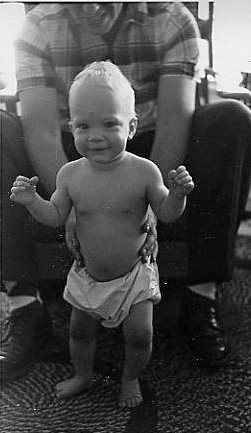
Dad and me in 1957, San Francisco, CA

and is a very nervous driver. So Jami and I, along with my Dad’s younger sister, will make the trip with her, as we do each year. Mom and Dad were, from the moment they met in San Francisco in the ’50s, very much in love with each other, and that never changed during their 49 years of marriage.

My hand has nearly healed, though it’s still a bit swollen. The wound on the back is puffy and sore-ish, but it’s closing up slowly but surely. The one in my palm has closed completely. Amazing how quickly the body repairs itself after injury, isn’t it? I don’t even need the band-aids; the wounds don’t look scary anymore, so there’s not even any need to hide them.

I hope this finds all of you, my friends, feeling well and getting ready for a relaxing and rejuvenating weekend. Enjoy the gifts it brings.

Good Dog

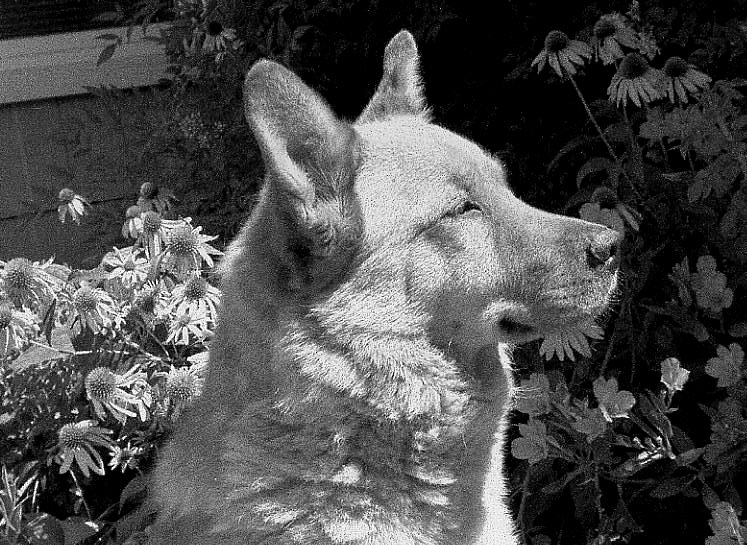
Logan and coneflowers, 1998.

My dear old Logan is gone.

He fought the sedative as hard as he could to the end, that brave old dog, still trying to protect us from Evildoers, but in the end he left this life peacefully and, I hope, without feeling fear or terror. Now we just have to figure out how to get on without his big presence in our lives.

When people we love die, we grieve. Their loss is stunning, life-changing. We can never face the world in quite the same way. A part of us is irrevocably gone, even though they live on in our memories.

For those of us who love animals, particularly the ones with whom we share years of our lives, there’s not a great deal of difference when they die. I didn’t cry over Logan’s bite or the pain of its healing, but today I cried at his loss. I still am. I can hardly imagine getting up tomorrow morning and not find him waiting impatiently for his three biscuits and his breakfast. It’s been our shared morning ritual for many, many years.

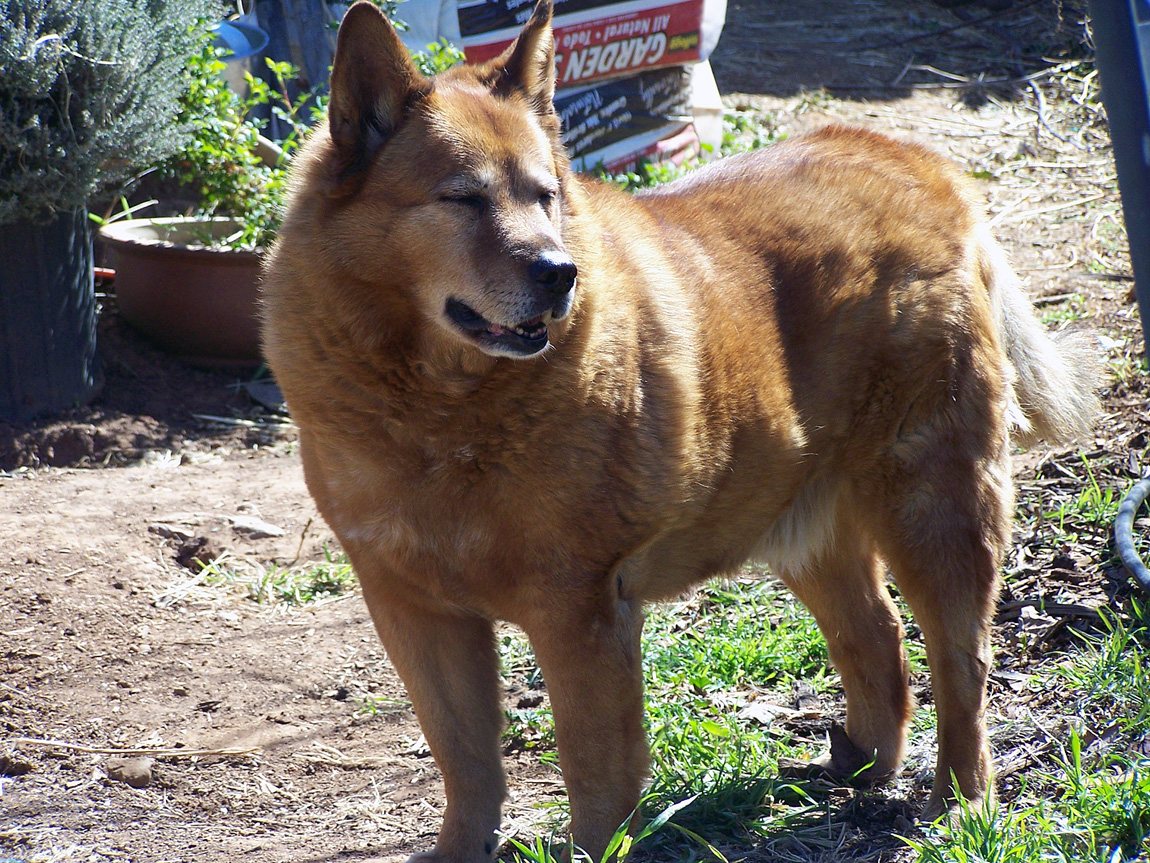
Logan guards the garden, summer 2009.

Logan was 91 year old in dog-years. He had a good, long life for a dog; a much longer life, I believe, than he would have had if he’d had people other than us choose him from the litter that day. Of the five puppies born to a Queensland healer dam and a Border collie sire, he was the only red one; all the others were black. He was beautiful then, and as he grew, he became even more beautiful, with gorgeous rufous fur so soft and thick and warm I could lose my fingers to the second knuckle in it. He was, even as a puppy, never the cuddly type of dog. He was afflicted with “fear aggression,” something we discovered when we took him to puppy kindergarten when he was six months old. It was intractable, though we tried hard to socialize him. Some people might have had him “put down” way back then, but we couldn’t do that. He was a member of our family. We’d adopted him for life. And with us, his personality was so loveable, so true and loyal, and he tried so very hard to be the Good Dog we wanted him to be, that “cuddly” and “socialized” didn’t matter.

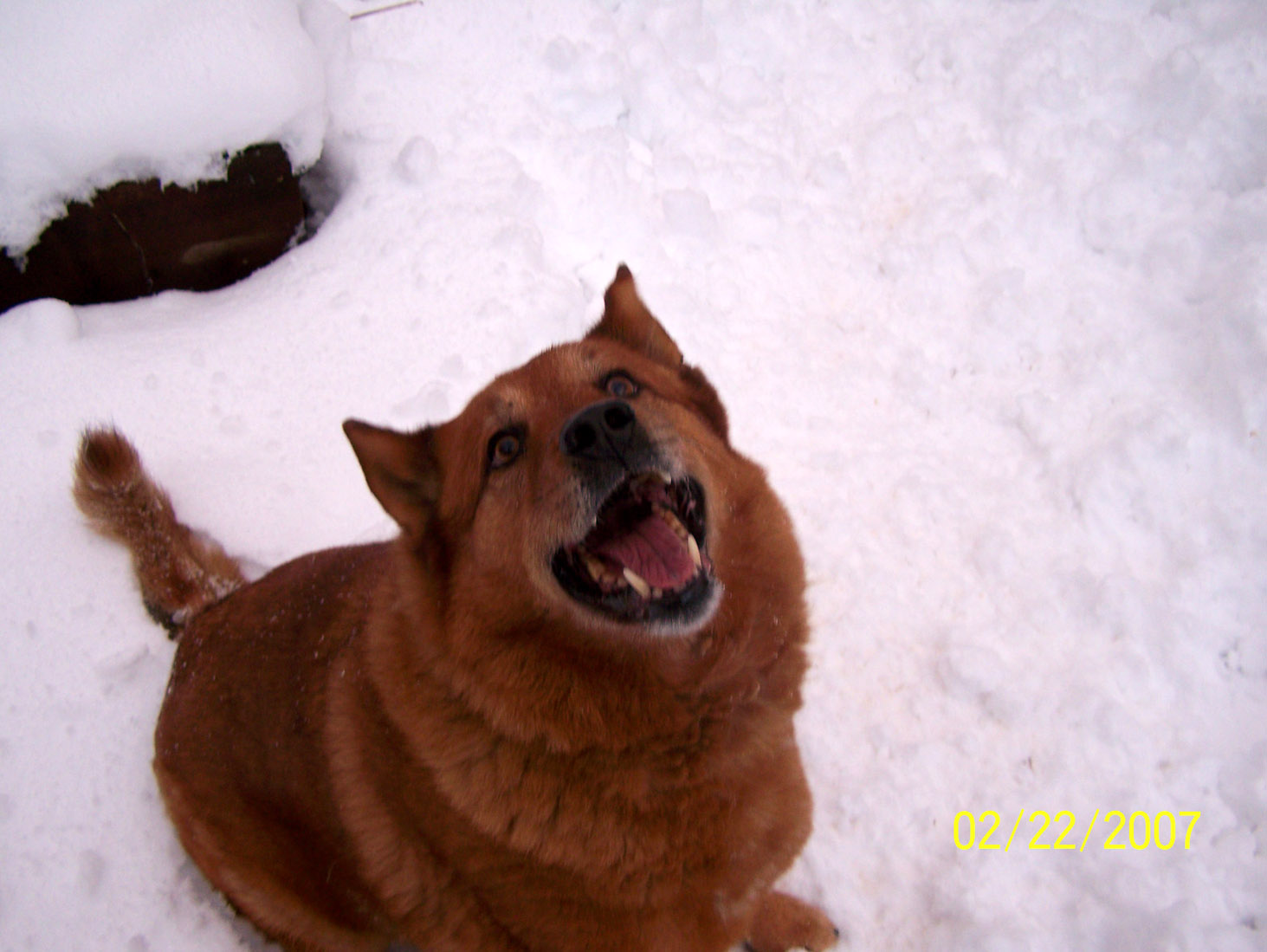
Logan ready for a snowball toss, winter 2006

Logan loved to play in the snow, leaping into the air to catch tossed snowballs and chomp them, spraying snow from the sides of his mouth. He’d do it for hours, as long as someone would throw the snowballs for him. He loved to run back and forth along the back-garden fence-line – there’s a worn-to-the-dirt path in the high grass there now that he made all by himself from years and years of determined patrol. For most of his life, he didn’t bark. Instead, he “yodeled,” a sudden, eardrum-piercing, banshee shriek that could raise the hair on the back of your neck. His world was our house and the big back garden.  He guarded it all faithfully. I was never afraid to be home alone with Logan around. He’d have made short work of intruders.

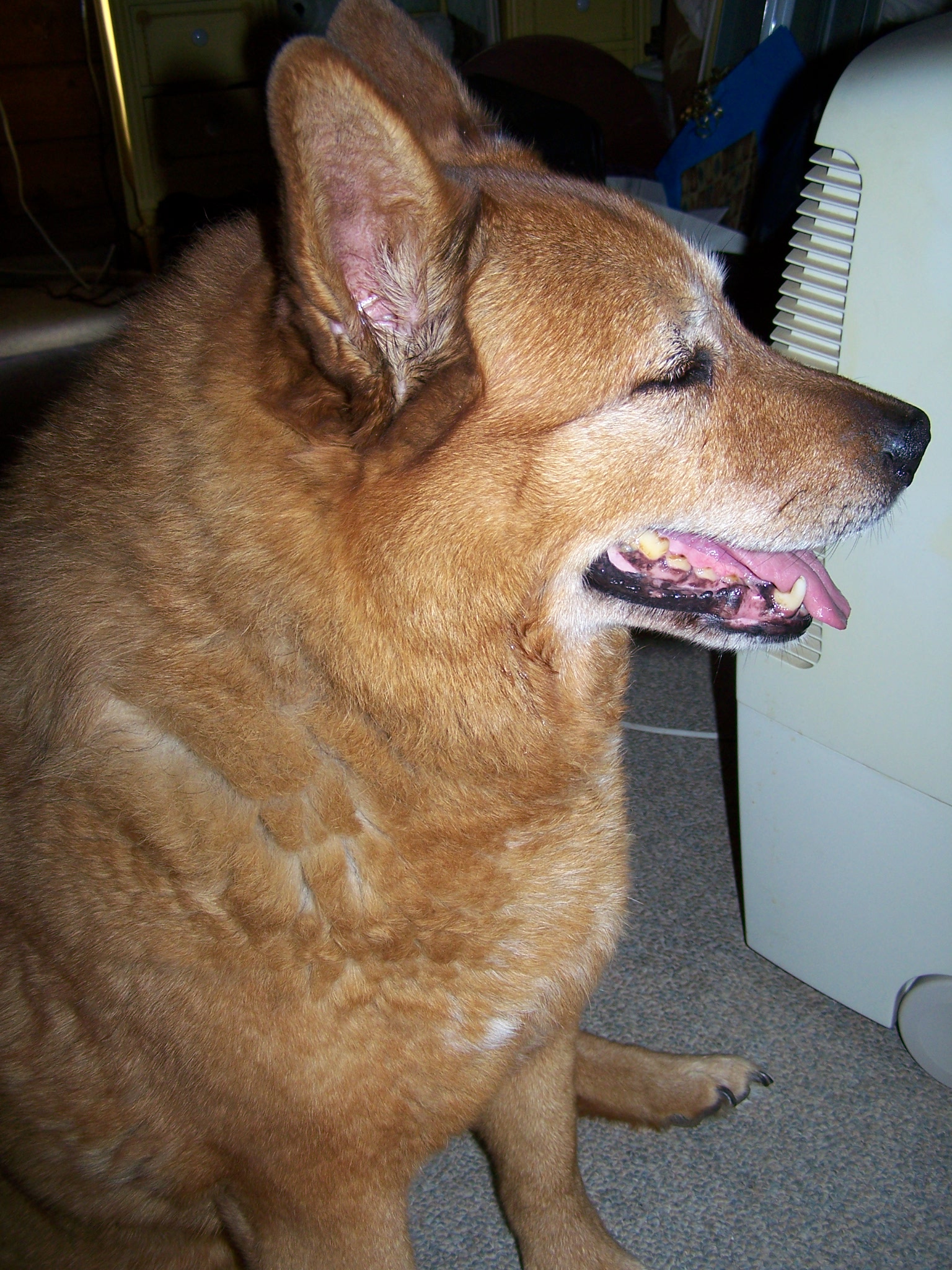
Quiet time for Logan, Summer 2008

He liked to shake hands, and sit up, roll over and sometimes give very gentle, careful kisses on our noses. Despite his failure at socialization, he never forgot his other puppy kindergarten lessons. He knew how to walk on a leash. He’d sit, lay down and stay on command. He spoke our language even when he didn’t understand.

Logan chased stray cats that came into the yard, but he tolerated PIB and Cary’s two cats when they came to live with us without protest. And even when I brought Finny McCool home not long ago, Logan didn’t protest. He knew which animals were from Out There, and which ones Belonged inside with us and with him.

And now, he’s gone. There’s a Logan-shaped hole in my heart and many years of memories to sift through. I know I’ll learn to live without him; I’ve lost many other beloved pets over the years, and with the loss of each one, my heart has broken. But Logan was special. He tried so hard – right to the last breath he took in this world. He was such a dear friend. And he was a Good, Good Dog.

Wren’s ER adventures

I’ve been a little low the last couple of days, so I thought I’d write and share some memories from my last, fascinating week to distract myself. Think of it as entertainment for those who find such things entertaining. If you don’t, I won’t be hurt if you move along…

  1. Setting: A Veteran’s Administration Medical Center ER, a week ago Saturday – I’m here an hour or so after Logan bit me. Hand is gory, self-wrapped clumsily in gauze pads and bandages left over following my synovectomy five years ago. My hair, which needs washed (and I was going to get to that today, really) has been scraped into a clumsy ponytail for me by my daughter. I’m wearing no make-up and dressed in my weekend grubbies. Lovely. The consolation? The other patients look about as spiffed and put-together as I do.

I’m holding my hand up at about shoulder-level, as if I’m in school, shyly trying to get the teacher’s attention. It hurts a lot more if I put it down. They haven’t got a cubby for me – it’s Saturday and the ER is full and there’s (inexplicably) only one harried doctor on duty – but being kind folks, and professionals, they didn’t want to leave me sitting out in the waiting room in a bloody makeshift bandage. So the triage nurse sat me on a cot in the ER inner-sanctum hallway, my legs hanging off the side. I’m watching all the activity and listening to the nurses chatter. Blog fodder. I wish I could take notes.

After a while, one of them comes over. “I’m John. What happened here?” he asks. He’s a chubby, cheerful fellow, early 30s, with a buzz cut, a gold ear stud and a friendly smile. He missed a few places shaving this morning, and has tats here and there. He pulls on a pair of navy blue surgical gloves.

I tell him my dog bit me.Your own dog?” he asks, surprised. I explain. “Man, that just sucks,” he says. I agree. “Let’s see that,” he says, and unwraps the bandages. He starts to pull the gauze off. I yelp. “Sorry.” He pulls it off anyway. I grit my teeth and blood wells up.  “Yeeeow,” he says. “That looks … stay right there.” No problem, I think, eyebrows raised. Where would I go? He trots off. I study my hand. There’s a bit of gristly-looking flesh hanging out of the wound on my palm, which makes my stomach flutter. I look away. Nurse John returns with the doctor, a tall, slender, serious black man in a long white coat and gold, wire-rimmed spectacles. He takes a quick look. “Mmm. Let’s soak it for a while,” he says, turning my hand from back to front with gentle, gloved hands. Navy blue. “You have pain? What level?” He doesn’t bother with the one-to-ten spiel (maybe I look like I know it by heart?); his voice is soft and deeply accented and his nametag offers an African name starting with an “O”, but not “Obama.” Dr. O, I decide. It’s easier. “Um, about five,” I say. This is a different kind of pain than rheuma pain, which I’m used to. I really want to say “eight” or “nine,” but that seems embarrassingly excessive, even if my hand is stinging and throbbing and hot and really, really hurts. And honestly, I’m not actually writhing or anything. I know I look far calmer than I feel. It’s my usual demeanor, actually, one I take some pride in. I’ve always been pretty cool under pressure. But mostly, I don’t want this busy doctor to think I’m a terrible wimp, or worse, angling for drugs, because if it turns out that I need them for the pain, I don’t want to have to beg. I do have my dignity. “OK,” he says, and hurries off.

Nurse John finds one of those rolling tables that looks like an old-fashioned typewriter table (maybe because that’s actually what it is) and gets a plastic basin, Betadine and several bottles of sterile water. He dumps them all in. “There. Put your hand in that. We’ll just soak it for a while.” Right. I gingerly lower my crabbed hand into the cold, rusty water. The pain level shoots up because of the new, lower position of my hand, but I don’t say a word. I can do this, I think to myself. To get my hand all the way down into the shallow water so it covers both wounds, I have to sort of hitch my shoulder up and hold it there. I hope I don’t have to do this for very long because I know for a fact my shoulder is going to complain. Loudly. John asks more questions and starts telling me about a dog he used to have that suddenly bit his uncle on the lip when his uncle was down on the floor playing with him. John’s uncle sued him. “How’s that for family?” he asks with a laugh. He had the poor dog put down. Sad. “He was a really good dog, too, but, well, you know.” Yes, I do know.

I sit there, right shoulder wrenched up, my hand throbbing angrily in the basin, for about an hour. Surely, I think, they haven’t forgotten I’m here? I’m sort of hard to miss, even if I am out of the way, stuck in the hall. Nurses pass me frequently without making eye-contact. (It reminds me of the day I gave birth to my daughter, almost 29 years ago. The military hospital I was in didn’t have a labor room immediately available, so I was left standing in a hallway while the nurse went off to do something about it. I stood there for the best part of an hour, holding the back of my hospital gown closed and breathing through the first phase labor pains. I was quite calm. I didn’t want to bother anyone …) The pain level in myhand has definitely risen, and it’s not just from the position change. I’m still not writhing, though. I’m not moaning or carrying on, just whimpering a little under my breath now and then. But I sure wish they’d get on with this. After what seems like an eternity, John happens by again. “How’re you doing?” he asks, and lifts my hand out of the water. It’s Betadine orange now and swelling alarmingly. “I’m OK,” I say, but my will breaks. “It does hurt a lot more now,” I say apologetically. “Can I maybe get something for that?”  “You bet. I’ll ask the doctor.” John-the-grinning-biker-nurse sticks my hand back in the water and trots off. Another eternity later, he returns. “Let’s go to x-ray and see if anything in there is broken,” he says. He carefully wraps my hand in a thick towel and tapes it closed, explaining that he’d rather not alarm the other patients by leaving it bloody and exposed as I walk by them. “I don’t think there are any broken bones,” I say, feeling like an idiot. “Yeah,” he says happily, “but it can be hard to tell just by looking. Come on, I’ll take you over.” I hop off the cot, wincing a little because my hips and legs have gotten stiff from sitting. They’re not happy with me at all, but my shoulder appreciates the change in position. My spring allergies have been acting up and my sinuses are clogged; I sniff without thinking. He wheels around and peers at me. “Are you crying?” “No!” I say, startled. Me? Cry? I realize what caught his attention. “Oh. It’s just an allergy. I’m not crying!” It’s vital to me that he doesn’t think I’m a big baby, for some reason. I was directing fighter jets against simulated Soviet bombers way back when you were wearing diapers, junior, I think to myself. I kept you from growing up to be a Russian-speaker and calling your colleagues ‘comrade.’ Me? Cry? Nurse John, of course, is oblivious. “Great,” he grins. “Come on, this way.” I follow him out of the ER and over to x-ray. Pictures are taken of my hand. He leads me back to my ER hallway cot, but another nurse tells him a room has finally opened up. “Put her in Three,” she says. Cubby #3 turns out to be a bit cozier and more private, but I get the same typing table for the basin, and back my hand goes into it. My shoulder is protesting quite adamantly, now, even though the little table has been cranked up as high as it can go. At least, I think as John darts out again, there’s something to look at in here. I gaze at a poster that shows the musculature of the body and read the text on another one that instructs veterans how to avoid metabolic syndrome. “Loose weight. Stop smoking. Eat a balanced, nutritious diet. Drink sparingly and exercise at least three times a week …” Got that drill down pat already, I think wryly. Another poster offers info on how to get hot-line help from the VA if you’re contemplating suicide. It strikes me as a sad thing to see tacked to the wall of an ER cubby, but I know, too, that veterans generally do have a pretty high suicide rate. Particularly those from the Viet Nam era who came home from their service overseas with Post Traumatic Stress Disorder, only to find themselves accused of malingering. These men were left to their own devices, untreated, for decades. For some of them, suicide was the final cure for their misery. What an awful thing to do to someone who’s risked his life for his country, I think. And now there’s a whole new crop of young vets coming back from Iraq and Afghanistan with all manner of mental and physical injuries. I hope they’re getting better care, now; perhaps that poster is one indication of it. I go back to my anatomy poster. My hand pulses. Will someone come do something?

Another taffy-like stretch of time passes. Dr O sweeps back in just as I’ve almost dozed off. I sit up straighter, blinking. “X-rays came back; there are no broken bones,” he tells me, and snaps on new gloves. Navy blue. There must have been an overrun on that color and the VA bought 600,000 boxes to save some money. “I didn’t think anything was,” I say. He takes my hand out of the freezing orange water and dries it carefully with the towel. Looks at it. “Mmm. There could be tendon and ligament damage, though,” he says. “That wouldn’t show up on x-rays.” He presses around the wound firmly with his gloved fingers. Blood wells up again. “Does that hurt?” Do bears shit in the woods? “Yes,” I say calmly from between my gritted teeth. My tummy flutters unhappily. He presses some more, asking if it hurts here, or here, and how about here? I say yes. Yes. Oh yes. “Put it back in the water,” he says. Oh, Lord help me. I obey. He turns to zing out again. “Might I get something for pain?” I ask, raising my voice a little and stopping him in his tracks. “It really hurts a lot more now.” I’m getting a bit testy in spite of myself; my calm, cool façade has developed some cracks. He looks at me. I gaze back at him unblinking, shoulder up by my ear, my lips tight. “Of course,” he says. “We’ll get you some Toradol.” His eyebrows are raised, as if he thinks I might protest his choice of painkiller. “Thank you,” I say, and he vanishes. As I try to get comfortable again I wonder why there’s only one ER physician working today. Was it a scheduling mix-up? Did someone call in sick? I feel a little bad for Dr O. He’s going to be wiped out by the time he gets off work, presumably sometime late tonight.

A new nurse comes in. She has a hypodermic syringe in her hand and a deadpan expression on her face. She gives me the towel, which now has rusty stains all over it, rolls the table with the basin away, tells me to pull my pants down halfway and then to lay on my side on the cot. “Do I really need to lie down? Can’t I do this standing up?” I ask hopefully. See, I haven’t been told to lay down for a shot in something like a hundred years; it’s very undignified and I figure I got to stand up for my previous, very rare shots because I’m an adult now. Laying down is just for children. “No,” she says. “it’s easier to get it in the just right spot if you’re lying down.” Well, I can’t argue with that logic, so defeated, I do as she says. It’s a bit awkward to yank your pants down and clamber back onto a cot with just one hand, I discover. But by this time, I really don’t care. I just want my hand to stop feeling like it’s going to explode any second, because if it does, I will cry. “A little sting,” she says, and injects the Toradol. I barely feel it, so I say “You’re good at that! Thanks! I remember shots I got as a kid that felt like they were administered by frozen ice-pick.” She laughed. “Oh, I do too, honey.” She pushes the table and basin back over.“You’re very welcome. You should feel a lot less pain soon.” And off she goes.

She’s right. Within just a few minutes, the Toradol makes my pain level drop several notches – and without making me feel woozy. Cool. By the time Dr. O returns – after another eternity (and I’ve committed the various names of the muscles in the forearm, shoulder and hand to memory and started on the leg and foot muscles) – my hand feels so much less painful that I’m wondering if I was a dork for rushing to the emergency room and wasting their time. After all, I could have soaked my hand in Betadine water at home, you know?

My hand is now a sickly sweet potato color. It’s swollen, and my fingers have turned into short, fat sausages with nails at their tips. “We’ll put this in a pressure dressing,” he says, pushing around the wounds again. I just gaze at them. The pressing hurts, but so what? “You can go home, but I’m putting in a referral to orthopedics – they’ll want to look at this. Unless they call you sooner, come back here on Monday morning. I want to check it again.” “I will,” I say. He asks me once again how it all happened, so I tell him. His manner softens, and he tells me that he’s never owned a dog himself, but he’s taking care of one right now for his daughter. “I was surprised. I really like that dog,” he says in his deep, accented voice, and he smiles. It’s the first smile I’ve seen on him, and it transforms his face, making him look younger and less careworn. “Everybody in the family always asks me for money, but that dog, he never does. He just wants to love me. I might keep him.” He laughs. I join him; I can’t help it. I agree that dogs are, indeed, great that way. All they want is love and attention. And regular feedings.

Back to business, Dr O tells Nurse John how he wants my hand dressed and wrapped, and in what position he wants my fingers. Then he’s gone. John does the job, chattering about his late Rottweiler, the one who bit his uncle’s lip bad enough to require plastic surgery. He has a new dog now, he says, a great dog, loads of fun, adopted from the pound. The new dog, he tells me, is a pit bull. I wonder about his intellect, but keep my thoughts to myself. After all, he’s an RN. That training takes some serious smarts. And besides, I remind myself, not all pit bulls are savage, homicidal maniacs. They just have a really bad reputation. When he’s done with my hand, it looks three times its normal size. It’s down in there somewhere, though, lost deep under all that gauze and stretchy bandaging.  As I get up to leave, Nurse John gives me a tip: Come back as early in the morning as I can on Monday so I can get here before the busses carrying crowds of ailing vets arrive. Dr O won’t be in until 10 a.m., but any other doc can look at my hand. I thank him for all his help, and I go home.

  1. Setting: VA ER, Monday morning, 8 a.m.: I’m a little surprised; we haven’t beat the crowd, which makes me wonder what Nurse John’s perception of the word “crowd” is. Nearly every chair in the waiting room is full, and there’s a line four deep at the reception desk. Every American skin tone and culture is represented here. Some are grungy, grizzly old vets with scraggly hair who look like soap and water are foreign to them and their last decent meal was a bottle of Thunderbird. Then there are the ones (my age and older), many of them with enormous potbellies, who’ve dressed for the occasion in baggy sweatpants and stretched out, silkscreenedT-shirts with flags and eagles, and service caps on their heads crusted with tiny enamel military emblems or embroidered patches. Sometimes both. They’re proud of their service and tell the world. Most of these guys have, at least, showered within the last week, and many of them have ponytails, too, (often thin and gray). To me, ponytails always clash a little with right-wing-super-patriot-America-love-it-or-leave-it paraphernalia, but thankfully, long hair on men doesn’t automatically mean “Dirty F*cking Hippy” these days. The rest of the chairs are filled by younger men who are slim and healthy-looking, dressed in jeans and sports team or band T-shirts. They’re much better groomed, even if they’re not feeling very well. Another incongruity to me, a child of the 60s and 70s: almost all of the young’uns, if they’re white, have buzz cuts or are shaved bald as a cue ball. What comes around goes around, I guess. Military service is mostly a man’s world, so the room is almost exclusively filled with males, except for a couple of wives or girlfriends sitting patiently next to their mates. A few guys flip through ancient magazines; one or two are actually sleeping upright on the pleasantly upholstered but strangely uncomfortable chairs. One of them is snoring peacefully. (I always envied those guys in the service who could snooze off anywhere, anytime, almost instantly; they had a place to hide from boredom for a while that us more jumpy, wakeful types couldn’t access.) Fox News blares on the big-screen TV in the corner, the right-wing talking heads earnest and outraged by turns over the latest scandalette. I take my place at the end of the reception line, feeling short and conspicuously female. I wish I had earplugs. All that idiotic, televised shouting, coming from the pie-holes of well-paid, sleek “personalities” with the brains of pigeons – and who even so should know better – rub my fur backwards. I try to ignore them.

I check in, slipping my VA ID card through the narrow slot in the bullet-proof glass and intoning my “last four,” the last four digits of my social security number. I tell the bored clerk why I’m there. She taps at her computer keyboard and tells me to go sit down. The triage nurse will call my name in a while. I join Mr Wren, who’s already sprawled in a chair, glum and sleepy, and offer him my iTouch, showing him how to make the games work, how to call up a classic book, etc. He perks up, happier. I don’t blame him a bit for wanting some sort of distraction; I’ve waited in this room both with him and for him several times over the years, often for hours and hours. It’s mind-killingly boring, even when you’re worried and stressed. Mr Wren is quickly absorbed in a game of Solitaire, his giant fingers poking at the tiny screen. OK, I think, the kid is safely occupied. I settle down, open my Kindle, and discover the battery is flat. It’s gonna be a long day. In desperation I pick a magazine out of the fanned display on the side-table. It’s a Newsweek, dated July 2008.

Fortunately, the triage nurse calls me in faster than I expected. My last four, she said, had been flagged in the computer. She takes my blood pressure (normal), my temperature (slightly elevated) and asks me all the same questions I was asked on Saturday. She updates to today: pain level? Six, I tell her. It’s the truth, but it still makes me feel a little guilty. Noncommittal, she nods and sends me back to the waiting room. I settle down again, wishing I knew how to take an upright nap without drooling on myself. It’s now about 8:30 a.m. My stomach grumbles. That thin slice of wholegrain toast I wolfed down before we left the house seems like I ate it a week ago.

Movement catches my eye, unusual because once checked in, hardly anyone moves at all again until they’re called to the ER’s inner sanctum. It’s like we all grow roots into our chairs. It’s a young man doing the moving, dressed in a jet black, unadorned T-shirt to his knees, a short, silky black windbreaker, baggy black trousers and thick, oversized black athletic shoes. He’s near the triage room. I didn’t see him come in, but he doesn’t look at all like your typical veteran. He’s slightly built, no taller than I am, and looks to be about 19, with beautiful, beaded dreadlocks that fan out from his head like the undulating fins of a lion-fish as he moves. His skin is smooth, dark chocolate. He’s strikingly beautiful. And he’s dancing. I can’t see an ear-bud or a wire to an iPod hidden in his clothing, but he’s clearly hearing captivating music the rest of us mere mortals don’t. He dances slowly back and forth, oblivious to our curious eyes, lost in his body’s grace, his face as serene as a Buddha’s. He’s a very good dancer; his control of his body makes me think of ballet training, though that’s not the type of dancing he’s doing. Maybe he’s a professional. Or perhaps he’s mad, living in some other, colorful dimension than the muted gray one that holds the rest of us captive here in the ER waiting room. Mentally unstable vets are pretty common here. After a few minutes (during which I watch him dance, fascinated) an old couple comes down the hall from the main hospital, as slow and stiff as cold molasses, the heavy man limping and supported by his wife on one side and a cane on the other. They don’t say anything to the young man; indeed, they don’t even seem to see him, but he dances out the sliding doors after them as if connected to them by an invisible leash. Do they know him? Are they his grandparents, and they’re so used to being accompanied by a mercurial young god with dancing feet that he no longer enthralls them? I’m intrigued and sorry to see him go.

Time passes. The millennial version of “Let’s Make a Deal” comes on the TV. Someone must have changed the channel, which was nice, though the game show annoys me almost as much as the animated Fox News mannequins. I try to concentrate on an article about the upcoming presidential election in my elderly magazine, even though I know the ending, instead of my throbbing hand. A nurse in dark blue scrubs appears and calls my name, and she takes me through the magic electronic keylock ER doors to a miniscule cubby. There’s barely room to turn around inside it. I wonder how a doctor will fit in here with me. But a moment later, a brisk woman in a white coat, about my own age, comes in and somehow does the impossible with ease. Smiling, she introduces herself. Dr. D is her name; Dr. O won’t be in until 10. She asks me to fill her in on what’s happened, so I do, and she unwraps my hand. It looks horrible, both wounds weepy with pus, misshapen, dark red and sore to the touch. We’re both a little shocked. Did I change the dressings on them after they applied Saturday afternoon? she asks levelly. “No. They told me to leave them put,” I tell her. “Does it hurt?” Oh, yeah. I explain, like I did to Dr. O, that I’ve been taking rheumatoid arthritis drugs that suppress the immune system for the last two years. I stopped taking them the day I got bitten, though, as I was a bit fearful of infection. “Too late,” she says. “You have one.” I nod. While I couldn’t see it under the bandages over the weekend, my hand didn’t feel like it was healing. “Don’t worry,” she says, then smiles again and asks me to tell my rheumatologist “hi” for her when I see him next. They worked long hours together in the ER several years ago. She tells me what a wonderful, caring doctor he is and how he’s a genuinely nice man, and how lucky I am to have him. I agree wholeheartedly and we both talk him up for a while. Then she gets serious again, back to business. She sticks s hand out the door and snags a passing nurse, tells her to get a basin, Betadine and sterile water, and to set up another soak for me. I sigh. “I’m going to call orthopedics in to look at this before we do anything else,” she says to me. “Just soak it in the meantime.” I lower my hand, which is still crabbed – I can’t straighten my fingers without yelping – into the chilly water, wishing they’d at least warm it a little for me. But I don’t say anything. They’re clearly busy, and warm water isn’t a necessity, just a small comfort. Dr D leaves me. I wait. And wait.

I’m memorizing a new anatomy poster, this one showing a naked, half-skinless, bloodless man’s skeleton, muscles and internal organs, when one of the most handsome men I’ve ever seen pokes his head in the door. “Ms Wren?” he asks with a devastating smile. My heart melts right there. You’re here to see me? I croak an acknowledgement, then remember to smile back. Yet another young god (two in one day!), he’s wearing a long, open white coat over neat green scrubs, and he has a bandanna-like surgical cap over his jet-black, short hair that has little skulls and crossbones all over it. This doctor has fashion sense and a sense of humor. He’s blooming with vigorous good health; his skin is a gorgeous, reddish-cinnamon color and his dark brown, almost black eyes are tilted up a bit at the outer corners. He’s probably just three or four years older than my daughter, but I’m not too old to appreciate beauty when I see it. “I’m Dr. Melody, from orthopedics,” he says. What a fitting name, I think. Dr Melody. Like a song. He definitely is that. He sits on the rolling stool in front of me, which puts us almost eye-to-eye and knee-to-knee. His voice is soft, low, smooth and soothing. Women of all ages must faint dead away all around him in social settings. How could they not? My trance is broken when an even younger doctor in a short white coat and light blue scrubs squeezes in behind him and introduces herself. She’s clearly a medical student; she looks like a teen-ager. I find myself envying the fact that she gets to follow the gorgeous Dr Melody around all day. This is a teaching hospital, staffed with earnest students from the UC Davis medical school, so given his young age, Dr Melody is probably still a baby doc too. But it’s obvious he’s quite a lot further along in his schooling than she is. “Dr. W is still in surgery,” he says, “so I’m going to take a look at your hand for him. What happened here?” Once again I tell the story about how Logan bit me. He takes my hand in both of his (oh be still, my beating heart!) and examines it carefully, pressing a warm fingertip here and there. I catch my breath and bite my lip. “That hurts?” Yes, yes it does. Quite a lot, actually, but don’t mind me. “How about here?” he asks. Press. “A little.”

“OK,” he says, and releases my hand. It feels lonely. “I’m going to talk with Dr. W, but I don’t think you’ll need surgery.” Surgery!? No one said anythin’ about no stinkin’ surgery! “We do need to clean them out, though,” he continues, not noticing that all the blood has drained from my face. “Can you bend your fingers?” I demonstrate that I can (you don’t need to operate on my hand, you lovely young man. See? Everything still works!) but not without some serious discomfort and a little difficulty, mainly because they’re sore as boils and fat as hot dogs. “Canines have really dirty mouths,” he says. “Not as dirty as human mouths, but still. Since you’re taking immunosuppressant drugs for your RA, it’s not a surprise that the wounds got infected. Dogs’ teeth are coated with bacteria, and when they bite, they insinuate the bugs deep into the tissue. So the first thing we need to do is get those wounds as clean as we can. We’ll do a blood draw, too, and a start a culture. I’ll be back in a little while. Sit tight.” Dr Melody puts my hand back into the Betadine water. He and his med student shadow leave me. I’m twitterpated.

A mobile phlebotomist arrives with the paraphernalia of her profession: that ouchy rubber tourniquet; a little box of glass tubes and a strip of labels; needles in various gauges fitted with small, brightly colored butterfly-wing props. Ever the stoic, I greet her and smile. I’ve had so much blood drawn in the 22-plus years since I was diagnosed with RA, the prospect of having it done yet again doesn’t faze me. I do, however, really appreciate phlebotomists who’ve elevated their vampirish skills to the level of high art. The ones who can stick me just once, with a minimum of ouch, fill as many vials as they need and then withdraw the needle and tape a cotton ball over the puncture in practically one smooth, painless move make me very, very grateful. So grateful, in fact, that I’d like to call their supervisors over and rave about how exquisitely skilled they are, how efficient and friendly, how gentle and precise and obviously knowledgeable. They should get a raise or at least an extra large Christmas bonus. But since they’re all usually in a big hurry, with lots more leery patients to stick after me, I don’t. I just thank them, profusely and sincerely. As this one sits down across from me and lays her equipment out, I point to the inside of my right elbow. “That one works better,” I say. “You can see the veins. They’re easier.” She shakes her head and gives me a regretful look. “I can’t draw from the injured side,” she says. “I’m so sorry.” Darn. I offer my left arm for the sacrifice. She ties the tourniquet on over my bicep (I hate those things more than the damned needles, to be honest – they hurt!) and I make a tight fist without being asked. She taps the inside of my elbow with her navy-blue-gloved fingers. No veins show anywhere near the skin. Even before I gained weight, they didn’t; it’s like that arm has always been vein-free. Now I expect it’s even worse, although I’ve lost a lot of those extra pounds over the last year or so and my flabby arm is somewhat less chubby than it was. To her credit, she taps and taps from elbow to wrist, trying to find that hidden font of blood, but finally shakes her head. She turns my left hand palm down and gazes with triumph at the thin, snakelike veins standing up, like neat, narrow pipes, just beneath the thin skin on the back of my hand. “I’ll have to draw from here,” she says. “Sorry.” The backs of hands are a lot more tender and pain-sensitive than elbows, but at least the target is clearly visible. You’d have to work to miss it. “S’okay,” I sigh, steeling myself. She swipes the area with alcohol and slides the needle into the small, now-bulging vein just south of my “birding” finger. To my relief, I hardly feel it and silently give thanks to the Gods of Blood-Draws for sending me a skilled, graceful phlebotomist today. She slips a vial onto the needle and it starts filling. Slowly. “Hmm,” she says. “That’s pretty sludgy.” Lovely. I’ve had my blood refuse to show up out of shyness or stop, coyly, within 15 seconds of starting, but it’s never been sludgy before.  “The vial is filling,” I say hopefully. Please don’t stick me again? “The vein hasn’t collapsed, has it?” “Well, not yet.” I look up and see Dr. Melody standing in the door, watching. He leans down and looks closely. “Wow. I’ve never seen blood that sludgy,” he says. I want to ask how and why my blood is like this today, but I decide I really don’t want to know. Gloppy or not, it’s still my blood and the only supply I have on hand (pun intended. Forgive me?). The apologetic phlebotomist changes the now-full vial for another. Come on, I think. Just keep flowing. Don’t stop, please? Don’t make her stick me again. The flow is a dribble but it doesn’t stop, and finally, she’s done. Two vials are filled with dark maroon blood and labeled. Justlikethat she slips the needle out and does the cotton ball and tape thing. Not even a drop spilled. No pain. This young woman is a maestro. An expert. A true and gifted artist. I babble my thanks as she releases the tourniquet, gathers her stuff up and says good-bye.

Dr. Melody takes her place. I’m still babbling and he’s going to make it worse, so I shut my mouth…

I’ll write more later, if anyone is interested. I realize that a minute-by-minute account of my ER adventures probably aren’t as interesting to you as they are to me, so I’ve set up a special page for long posts, and I’ll move this one there in a couple of days.

It’s getting close to the time for the veterinarian’s visit to Logan. Writing has been a welcome distraction from the inevitable, but now I must prepare myself, and him. I’ll post later if I can. Hope this finds everyone feeling well and finding joy in life today. I’m doing my best.