Puzzled and intrigued …

Here’s a puzzle:  Since being bitten by Mouse-the-cat a week ago, I’ve had very little RA or bursitis pain.

Could it be because my attention has been more focused on the bite wounds? You know—this immediate pain is more noticeable than that other, older and more routine pain?

Like that old joke: “Aw, you’ve got a headache? Here, let me bash your hand with a hammer. You’ll forget all about your head!”

Or could it be that my body’s immune system has been so busy fighting the infected bites that it hasn’t had antibodies to spare for its constant, erroneous attack on my joints? And if my body isn’t attacking my joints and making them become inflamed and painful, maybe those busy antibodies aren’t attacking my hip bursae either?

I have no idea if either situation, or both, could be possible. But it’s not the first time that some immediate, temporary pain has pushed my RA pain out of the way for a while. I’m not alone in this, either—I’ve read several other RA bloggers who’ve mentioned this phenomenon.

Whatever it is, it’s real, odd and fascinating. Any thoughts on this out there? I’d love to hear them.


Healing up nicely …

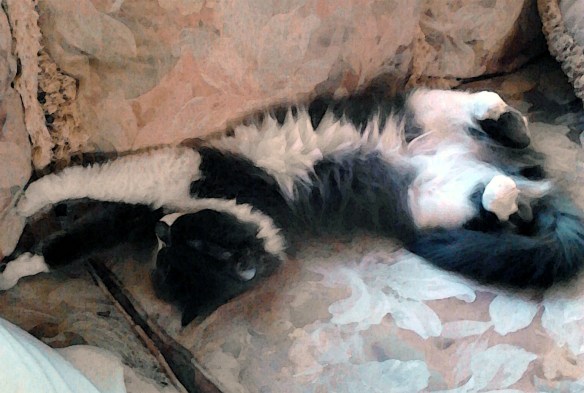
My clownish little friend Mouse turns into a very fang-y mountain lion when she’s scared…

Whew! Whadda week!

In my previous post, I wrote in a sort of brief, tongue-in-cheek style about how I managed to get bitten by my cat-friend, Mouse, on Thursday night last.  She was terrified when it happened; in retrospect, I shouldn’t have tried to untangle her back feet from the thin purse straps that had gotten wrapped around them. But honestly, it all happened so fast! I was bitten and bloody before I knew it.

That was almost a week ago. Here’s an update:

First off, I’m doing just fine. But just as it was a couple of years ago, when I was bitten by my dear old dog, I have serious reason to be grateful to the VA medical system. I’ve no doubt at all that my life would have been at risk without them.

Because I’m taking disease modifying anti-rheumatic drugs, or DMARDs, for my rheumatoid arthritis, my immune system is somewhat compromised. These drugs suppress and inhibit the body’s normal biological defenses in an attempt to keep them from mistakenly attacking and destroying its own joint tissues. But those defensive antibodies also protect the body from foreign bacteria and viruses. By taking DMARDs, I’ve made myself more prone to infection and have a harder time fighting it off than most people do.  It’s the trade-off that so many of us who have autoimmune arthritis choose to make to avoid awful pain and disability.

So, being infection-prone, I made a beeline for the local VA medical center for emergency care. I arrived at the ED just before midnight. Once I was called back to an exam cubby, a nurse thoroughly cleaned the many puncture wounds Mouse had inflicted on me. Some were on my left hand over the large knuckles. The rest were on my right leg, about halfway down my calf. All of them were angry, raw, ugly and beginning to swell. And they hurt about as much as you might expect such wounds to hurt; to me, the pain was about a four on the pain scale—unpleasant but bearable.

The nurse drew vials of blood for analysis and cultures and sent them to the lab. Finally, after looking the wounds over, the ED doctor prescribed oral antibiotics and told me to come back on Sunday for a progress check. I took the first dose of antibiotics when I got home.

By late afternoon the following day, it was clear that rather than healing, the wounds were getting worse. Both my hand and my calf had become grossly swollen. Both were also becoming increasingly tender and now were quite painful. Walking on the injured leg hurt enough to make me limp; dropping my injured hand below my heart made it throb angrily. It appeared that the cat bites had become badly infected. But since I was taking antibiotics, I decided to wait before running back to the ED.

By the evening, the wounds were so much worse that I decided that making the 30-mile trip to the ED would be prudent. Sure, the doc might tell me that all my symptoms were normal, not to worry and send me packing. But I figured it was better to be safe than sorry.

The ED was surprisingly quiet for a Friday night (I’d expected a packed waiting room and a long, long wait). But after only a few minutes, I was called back and they got started. I was having my temperature and blood pressure taken when one of the docs wandered by. “Whoa,” he said, stopping dead in his tracks, his eyes on my arm. “Look at those streaks!”

Sure enough, in the ER’s bright lights, several ominous red streaks were clearly visible running from my hand up to just above my elbow. In the much dimmer light at Mom’s house, none of us—Mom, me or my sister, who’s here visiting from New Mexico—had seen them. Their significance was dire. Not only were the wounds on my hand infected—it was traveling. Without much more aggressive treatment, my wounds could start to gangrene. I could lose my arm and/or my leg to amputation. The infection could become systemic. I could die.

The doctor wasted no time. Within a few minutes I was hooked up to an intravenous drip containing a much stronger antibiotic. When it was gone and the nurse removed the IV, he drew a thick black line with a Sharpie along the border of the hot, red, tightly swollen area that now surrounded the puncture wounds on my knuckles. He drew a second black line around the wounds on my leg, too (although there were no red streaks coming from them, yet).

“If the redness expands past those lines, I want you to drop everything and come

This is how the leg wounds looked on Tuesday, the last day I had IV antibiotics. It looks gross, but it’s much, much better than it was on Saturday…

right back here,” he said, the seriousness of the situation clear in his voice. “Don’t delay. Even if it doesn’t, I want you back again tomorrow for another infusion.”

I agreed to do as he said—and that’s what I did every day until Monday, when that day’s ED doc decided that day’s infusion would be the last. The streaks on my arm had disappeared, the heat and swelling in my hand and my calf had gone, and the wounds were healing nicely. The pain was mostly gone, too, except for some tenderness immediately around the punctures. He changed the oral antibiotics I’d been taking to a stronger variety and told me I didn’t need to come back unless things went south again on me—in which case I should run, not walk, back to the ED.

Yesterday, I saw my primary care doctor, who had called me Monday afternoon, wanting to see the wounds. She gave me a thumbs-up and told me to be sure to finish the oral antibiotics.

No problem, doc.

My hand as of Tuesday. Nice, eh? What a difference from a few days ago.

And that brings me to today. The wounds on my hand are now just small scabs. They look like I scuffed my knuckles. The leg wounds still look a bit scary, but they’re also healing well. I’m doing great.

If there’s a moral to this story, it’s this: If your pet is in a terrified frenzy, don’t get anywhere near those teeth and claws. She will bite you, even if she’s normally the gentlest kitty in the world. When they’re scared, animals react defensively to protect themselves, and they do it indiscriminately.

I’ve learned my lesson, I think.


A little excitement

Purse on kitchen desk.

Curious cat on desk.

Purse strap tangles around cat’s back leg.

Cat jumps down.

Cat panics, screams and runs, spraying wallet, checkbook, various lipsticks through the air.

Cat sprints at me where I relax in a living room chair.

Startled, I reach down to disentangle purse straps.

Frenzied cat sinks her fangs deep into my bare left calf.

I yelp with pain and surprise.

Cat bites again, this time into the knuckles of my left hand while wrapping clawed feet around my legs.

I yelp again, stand up.

Cat darts for staircase, still screaming and trailing purse.

I run for kitchen, trying not to leak blood on mother’s white carpet. I fail.

Sister manages to free cat from purse,

Cat does a slider under sofa, won’t come out.

Mom blots blood on carpet, applies spot remover.

My bleeding stopped, my calf wrapped in gauze and masking tape, sister drives me to ER.

Nurse cleans wounds, doctor prescribes potent antibiotics, tells me to return for check on Sunday.

Sister brings me home, we all go to bed.

Now, hand and calf painful and swollen. Sausage fingers.

Cat is uninjured and affectionate.

I blog one-handed and vow to stay away from horses.

In which Wren gripes, then updates news

Hi, friends!

Pardon me for not posting recently, but nothing much has changed on my personal RA/hip bursitis front. Seems like each time I start to write, I just end up spewing a load of whiney angst and helpless aggravation. Cathartic to write, no doubt, but utterly brain-numbing to read.

Ugh.

That said, allow me to complain about a different subject entirely. (Disclaimer: As a former graphic designer and newspaper editor, I have a few pet peeves when it comes to publication design and style. I cannot help myself … )

Many websites (almost all of them with a white background) not only indent quoted material but also change the quote’s font color to a very pale gray, presumably to make the quote stand out from the rest of the text.

I wear glasses to correct my vision, which is slowly deteriorating year by year. Reading that pale gray text on a white background drives me bats–t! I have to put my nose to the screen just to see the words, let alone read them. Even worse, some websites have chosen to make this pale gray font color their standard throughout.

I realize that this “style” is trendy and considered sophisticated. It does, in fact, look classy at first glance. But if I land on a site that uses it exclusively, I sigh, grumble under my breath and move on—even if I’m interested in the material. If it’s only the quotes that are in pale gray, I’ll read them, but grudgingly. And only if they’re short. Otherwise it’s just too much work.

A good publication design is one that makes reading the material quick, easy and pleasurable. The reader should never have to think about the act of reading. It should never be a chore.

Surely I’m not the only middle-aged bifocal wearer who has trouble seeing and reading pale gray text. Why would anyone want to make their website difficult to read for a significant portion of their readers?

In other news, in the early morning of Friday last, my mom had what seemed to be a heart attack. Awful chest pain, panting for breath, skin gone waxy and colorless. I called an ambulance and they whisked her off to the hospital. Within an hour after arriving in the ER, the pain had abated to less than half of its previous intensity, her blood pressure normalized and she was breathing easily. She was admitted and taken upstairs to a bed in the cardiology unit. By mid-afternoon her pain had disappeared.

After a myriad of blood tests and cultures, several EKGs, an echo-cardiogram and a nuclear stress test, the cardiologist on weekend call determined that she hadn’t suffered a heart attack after all. He also determined that he didn’t know exactly what had caused her symptoms, but with her history of gastrointestinal problems, he suspected either her stomach or her gallbladder. Apparently either of them can cause the scary symptoms Mom suffered.

Did I mention she had a urinary tract infection, too? She was already taking antibiotics for that when she had the pseudo heart attack, so they switched her to IV antibiotics for the duration of her stay. The cardiologist didn’t think her UTI had anything to do with her symptoms.

They discharged her from the hospital on Sunday afternoon, heart-attack-symptom-free but totally exhausted from all the tests and not being allowed to do more than cat-nap day and night. She left with a new prescription for more UTI-busting antibiotics. She also had a roaring headache; they hadn’t allowed her to drink any coffee, ascaffeine is a stimulant and a strict no-no for heart patients.  Poor Mom had gone into withdrawal.

If you’ve ever had a caffeine-withdrawal headache, I’m sure you can sympathize. They’re horrible, front-and-center, pounding, nauseating things. I made her a largish cup of coffee as soon as we got home; she drank it down and her headache disappeared within an hour. Her relief was palpable.

We’re currently trying to get her an appointment for an abdominal ultrasound and another appointment for soon after with her gastroenterologist. It would be nice to get to the bottom of this; our weekend was by turns terrifying and dreadful. Neither one of us wants to go through another one like it.

On Monday afternoon Mom broke out in a rash that spread slowly from just under her left ribs up onto her chest. At first it just itched intensely; by evening she said it felt like it was “burning from the inside out.” She was absolutely miserable. The cold packs from the freezer that I use for my bursitis hips relieved the itch and burn as long as they stayed cold but had to be changed frequently.

At first, we feared that she’d gotten shingles. It wouldn’t be the first time; she had a really bad attack once about 15 years ago. But other than the itch and burn, she said she felt just fine. Shingles usually come with flu-like symptoms.

She refused to go to the local urgent care clinic. “I’ve had enough prodding and poking to last me a lifetime,” she growled. I couldn’t blame her. She went to bed late Monday evening with a freshly frozen cold pack. Both of us crossed our fingers. If the rash was from shingles, it would start raising tiny, leaking blisters by morning. We’d get her in to see her primary care doctor for treatment. The other possibility was that the rash was a side-effect from one of the drugs used on her during her hospital stay.

Yesterday morning she arose with the rash still visible but no longer itching or burning. No blisters. No sickness. We concluded that it must have been a side-effect. All that remains now of the last several days is that deep fatigue. She tires to the point of needing to lay down after even a little exertion. Gallbladder? Stomach? Your guess is as good as mine.

And me? I’m fine, except for my ever-aching hips and hands. Boring. I’m coping and trying to maintain my optimism and sense of humor.

I think I’m succeeding.

That old river in Egypt …

… d’Nile.  You know–denial. I’m thrashing in the reeds along denial’s shallow edge, vigorously shaking my head at my recent fibromyalgia diagnosis.

Because this constant, aggravating pain I have in my hands isn’t fibro, it’s RA. The persistent dull ache in both my hips is a symptom of bursitis. Not FMS. I don’t have pain “all over,” just in those two specific spots.  So here I am, sitting with my arms crossed tight in the bullrushes. I deny fibromyalgia. Its facts are the round holes to my square pegs.

I don’t have fibromyalgia. That’s my solid opinion after a couple of weeks ofmulling over Dr. McA’s surprising words over following my appointment with him. “You have fibromyalgia,” he said to me, causing instant jaw-drop.

No, I don’t. Sure, when he tested the fibro tender points on my body, his pressing fingers caused me to wince a couple of times. One of the points was my knees. Both of them have flared intensely but very briefly several times over the last couple of months. Tender? Sure. But I’m confident that pain was from rheumatoid arthritis. It felt like RA pain, centered deep in the joint, throbbing angrily at rest and shrieking if I bent my knee or put my weight on it.

Your garden-variety rheuma-dragon pain. His teeth were in my knee.

I know Dr. McA simply whipped the fibromyalgia diagnosis out of his hat because my last several blood test results indicate that my RA is in clinical remission. My pain doesn’t fit the test results, so it has to be from fibro, the syndrome that consists entirely of pain that can’t be clinically explained. I’m guessing that he was grasping at straws and found one.

But those of us who actually live with the effects of RA in our bodies know that “remission” is one of those weaselly words that can mean different things at different times and among different people. You can be in “remission” but still hurt like a you-know-what. Or not. I’ve experienced “remission.” It lasted about six years and during it, I was almost entirely pain-and-other-symptoms-free.

So this time, my blood tests might be shouting “remission” but my rheuma-dragon hasn’t got the message. Nor has the bursitis-wyrme who’s chewing on my hip bursae, keeping them constantly inflamed and aching. I don’t know why they haven’t stopped aggravating and disabling me. Maybe they’re deaf.

Anyway. I don’t have fibromyalgia. And I’ve had a couple of fairly decent weeks since writing the two previous posts. Except for a few harsh flares, my hands and hips have kept the volume turned nicely down–enforced by pain meds, of course. When I stop them the volume ratchets up quickly. I can live with that. I’ve been sleeping very much better since my nortriptyline prescription was finally and copiously refilled.

And I’m going to ask Dr. McA to strike his fibro diagnosis from my medical records. Why? First, because it’s in error. Second, because until medical science can take the word “syndrome” off the name, a diagnosis of “fibromyalgia syndrome” implies that the sufferer is either a whiny hypochondriac or a malingering drug-seeker of low character. I believe that the vast majority of those diagnosed with fibro are neither; that their pain is real and devastating. But a lot of people both inside and outside the medical profession believe otherwise. And that’s why I want this mis-diagnosis struck from my records.

It’s a negative I simply don’t need.


Morning Mooselight

What would I do without my morning dose of Mouse?

I stretch out my finger, she stretches up her nose; we touch, her motor revs, a chuckle burbles from my lips. Under my stroking hands her fur is cool, downy as dandelion floss and just as summer flyaway.  Her small head pushes purring into my cupped hand, a demand for more of this fine, dawn massage, this fine schmooze that starts our day with feline and human sweetness and smiles.

Heartfelt thanks to everyone who commented on the previous post. I can’t tell you how much better; how encouraged; how much calmer and easier I am because of your thoughtful words and loving support. May you all walk in peace and find sudden joy today.

–Wren

"I wish I could relax..."

Morning Mouselight

Shocked and appalled

During my appointment with him Saturday (finally!), my rheumatologist reviewed the results of the blood test I had done back in early April. It was full of good news, he said, smiling.
I ratcheted my dropped jaw closed. I’d been certain that this blood test was not going to show anything good, given how much constant pain I’ve been in since my last rheumatology appointment in January.

Everything looked just fabulous, said Dr. McA. My sed rate was normal. Liver enzymes were lovely. As the latest part of a trend stretching out to about 18 months, he said it appears that my RA is actually in drug-induced remission. “The meds are doing exactly what we hoped they’d do and you’re tolerating them well,” he said, still smiling.

“But …”

“Now, it’s clear that your trochanteric bursitis is not improving,” he went on. “After several sessions of PT and several rounds of steroid injections, oral and dermal steroids, you’re still experiencing frequent pain. So I’m referring you back again to the orthopedic surgeon to explore possibly draining the bursae or removing them entirely.”

I sighed. Bursitis-wise, it has finally come down to surgery or resigning myself to living with the pain. Neither prospect feels very positive to me, but eventually I’ll need to choose. In the meantime, I remain hopeful that the damned bursitis will just go away on its own if I’m a very, very good girl.

The doctor turned away from the computer screen and gazed at me. “You have questions.” He darted a glance at the small notebook I’d laid on the corner of his desk.

I nodded and told him about the slowly increasing, constant pain I’ve felt in my hands and wrists. I told him about that bone-ache in my legs, which usually happens at night and is a comparatively new symptom in my long experience with the rheuma-dragon. I wondered if the Fosamax I’m taking for osteoporosis might be causing it.

He asked how I was sleeping. Not great, I admitted, but that was because I ran out of nortriptyline again. He promised me he’d remedy that. Then he looked carefully at my hands. He checked the range of motion in my various joints. It’s very good. He noted that I have no swelling. No deformities. I present with a body that backs up my blood test results. “Your RA really is in clinical remission,” he said again.

I managed to breathe back the sudden tears that pricked my eyes. I hate to cry. That really is all good, I said after a moment. Please don’t get me wrong. But my hands hurt literally all the time. My knees now join the chorus more and more frequently. The pain feels like rheuma pain, the kind that leaves me anticipating more and worse pain at any moment. It’s distressing and scary.

And what’s with this nasty ache in my leg-bones? “If I’m in remission,” I asked quietly, “where’s all this pain coming from?

Dr. McA started pressing various places on my body and limbs. Ouch—elbows were ultra-tender. So were my knees. There was slight discomfort in the other places he pressed on, but nothing worth getting excited over.

I have WHAT?!

“You have fibromyalgia syndrome,” he said in answer to my question. “Your symptoms are classic.”

My jaw dropped. The tears rose into my eyes again.

I’ll be honest, here. This concept just staggers me. It makes me want to find a cave I can crawl into and die. Worst of all, it embarrasses me. I know I shouldn’t feel this way, but the fact is that there’s a considerable portion (more than half, depending on which source you look at) of the professional medical community that dismisses fibromyalgia as a fantasy condition. These doctors and medical researchers believe that some hapless physicians, looking to offer some sort of diagnosis for their patient’s clinically baseless but persistently whiney complaints of pain, fatigue, insomnia, bowel problems, brain-fog and other various etceteras, just tossed all these phantom symptoms into a bag and made up an important-sounding name for them to satisfy their nutcase patients that they actually had something wrong with them without calling it what they really believed it was: hypochondria or plain, old-fashioned malingering.

This pain I’m experiencing isn’t my imagination. I’m not looking for attention or for an excuse not to work. I’m not drug-seeking. I’m not a shameful malingerer or a bloody hypochondriac. Not only that, I’m quite aware that there are many autoimmune arthritis sufferers who have also been diagnosed with fibromyalgia, and the pain and other symptoms they experience are no less real than my own.

Finally, I’m aware of the other half of the medical community that believes FMS is a credible diagnosis. The American College of Rheumatology is among the most prominent.

And yet … and yet.

“Fibromyalgia syndrome.” Wikipedia defines it thus: “From the new Latin, fibro-, meaning “fibrous tissues”, Greek myo-, “muscle”, and Greek algos-, “pain”; the term literally means “muscle and connective tissue pain.” The syndrome’s symptoms run the gamut from soft tissue pain, joint stiffness and painful tingling to intractable fatigue, chronic insomnia and brain-fog, among others.

“You’re experiencing soft-tissue pain, Wren,” said Dr. McA gently. “You have no swelling. No permanent disability and no deformities from your RA. Clinically, you’re in terrific shape right now. But you still hurt, sometimes very badly.”

He went on to suggest I look into gentle-resistance water exercise at a local warm-therapy pool. I didn’t tell him, but I’ve looked into that already. There’s only one pool like that in the Sacramento area (funded by Easter Seals) and it’s about 25 miles from Mom’s place and more like 50 from my home in the mountains. Either way, going to water exercise classes a couple of times of week sounds both expensive in terms of gas (in California, gas still costs anywhere from $4 to 4.50 per gallon) and time, considering our increasing traffic gridlock at all hours of the day.

So I guess I’ll just continue doing my bursitis exercises and try going back to the recumbent bike and doing low-weight resistance, slow repetition exercises at the gym. I ordered a Rodney Yee beginners yoga CD yesterday. (At least it will be fun to try and to watch. Wow, is that guy fit!) Everything I’ve read about fibromyalgia so far stresses gentle, daily exercise, sound nutrition for healthy weight loss and/or maintenance, and plenty of restful sleep as good, proven ways to treat symptoms. Some of what I’ve read also suggests cognitive therapy and therapy for stress and depression, as there seems to be a psychiatric aspect to the syndrome. I’m not sure what I think of that.

Well, yes I do. I feel humiliated whether I ought to or not. I’m working on that, too.

There’s a big part of me that refuses to believe this diagnosis. My pain isn’t “all over,” as it’s described in the research regarding fibromyalgia. I often don’t sleep well, but that’s more a result of my hip bursitis pain than anything else. And that can be mostly fixed by taking an appropriate dose of nortriptylene—which I do, nightly, as long as I can keep the danged stuff refilled. Dr. McA fixed that problem on Saturday once and for all, and I’m back on a three-month appointment schedule with him now. I’m not particularly fatigued; except for that deep bone pain in my legs and the bursitis, my pain seems isolated to just a few joints (not the tendons and muscles); and unless I’ve had several nights of interrupted sleep, I don’t experience brain-fog.

Further, as I said above, the pain I’m having in my hands, wrists and occasionally, my knees feels exactly like RA. Can I be in clinical remission and still experience rheuma pain? When I went into natural, drug-free remission 12 years ago, I had (with only two or three exceptions over time) no pain or other RA symptoms at all.

Dr. McA also told me Saturday that the x-rays he requested done on my hips show some osteoarthritic erosion of the femoral head on the right side. I am, as you might imagine, completely unsurprised. I’m already aware that I’ve some on-again, off-again osteoarthritis pain (and I guess, slow erosion) in the tiny joints at the tips of my fingers in both hands. That it’s showing up in my hip (and my knees? Hmmm…) seems par. I’m 55 years old. It happens. Our bodies do finally start wearing out; I’m no different than anyone else, that way.

Finally, we’re experiencing a very unseasonable (read freaky) cold front here in California today. The temperature has dropped from a late spring high of 99 degrees Fahrenheit two days ago to a forecast of 66 degrees today. Talk about rollercoasters! The sky is dark gray. It’s been either drizzling or raining since before dawn and will likely continue to do so off and on for the rest of the day. The barometric pressure has been dropping like a rock since late last evening; I spent one of the worst nights I’ve had in quite a while last night, my bursitis hips aching abominably and waking me up over and over again. It drove me out of bed for several hours. I took pain meds that finally eased it enough so I could finally get to sleep. My hands are hurting even more intensely than usual, too. Whatever’s causing that—the RA that’s “in remission,” wear-and-tear osteoarthritis or (sigh) fibromyalgia—it seems that the barometer affects them all. Goody.

I’m trying to wrap my head around this new diagnosis, friends. It frankly appalls me. I don’t want to believe it; I’ve just about decided not to until we see yet another “perfect” set of blood tests in early September when I see my rheumatologist again. And I wonder: What do those of you who’ve also been diagnosed with fibromyalgia think? How do you feel about it? I’d really like to know. Feel free to comment here or email me, please?

The one consistent thing about RA and it’s co-morbidities is that none of them are ever consistent. I feel like I’m caught in a lifelong, slow-motion whirlwind.


Remembering on Memorial Day

There was a lovely, fierce, white-haired woman who lived in the community where I edited a newspaper in the late 90s and for a little more than half of the 2000s. Evie was in her 80s, but she was sharper than most 40-year-olds I knew. She was a senior advocate, working tirelessly for the rights of elderly people. She decried those who would abuse and exploit the elderly, laid shame on the Bush Administration for its royal balls-up of Medicare Plan D and reminded readers of all ages that elders have an active voice in their communities and indeed, a great deal of wisdom to pass on, should anyone take the time to listen.

She wrote a weekly column about senior issues. Believe me when I say she was a tigress, as small and immaculately dressed and civilized as she was.

Evie never let a holiday pass without a written observation. In 2006, as the war in Iraq was about to surge, she wrote her Memorial Day column, musing about how most Americans seemed to be more interested in a three-day weekend and going out to play than in the real meaning of the holiday: Honoring our war dead.

“That there are American soldiers dying the war against terror on a daily basis is reason enough for us to spend the day in honoring and remembering those who have made the ultimate sacrifice,” she wrote.

She stated that she’d like to see the old tradition of wearing a red poppy on Memorial Day return. It originated, she wrote, with “a woman by the name of Moina Michael who, in 1918, wrote a poem with the words, ‘We cherish too, the Poppy Red / that grows on fields where valor led, / it seems to signal to the skies / that blood of heroes never dies.’”

Evie believed that Memorial Day should also honor veterans who are still living, but who spend their days enduring physical or mental pain and disability as a result of injuries received on the battlefield.

She was close to this issue. She had personal experience with it. Her only son was one of the many Viet Nam vets who fell ill following the war from his exposure to Agent Orange. He contracted non-Hodgkins lymphoma and severe and chronic respiratory disease.

“He is and will remain a 100-percent disabled veteran for what remains of his life,” she wrote. “It took more than 20 years before symptoms of his disability appeared, as many other veterans of that war have found who were also exposed to that deadly chemical.”

She visited him at his home once a week, and in spite of her age, gave it a thorough cleaning and made dinner — because he couldn’t.

As she did every year until she passed away in 2010, Evie flew the American flag in front of her house to honor America’s veterans, both living and dead.

“However, there’s one nagging question which may never have an answer,” she wrote. “Will all those soldiers who did not die on the battlefield, but nevertheless will die premature deaths because of war injuries, ever see their names on the Memorial Wall in Washington, DC? They, too, are giving their lives for their country. It’s just taking them longer to die.”

In Flanders Fields
In Flanders fields the poppies blow
Between the crosses, row on row
That mark our place; and in the sky
The larks, still bravely singing, fly
Scarce heard amid the guns below.

We are the Dead. Short days ago
We lived, felt dawn, saw sunset glow,
Loved and were loved, and now we lie
In Flanders fields.

Take up our quarrel with the foe:
To you from failing hands we throw
The torch; be yours to hold it high.
If ye break faith with us who die
We shall not sleep, though poppies grow
In Flanders fields.

– John McCrae (1915)

We Shall Keep the Faith
Oh! you who sleep in Flanders Fields,
Sleep sweet – to rise anew!
We caught the torch you threw
And holding high, we keep the Faith
With All who died.

We cherish, too, the poppy red
That grows on fields where valor led;
It seems to signal to the skies
That blood of heroes never dies,
But lends a lustre to the red
Of the flower that blooms above the dead
In Flanders Fields.

And now the Torch and Poppy Red
We wear in honor of our dead.
Fear not that ye have died for naught;
We’ll teach the lesson that ye wrought
In Flanders Fields.

–Moina Michael (1918)

The above was excerpted and updated from a post I wrote for my other (and now defunct) life-and-politics blog, Blue Wren.

–Wren

Predicting the unpredictable

Heh. Just when I think I’ve got my rheuma-dragon’s modus operandi down, he flibbers his tongue at me and changes it.

I’ve been checking the barometer whenever my hands start to hurt. Most of the time, the pain coincides with a fall in atmospheric pressure (most often associated with a low pressure area moving in over the state). Dark clouds and rain generally accompany a low, but this is California, so actual wet weather is rare. Occasionally, though, I flare as the barometer rises. Here, that always means clear, dry skies.

My conclusion? My rheuma-dragon gets snarly and starts biting at my joints whenever the barometer changes, though it happens more often with a fall.

Today I’m experiencing a particularly rotten flare in the knuckles of the first two fingers of my right hand. They’re swollen and hot. I got online and checked the barometric pressure for my area, expecting to see a fall or at least, a change. There’s a certain amount of satisfaction in knowing I can attribute the pain to something.

So you can imagine my surprise when I saw that the barometric pressure was steady, neither rising nor falling. It has stayed that way all day.

I can almost hear my tricksy old dragon sniggering at me. That’s what I get, though, for trying to squash him into a neat, predictable box.

I should know better. There has never, from the beginning 24 years ago, been anything I could point to as a positive trigger for an RA flare. Not any particular food, weather or activity.

It was cold and rainy in Northern Germany, where I lived when I first had symptoms of rheumatoid arthritis and where I was eventually diagnosed. I flared on wet days, but I flared when the weather was dry, too. I flared in all seasons, at all temperatures, or I didn’t. There was no rhyme or reason. When people (usually my parents or friends back in the States) asked if I thought I’d feel better living in a dryer climate, I said I doubted it, because the weather sure didn’t seem to make any difference.

The way RA affects me isn’t necessarily the way it will affect you. I can eat tomatoes without bringing on a flare, but maybe you can’t eat those or any other vegetable or root from the nightshade family. I might flare after I exert myself, but it also happens when I’m resting. I’ve felt terrific when I’ve been under a great deal of stress and felt awful when I was carefree—and vice versa. There has rarely been any warning of an oncoming flare. I never know if the next one will be mild or a killer. Hot baths, heat packs and paraffin baths are soothing on painful joints to me; ice packs are agonizing. Simply unbearable. For you, it might be the reverse. RA drugs that relieve your symptoms may not relieve mine, and you might have been diagnosed as a four-year-old while I wasn’t until I was 31. My joints might be gnarled, disfigured and stiff; I might have had my wrist fused or a knee replaced. You, on the other hand, might have had RA as long as I have but with little or no joint damage. It’s a maddening disease.

And in the end, it’s simply unpredictable.

Why do they think we’re wimps?

I was browsing around the Internet this morning and happened upon, as we do, a series of CNN Health webpages about rheumatoid arthritis.

Now, I consider myself fairly well informed about RA. I’ve read and read and read about this disease, everything from what it is to how it can damage the joints, soft tissues and organs. Still, I keep reading. I might find something new and hopeful.

As I clicked through the various sub-heads on the page about different aspects of RA, I saw one that asked, “Is Your Pain Threshold Low?” Huh? I clicked. The headline on the new page: “Are People with RA More Sensitive to Pain?”

They can’t be serious, I thought, my hackles rising. If anything, those of us who cope with RA pain and disability every single day have very high pain thresholds. We have to handle pain well or we’d never be able to get anything done. Surely, I thought, they’re going to acknowledge that in this article, so don’t jump the gun. Just read it.

So I did.

I wish I hadn’t. Because now I’m angry and frustrated. What the article said, in essence, is that people with RA have very low pain thresholds because of stress, lack of sleep and (oh, what a word!) catastrophizing.

Now THIS is a catastrophe.

Now, I can’t argue too hard against the stress and sleeplessness that go along with serious chronic pain. They’re both real. Both can make rheuma pain worse. The article even acknowledges (without going into any detail) the vicious loop that can occur with RA pain: You hurt, which causes stress, which make your muscles tighten up, which causes more pain and stress, which brings on sleepleness, which causes even more pain, stress, sleeplessness… and so on. In this case, any help we can get to lower stress and sleep better is precious.

But… but… catastrophizing?

The article defines the word thusly: [It’s] “a word used to describe a particular response to pain: feeling pessimistic and helpless, resulting in an even greater sensation of pain.” Honestly, I think that everyone, RA or no RA, does this at one time or another, usually briefly. Feeling blue and pessimistic goes hand in hand with any painful injury or illness, particularly injuries or illnesses that cannot be healed or cured. In such circumstances, anyone would “catastrophize.”

The article goes on to state that “[p]eople who catastrophize have a tougher time coping with pain and are more sensitive to pain than others. Studies involving people with RA have found that those who catastrophize experience greater disease activity and inflammation. Why? One study found that, when exposed to painful stimuli, people who tend to catastrophize experienced a greater boost in levels of interleukin-6, the inflammatory molecule that can increase pain.”

Okay. So science proves that stress can cause a rise in the level of inflammatory molecules in the bloodstream, and that this rise can increase pain, presumably because it increases inflammation.

And that singles out RA patients, how? It proves that they have lower pain thresholds, how?

It doesn’t prove the premise of the headline, “Are People with RA More Sensitive to Pain?” (which implies that we are, because why would anyone ask that question in the first place?).  Increased inflammation can cause more pain regardless of its cause. For example, if I sprain my ankle—the sprain being caused by injured ligaments that, because of the injury, become inflamed and thus, painful—and then I put my full weight on that sprained ankle accidentally and irritate it further, I’m going to suffer increased pain. If I’m stressed because now I can’t get to work in time for a presentation to the boss and clients I was scheduled to give, then naturally, the pain is going to feel worse, since stress causes a further release of interleukin-6 into my bloodstream. And if the pain in my ankle keeps me awake all that night, and I have to stay home from work again the next day and get even more stressed out, then… well, you get the idea. It’s a nasty loop of pain, stress, sleeplessness and pain.

And that’s without  even having RA. Again I ask, why single out RA patients for this pain threshold question? It can apply to anyone.

And what about the “people who tend to catastrophize” part of the statement? What does “tend to” mean. Does it mean they studied people who have frequent, intractable pain who complain about it a lot? How did they find those people? How was the RA pain they complained about categorized? As “mild?” “Moderate?” “Severe?” How long had they had the disease? Was their RA being treated? Were they taking pain medications? Did their pain keep them from working, playing with their kids, or doing things they loved? Did it stop them from doing little, everyday things like lift a coffee cup, fold laundry, open a jar of peanut butter or even button their own clothes?

An accusation of “catastrophizing”—and that’s what it feels like to me—better have a lot more depth beneath it if it means to be taken seriously.

This is not the first time I’ve seen RA patients’ pain trivialized—even pooh-poohed—like this. A couple of years ago the Arthritis Foundation magazine also ran an article that suggested that those of us with RA “catastrophize” our condition, thus making it seem worse than it really is. It was a not-so-subtle implication that, far from being the tough, courageous and often stoic people we actually are, we’re all doom-and-gloomers. Weaklings. Head-cases. Wimps.

I take serious exception to that premise. You probably do, too.