Your Care Moments: Surveys & Money for Free

Recently, a nice young man from company called Zitter Health Insights emailed to ask if I’d participate in project they’re doing. Called “Your Care Moments,” it consists of a series of surveys about patient’s healthcare experience, and in my case, as a patient with rheumatoid arthritis. Zitter chose me as a possible participant because of my RA blog activity.

Slide2

Results from one of Your Care Moments survey questions. Click to embiggen.

In return for completing the survey, the fellow stated, Zitter would pay me. Then he asked if he could call me and tell me more about the project. He sounded so nice, and so earnest, that I said OK. A few days later, Keith—the nice young man—called and explained in more detail what Zitter and “Your Care Moments” were all about. He was just as pleasant on the phone as he was in his email, and I decided to go ahead and participate.

The following day I registered and filled out the first survey. It was simple, less than 10 minutes to complete. When I’d finished the last page, a window came up. It thanked me and assured me that there’d soon be a small stipend payment in my Pay Pal account in return for my information and time. And, it stated, in a few weeks, they’d send me another survey.

Keith called a couple of days later to ask how the survey had gone for me. I told him it hadn’t been a problem at all, and thanked him for picking me to participate. And that’s when he asked if I might tell all of you about it.

I told him I would, because I think what Zitter and Your Care Moments are doing is important and helpful for all of us as patients.

Zitter Health Insights does market research for pharma companies with the payer side of healthcare: medical directors, pharmacy directors, and managed care professionals. “What they think and recommend about different drugs … is

More question results. Click to embiggen.

More question results.

so important,” Keith stated in an email, “but the most important decision sits with the patient who actually takes medicines and experiences our healthcare system.”

Your Care Moments provides insights into consumer habits, decisions, and healthcare experiences. They do this through short, online, anonymous surveys that they send to their registered patients. [like Keith did for me.] The surveys take 5-10 minutes to complete on computers or mobile devices, and Zitter pays per survey. The company keeps in contact with each participant over time to follow when they’ll next see a doctor or pick up a prescription in order to survey them when the information is still fresh in their minds. Patients don’t need to worry that Zitter might share their identities; the company never asks for names or addresses.

“We give patients a voice to their healthcare experiences and a way to make some money while doing it,” Keith stated. ”Pharma companies want to know what patients go through, think, and want. The more people we bring on board, the better our research results will end up and the more opportunities there are for patients.”

The amount of each payment for completing a survey varies according to its type and length. Zitter informs registrants how much each individual survey will earn before they start.

Zitter receives and analyzes the information they collect, then sells it to bio-pharmaceutical companies to help them gain insight into patient healthcare experience, opinions, and habits. Zitter doesn’t work for any specific company or drug. They never sell or share email addresses, and all information you share with them is safe.

If you’re interested in participating in Your Care Moments, like I do, and would like to make a few bucks for your survey answers and time, click here. To learn more about Zitter Health Insights, click here.

Posted in RA

Shot in the Belly

Just thought I’d stop by and tell you how my last Humira injection went.

If you read my last post, you’ll know that self-injecting this medicine has been fraught with jitters for me. It hasn’t mattered that I know the shot won’t hurt as much as my imagination is sure it will. It hasn’t mattered that I know the stuff may send my rheuma-dragon into a stupor and, perhaps, put an end to at least some of the neverending pain that claims so much space in my consciousness each day.

Nope. Doing this twice-monthly jab has simply been crap.

Many, many nice people, fellow-rheuma-travelers all, responded to my post. They commented here, on RheumaBlog, and at RheumatoidArthritis.net, where the post was published in full. The vast majority commented on RA.net’s Facebook page.

I just want to say thank you, right now, to everyone who commented, for being so incredibly supportive. I didn’t really think that I was alone in hating to jab myself, but I had no real idea just how many people who take subcutaneous biologic DMARDs have almost exactly the same fears that I do, and that they face and overcome them every single time they inject, too. I realize, now, that I’m an unwitting member of a huge secret society. It’s called the I HATE JABS Society. 😉

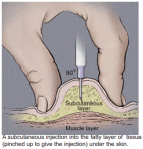
Many of those who commented suggested I switch injection sites from my upper thighs to my abdomen. I chose to inject into my thighs, originally, because it seemed to me that if it was going to hurt, it would probably hurt less there. The idea of sicking a needle into my belly gave me the heebie-jeebies.humira-pen-figure-j-90-degree-angle

But so many people said it hurt less in the abdomen. A lot less. So many people, I reasoned, couldn’t all be wrong. So when I injected the other night, I did it in my tummy.

Heheh. Wow. It … worked. There was no pain. OK, maybe a second or two of “ah, there it is, here comes the burn” but then that went away and there was no burn at all. There was no pain when I removed the pen, and no pain when I put the little bandage over the tiny bead of blood that welled where the needle had penetrated.

No pain. No nothing!

So, I’m pleased to say that I’ve no longer any reason to dread these injections. I am so glad–and so incredibly grateful to everyone who commented. Let me give the advice, now: If you inject DMARDs, seriously consider injecting in your abdomen, even if the idea makes you shudder.  It’s so much better!

Now, if only my super-charged immune system will slack off a bit and let the Humira do its job. That would be the real triumph. Fingers crossed.

Driven to Distraction

Renoir-woman-at-the-garden-1873self-portrait-pierre-auguste-renoir-SAFEThe pain, fatigue, and malaise of RA can be completely overwhelming. It can keep us from working, going out with family or friends, or simply stop us dead in our tracks. How was the beloved Impressionist Pierre-August Renoir, who had severe, disabling RA during the last 20 years of his long life, able to keep on? His art–and with the power of distraction.

Read about how Renoir’s drive and courage can apply to our own lives with RA in my latest post at RheumatoidArthritis.net.

The Storms in my Joints

Everett Shinn, "Snowstorm on Broadway"

Everett Shinn, “Snowstorm on Broadway”

With winter still pummeling large parts of the U.S., it seems like a good time to talk about how the weather may affect rheumatoid arthritis. Because I’m here to tell you, I don’t care what those skeptical scientist/doctor-types say. For an awful lot of us with RA, the weather does have a rather big effect on how we feel …

Read the rest here.

Posted in RA

Moody

Remember mood rings?

Heh. Well, unless you’re of a certain age, you probably don’t. Created back in 1975, mood rings were these quirky, goofy rings with a fabricated stone that responded to–the makers claimed–your mood. If you were happy, the stone was a lovely aquamarine blue. If you were depressed, it was gray. Angry? Red. And etc. They were all the rage for a couple of years, and then, like most gimmicks (think Pet Rock), they faded mostly off the market.

 *Note: A quick googling tells me that mood rings are still out there, now in a huge variety of shapes and settings. Who knew?

Anyway. Back in August of last year, when I was in the middle of packing up and moving Mom and myself to our new apartment, I bought not a mood ring, but one of those little solar-powered toys for a couple of dollars to cheer myself up. It was a rough time for both of us: physically and emotionally exhausting at once. My toy is a daisy that nods its flower head from side to side, and sorta flaps its little leaves up and down when the sun hits the sensor. I used a black Sharpy to draw a little smiley face on the yellow middle of the daisy, too. It just tickled me.

Since then, I’ve gotten into the habit of setting it in my window when I get up in the morning so it nods happily nearby as I work. No matter how much pain I’m in or how blue I might feel, it makes me smile whenever I look at it.

So you can imagine how I felt this morning when I started to move the blinds aside a bit for my Happiness Daisy–and discovered

IT WAS BROKEN!

BrokenHappyDaisy1Oh, woe! Somehow my toy daisy’s stem got broken at the curve. It’s little head was drooping sadly.

Now, here’s the thing. When I saw it, my mood just flopped to my slippers. It’s silly, I know. I can replace that toy without much effort or cost. But it was special because of when and why I bought it, and that time is past, gone, and can’t be reproduced.

And that’s what made me think of those goofy mood rings. If I had one now, I wonder what color it would be. Black? Olive green? Brown?

I’m going to try a drop of epoxy or tape or something to fix my Happiness Daisy. In the meantime, I’ll just have to remind myself that life does go on, and in spite of the highs and lows, it’s usually pretty darned good–today included.

Here’s hoping that your Happiness Daisy, whatever it is, is smiling for you today.

Posted in RA

Wren Interviewed

Recently, HealthyNew24 got in touch and asked me to answer a series of interview questions about living with RA. Here’s the result.

Rheumatoid Awareness Day

Rheumatoid Awareness Day is today, February 2. Let’s join the RA Day’s founder, the Rheumatoid Patient Foundation (RPF), in taking up the banner to help spread the word about rheumatoid arthritis, a confusing and misunderstood disease…

Read the rest at RheumatoidArthritis.net.

New Blogger Alert!

Starting a blog takes a special type of courage. You’re putting yourself out there for the whole world to see, baring your thoughts, details about your life, and sharing your hopes and dreams.

Now add that you plan to blog about growing up with Juvenile Rheumatoid Arthritis, and about what it’s like to live with the disease as a young adult, just as you’re getting a good start in the world.

Please join me in a warm welcome to Stephanie, who’s just started her new blog, “All Grown Up With JRA,” to the online RA community. Stop in and say hi, won’t you?

To read her first post, click here. You can also find “All Grown Up With JRA” in the blogroll to the right.

Vintage

Writer/curator Maria Popova used the word “vintage” in a recent post on her delightfully fascinating website, Brain Pickings, referring to a children’s book published in 1971.

I love Brain Pickings (I love books, and art, and illustration, and it satisfies all three appetites), and I love Popova for her informed, whimsical style, but vintage? Vintage?

I was 15 years old in 1971, teetering on the cusp of high school. But yes, I know. That was, um, forty-three years ago, but I swear it only feels like 13. Maybe. So how can a book written in 1971 be vintage?

I mean, doesn’t that make me vintage, too? Since I’m … ah … even older?

When I think of something that fits the word “vintage,” I think of a really old bottle of wine. A vintage book, to me, is Moby Dick or The Last of the Mohicans. (A really vintage book might be anything by Plato). Vintage clothes, to me, comeVintage clothes from the 19th and early 20th centuries, and a vintage car is Packard, not a ’68 Mustang (which I owned).

But maybe I’m looking at the whole concept of “vintage” too narrowly. If I think back to how I perceived life when I was 30 (that was about five years ago, memory-wise), I saw things that had happened or were made around 40-50 years before as “vintage.” Meaning, of course, “old,” but in a fond, venerable sort of way. Some of those events, like WWII and Hitler and the slaughter of the Jews were horrifying, tragic, and mind-shudderingly awful, but they were also safely “vintage” in my mind, lost in a past, in times, and in circumstances I felt sure we’d never, ever repeat.

So it shouldn’t really surprise me that Maria Popova sees the 1970s and earlier as “vintage.” She’s about 30 years old, bless her heart. My daughter is 32, and I know she thinks I’m rather old. Given how I felt at their ages, I guess I can forgive them both.

And maybe there’s nothing wrong with being of a “vintage” age and era. Vintage wines, after all, are the best. Of course, if they turn to vinegar they can also be the worst, but in real life, a little vinegar now and then keeps us humble and honest.

I’d have never believed that I’d ever be “vintage” when I was 15 years old and the world was a vast, inviting, dazzling playground, filled with dreams and adventures and spread out in front of me like a magic carpet, inviting me to take a ride, but here I am.

And you know what? I don’t mind a bit.