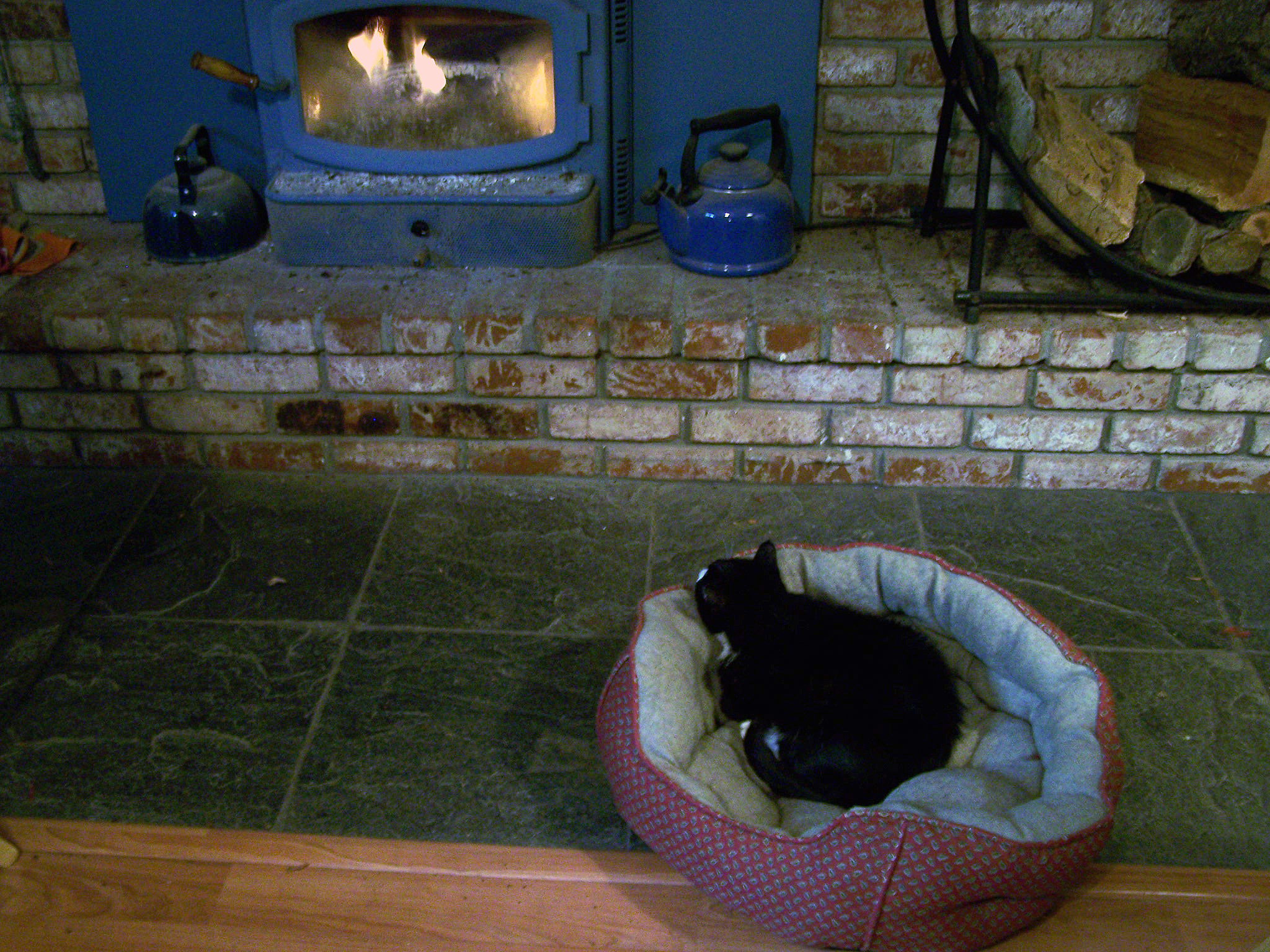
Thoughts of the meandering type

I’m up early-early after sleeping not-so-well. I took Tylenol PM last night, as I have the last three, but this time it didn’t work even a little. So I saw each hour on the clock, waking in annoyance from image-and-thought-crowded dozes to wide-blinking-awakeness as I flexed my throbbing, gravel-filled digits and wished for hands less demanding of my complete attention.
The single, bed-time Elavil tablet my rheumatologist prescribed – which I looked so forward to as a solution to the two a.m. ceiling stare – worked only half-heartedly and erratically to help me sleep. But it worked enthusiastically to increase my appetite. This is aggravating. I don’t need help with my appetite; in fact, I’ve only just this year gotten the beast under control after a lifetime of bad eating habits. To suddenly crave buttery Ritz crackers, salty-crunchy tortilla chips and sweet slice after slice of Thanksgiving spice cake with fresh whipped cream – and to mindlessly indulge the craving – is to look away as Doom creeps in the back door, quiet, breathing the rancid-sweet breath of the ketosis-plagued diabetic.

Bleh. I’ve shoved the evil Elavil to the back of my pill cabinet (yes, I have one, to my chagrin) and put ranks of vitamin and supplement bottles in front of it. I’d rather lose sleep than regain those hard-lost pounds. Besides, I gave all my fat clothes to the local hospice thrift store. My wardrobe consists now only of lesser sizes. I like them.

 ******

 Yesterday Mr Wren and I took a ride down the mountain to Home Depot. The reason? To buy door levers. Our house is currently equipped with nice, small, round, ubiquitous doorknobs. I’ve never given them much thought. But with my hands in a seemingly endless flare, it hurts like a _________ (fill in the appropriate curse) every time I open a door. My right hand protests loudly at grasping the knob and then shrieks when I twist. The result is me standing in front of the still-closed door, clutching my angry hand to my chest as I turn the air around me blue. And sometimes, the door does not open.

This is not good.

When I told Mr Wren that I wanted to change all the doorknobs in the house to levers (and this after 12 years during which the knobs did the job just dandy), he didn’t even blink. Off we went.

After perusing the door-paraphernalia aisle and exclaiming in dismay over the stunning prices, we bought five “brushed antique” door levers. Two with deadbolts for the front and back entry doors, and three with thumb locks for the bedrooms and bathroom. That leaves one bedroom and one bathroom still to change out, but as I don’t use either of them very often, they can wait for their levers. If I need to get into one or the other, I’ll either grit my teeth or holler politely for assistance.

The hard part will be the actual removal of the old knobs and installation of the new levers. Mr Wren will do his best to procrastinate this unpleasant task until Hell freezes over, but I can’t wait that long. I’m going to give it a try myself today. And if I can’t do it, then perhaps Matt will come to my rescue. One way or another, I’m going to be able to open doors with my elbows if I need to before the day is out.

 ******

 It took its sweet time arriving, but early winter (such as it is) has tentatively arrived here in the California mountains. The daytime temps are just reaching the mid-50s; nights are down into the mid-30s. I realize that for most people, these temperatures are downright balmy for this time of year, so I have no right to complain. And I’m not. I like the cool weather. In fact, I live through the warm springs and sizzling summers dreaming of the chill breezes of late fall and the hard frosts of winter. Over the next three months or so we’ll have some snow – more than a little, if we’re lucky – and plenty of rain, also if we’re lucky. I know this sounds perverse to those of you who dread the cold and damp of winter because of rheuma or simply out of preference. But along with the fact that California’s well into its Third Official Year of drought conditions (more like five years, if you ask me), I just prefer bundling up to stay warm to stripping down to stay cool. I like wearing sweaters and thick socks. I adore hot soup – the aroma as it cooks and the flavor when I eat it. I love working and playing outside in the cold so I can go inside and warm my hands and backside at the living room wood stove. I love the way snow transforms the world and the sound rain makes when it spats against windows and drums on the roof.
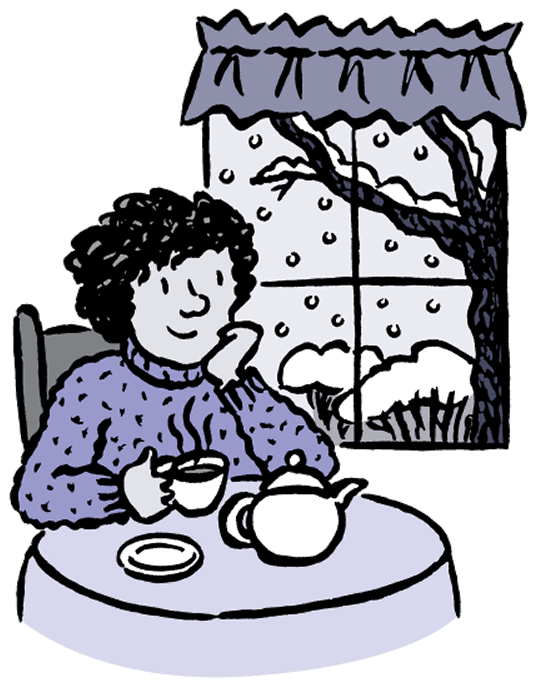
Yeah, I’m cracked. So what’s new?

About disablement

RA Guy recently wrote about his ambivalence concerning the possibility of having to use a wheelchair in the future. He’s a positive person and a pragmatic one; eventually he came to the conclusion that there’s no need to be ashamed or to feel diminished because one needs assistive mobility devices in order to maintain one’s independence.

Walking isn’t a problem for me right now. But there have been many times in the past when my rheuma-caused pain and disability made the world seem pretty bleak.

In the first years after I was diagnosed, I lived in a German maritime city on the coast of the frigid, stormy North Sea. The surrounding land was flat, a strangely beautiful mixture of marsh, moor, farmland and patches of deciduous woods. Across this level plain the sea winds danced, whistling and shrieking their way through the seasons, all of which were damp and only one of which was warm. The winters in Norddeutschland were utterly, bone-chillingly cold. Snow was rare. Slashing rain, sleet and glazings of ice were not.

 I absolutely loved it there. Living in Germany, in Europe, was a lifelong dream come true. Then Rheuma crashed the party.

Sometimes it seemed like it was working in collusion with the weather and the Fates. RA would strike my knees, my ankles, my feet or toes on the very same, frigid days the dang car wouldn’t start. (we had an old BMW 2002 that refused to run for more than two weeks between trips to the garage.) So I’d venture into the pre-dawn, winter dark, bundled up like the little brother in The Christmas Story, gimping and cussing as I walked the four-block journey to the bus stop as fast as I could so as not to miss the bus and end up standing in the cold for another 20 minutes. Once on the bus I’d greet my German neighbors, grab a strap and stand for the whole ride into work, as there was seldom a free seat. In the course of a day, I’d limp rather than drive from one end of the U.S. Army kaserne where I worked to the other, doing my job. And when the day ended, I’d repeat the whole process in reverse.

In a car, these distances were nothing. But walking even short distances with a flared knee or foot in those cold weather conditions were, I realize now, feats of courage I’d never have believed I could muster.

Yet I did it. Frequently. And I smiled and laughed and conversed with people because I didn’t want them to know how frickin’ bad I was hurting.

Of course, there were times when the pain was so intense I couldn’t bear moving, so I’d call in sick and stay home. I never got comfortable with that; I always felt like I was being a weakling, and that others would think I was faking it. I wasn’t – and I loved my job – but no one I knew or had ever known had RA. I knew little about it myself, so I had no context in which to place my pain, disablement and, sadly, my shame.

After a year or so of living with frequent flares, I learned to just use my cane when I needed to. I learned to use crutches, too, for those times when I couldn’t bear to put even a little weight on the affected joints and my doctor, stumped, put a plaster cast on my foot and told me to stay off it for several weeks. There were so many times when I’d have given just about anything for a wheelchair just so I could get off my feet or stop using my aching hands or shoulders to support my weight. But I never dreamed of asking for one.

Silly goose.

I didn’t like having to use a cane or crutches. I didn’t like how they made me stand out (although I’m sure my limping made me stand out anyway). When I used a mobility aid, sometimes people would ask, solicitously, how I’d hurt myself. I’d have to explain, embarrassed, that I wasn’t hurt – I just had rheuma and my foot was flared. More often than not, they’d blink and change the subject. I couldn’t blame them – even to me, I sounded like an attention-seeking wuss.

I’d like to think I’m past embarrassment when it comes to mobility aids, but I’ll admit I don’t like wearing my Spidey-gloves in public. And I’m a little ambivalent about my old cane, which hangs hidden in the back of my closet. Although I haven’t needed it in many years, and even though the disease was in remission for a long time, I could never bring myself to get rid of it. In the back of my mind were the quiet warning words, “just in case.”

What’s new to me is this rheuma fatigue. I just don’t remember getting so wiped out so easily when I was fighting the disease originally. It keeps catching me out. Yesterday I was doing a little Christmas shopping with Mr Wren. We were in one of my favorite stores – World Market (used to be called Cost Plus). I love browsing through this store at any time of year, but I particularly love it during the Christmas season because they carry so many of the candies, Christmas things, ornaments and specialty foods I used to see when I lived in Germany. Wandering around World Market puts me into a sweetly nostalgic mood. I rarely leave empty-handed.

And yesterday was no different, at least that way. What WAS different was that after 20 or so minutes of perusing the aisles, suddenly I was tired. And I mean sit-down, close-your-eyes, hug-your-knees tired. I knew I had to give it up. We still had to go pick up my car at the auto mall (Mr Wren had bought a new Toyota Tacoma the day before and left my Kia there overnight). I still had to drive it the 50-plus miles home.

Well, we made it, but I was truly done in. While I can recall times in the past when I was so tired after a long day at work that I could barely drag myself up the three flights of stairs up to our flat, it’s not the fatigue that stands out. It’s the pain.

Today, it’s both.

Rheumatoid arthritis is completely unpredictable. I hope it will be a long time – if ever – before I need to use my cane, get crutches again or use a wheelchair. But I know better than to ignore the possibility. Acceptance, with every else that’s good in life, comes with time.

That sneaky rheuma

Rheumatoid arthritis pain can be sneaky. You’re familiar, I’m sure. You know, you’re cooking dinner. You grab the handle of a pot and lift it off the burner. The moment you do, it feels like the small bones in your fingers just shifted a quarter-inch sideways inside your skin. Hurts like a – well, I’ll be a lady. But you don’t drop the pot – it has boiling hot liquid in it. What you do is yelp, set the pot back down with a clang and clutch your now-throbbing hand to your chest.

From the living room: “Are you all right, Mom?”

“Yeah. Rheuma.” And under your breath, you cuss your fingers, the pot, the disease, your screwed-up immune system and the handfuls of drugs you take each day that aren’t working.

Or you’re typing. Just breezing along. Yeah, it hurts a bit. The joints aren’t happy, but you can’t just stop doing everything, especially when the pain is low-level and bearable (if not actually ignorable). Suddenly, as you stretch your right index finger that tiny upward and leftward distance to tap the “y,” it sends a vicious jab of eye-popping pain from fingertip to knuckles and back. You flinch, yelp again and stop typing. You wait, hoping that the annoyed digit will calm down.

Or, like this: A few minutes ago I cleaned the ashes out of the wood stove and, with my hands encased in heavy work gloves (but pink ones, because one has to keep up appearances) I carried some heavy stove-lengths of split almondwood inside so I could start a new fire. The previous one burned out in the wee hours this morning, while we were still all tucked into bed, so now it’s about 56 degrees inside. Since the wood stove is our main source of heat during the chilly months, this has to be done unless I want to huddle under the comforter all day. OK. It’s tempting sometimes, but …

Anyway. I got the fire going after two or three tries. I pulled my thick Spiderman* gloves on (I’ve learned to be solicitous of my hands and even apologize to them when I do things like lift weighty chunks of firewood). As polite flames licked up the sides of the logs, I sat down on the sofa. Opened my laptop to start reading the day’s headlines. I cradled my coffee cup between my hands, enjoying the warmth, and had a sip, a reward for dealing with this daily, early morning chore without a hitch.

And as if on cue, my right hip started stabbing me in time with my heartbeat. Buh-STAB-bump. Buh-STAB-bump.

So here I am, back in Rheumaland, where the air smells like eucalyptus and Tiger Balm, joint splints live tucked among the underwear, and pill-bottles rattle in the corners. I’m unable to forget for even a little while that I have this … this … disease.

And that’s how it’s been around here for the last three days or so. Sneaky pain. It always surprises me. You’d think after all these years it couldn’t ambush me like that anymore, that I’d always be ready for it, steely-eyed and armored-up. Well, no. Because when my joints aren’t hurting, I slip with heedless ease into normality, just living and doing, moving like my body was meant to move. And since I’ve slimmed down, moving is so much easier. I’m more graceful. (!) And I enjoy moving again. Who wants to remember the threat of painful joints?

As my re-newed bout with rheumatoid arthritis re-enters this more active stage (and I begin re-learning old lessons), I find myself being a little … tentative … about doing things I’d usually do without thought. But I resent having to slow down and think “how will this hurt me?” before I do things. I worry, too, that the pushing and pulling I’ve been doing with the weight machines at the gym is irritating the joints in my hands. Which means I’ll need to re-think that healthy activity and (sigh) come up with an equally healthy alternative.

Oh well. I guess there’s never a dull moment in Rheumaland.

*Thermoskin gloves, which are black with a sorta of fish-scale, grippy pattern. Spidey-gloves.  They’re made of a thick, soft, flexible, rubber-like material and offer support without inhibiting necessary movement. They also keep the joints very warm – always a good thing. And finally, they’re making them in beige! I just ordered two more pairs here.


We all need a “time out.”

This has nothing to do with rheuma, obviously. But I just had to post it. I’m … stunned (pun intended).

A police officer in Little Rock, Arkansas “tazed” a little girl, with her mother’s approval, because the child refused to take a shower.

Officer Dustin Bradshaw’s report states that the girl was “violently kicking and verbally combative,” so he darted her with his Tazer, giving her a “very brief stun to her back.”

Is it just me, or does this seem a trifle … overboard?

I mean, this was a 10-year-old, not a 180-pound man hopped up on angel dust and waving a tire-iron. A 10-year-old girl. Unarmed. Kicking and screaming and obviously out of control, but this is not necessarily abnormal behavior for a child. Annoying, aggravating, even infuriating behavior, certainly, but who in hell would shoot a 10-year-old with a Tazer gun?

Apparently, an American policeman.

Officer Bradshaw has been suspended from duty for a week, with pay. I know the suspension will go on his records, and that’s not so good for him, promotion-wise, but otherwise, it’s like he’s getting a free week of vacation for electrocuting a child in order to stun her into submission. And you know what? He wasn’t suspended for shooting the child, but because he forgot to attach a video camera to the gun before he fired. Seems he broke department rules when he did that.

The little girl was physically unharmed, according to the story by the Associated Press, though one does wonder what her mental state must be, given that her mother called the police on her for not taking a shower when she was told – and then gave the officer permission to shoot her with a Tazer because she was throwing a tantrum.

This is incredible. No – it’s monstrous.

The child is now staying at a youth shelter. Ozark Mayor Vernon McDaniel wants the Arkansas State Police or the FBI to investigate whether the use of the Tazer on the child was proper.

Holygods. This is a question?

What’s next? “9-1-1? Hurry! My 14-year-old son won’t clean his room! Have the police come and taze him! That’ll teach him to do what I tell him to do…”

Sometimes I wonder what we’ve turned into. Where are the brakes? We accepted that our government was torturing people – most of them innocent people. It was, I guess, a kind of revenge for the Sept. 11 terror attacks, along with two wars. Now we stun children into submission with high-voltage darts for not minding their mothers.

America seriously needs a “time out.”

A preemie’s story

I was born on October 25, 1956. My timing was a bit off; I wasn’t expected until the second week in December, a sort of early Christmas present from the stork. Instead, I was an early birthday present for my mother, who was born in mid-November.

I jumped the delivery gun by seven weeks.

I didn’t actually plan this. If I had, I’m sure I’d have been in the proper position for launch. As it was, the first part of me the startled doctor saw was my tiny, skinny, wrinkled butt (a physical state I’ve never been able to duplicate, though at this particular age, I’m working on the wrinkled part and feel sure I’ll achieve it before long).

It was a real big pain for my mom, my premature birth. Dad was caught off guard but he took it all in stride. All he had to do was pace the waiting room, smoking, wondering which flavor he’d gotten and hoping he’d know soon so he could go buy cigars to hand out. Mom was the frightened, brave girl-woman with her feet up in the cold steel stirrups, though, unprepared for any of it, no anesthesia, no Lamaze training – hell, no cigarettes. They had a hard time getting me out – I guess maybe I realized my mistake and changed my mind. Anyway, my birth took a long time. Mom endured it, terrified as she was.

I’m flip about this now, 53 years later. But the fact is, Dad was terrified for my mom and for me, because being born prematurely in the middle of the 20th Century was pretty dangerous situation. It still is, but today medicine can save the lives of premature babies who would surely have died back when I was born. I was terribly early and breech to boot. I’m lucky to be here at all.

They kept me at the hospital, in an incubator, for seven weeks. During that time my parents visited me every day, but they weren’t allowed to hold me. A nurse would get me out of the incubator for a minute or two and bring me to the window so Mom and Dad could look at me. At least once she held me up, cradled in and balanced in one hand, so my Dad could take a photo.

I gaze at that old, faded and yellowing black-and-white print in something like awe. My head wasn’t even as wide as her palm. My bare feet – each with the correct number of toes – couldn’t have been more than an inch long. And my toes: think baby corn kernels.

“You were like a baby doll,” Dad used to tell me, wonder in his voice, “but you were alive.” I had yellow jaundice because my premature liver wasn’t ready to work on baby formula yet. I had yellow fuzz on my head. Today my left ear lacks the curl-over along the top, making it sort of pointed, like an elf’s ear, because I wasn’t quite finished when I came off the assembly line.

I like to think that perhaps there’s an elf in my ancestry.

I’ve never met another preemie, but I know of one other, a man who’s a year older than I, and who, in a quirk of coincidence, is also of Finnish ancestry. Stephen Kuusisto is a poet, an author, and a professor of writing and disability studies at Iowa State University. He’s a speaker, a blogger, an advocate for people with disabilities and a Fullbright Scholar.

Kuusisto is also blind, a victim of the pure oxygen that was pumped into his incubator to help keep him alive. The trouble was the oxygen sometimes damaged the delicate eyes of premature babies.

The medical world realized this mistake the same year Kuusisto was born, 1955. Unfortunately, the practice wasn’t stopped in time to save his vision. By the time  I was born, they no longer used pure oxygen in the incubator. My peepers were just fine, though I wear glasses and have for the last ten years or so. My eyes are getting old right along with me. Once again, I was very lucky.

I was a preemie, but I grew up to become an average-sized woman. I was on the slow end of the pediatric growth charts for the first seven years of my life, though, prompting my doctor to worry, privately, that I might be a midget.(He only told my mother years later.) Then I had my tonsils out and started growing like a weed.

Sevens have always been important in my life.

According to the March of Dimes, there are 31 percent more babies being born prematurely since 1981, the year my own daughter was born (right on time). Prematurity is the number one killer of newborns and can lead to lifelong disabilities. These babies aren’t only diminutive. They’re unable to suck, and often unable to breathe on their own. Their tiny bodies – their organs, brains, circulatory systems, renal systems and lungs aren’t ready for life outside the womb yet. That’s just not good. In fact, it’s tragic.

The March of Dimes – and millions of moms and dads and prospective moms and dads all over the world – would like to know why so many children are born before they’re “done.” Because right now, there’s no good, solid answer. Premature births happen without warning and often, without discernable reasons.

Many people are donating funds toward finding the answer, and a solution, for premature birth. You can be one of them, as I am. Visit http://marchofdimes.com/prematurity/index.asp for more information about how to do that, and how to raise awareness of this serious issue during November, Premature Awareness Month. Join us in the March of Dimes’ Fight for Preemies.

Everyday magic

I pulled my car into my driveway a little while ago after a busy morning of chores and errands. As I climbed out and closed the door, I realized that there were things peeping all around me. “Peep!” over here, “peep!” over there, “peep!” high and “peep!” low. The peeps sounded – just slightly – as if they were coming from some other dimension along with the one we all live in. Like an off-kilter echo.

I stood there next to the car, joy filling my mind as I listened. For several long moments, I couldn’t think of anything else — not my twinging fingers, not the chores still ahead, nothing.  Just this beautiful, otherworldly sound that was coming from all directions, like random raindrops.

The “peeps” were the voices of bush tits, some of the tiniest birds on the planet. Really. They’re around three inches long, tops. They have to be almost as light as the air itself. They are always moving, little bundles of energy and velocity, never still. They’re native to Northern California and make their long, hanging, sack-like nests high in the branches of foothill live oaks in the hot summertime.

Bush tits are tiny, but they make up for their diminutive size by having these booming (for them) peeping chirps and traveling, always, in a massive mob of featherpuffs. Where other birds move around singly – a single robin, for instance, will land in that tree over there – bush tits move as a cacophonous crowd, an amorphous entity. When they choose a tree in search of an aphid smorgasbord, they permeate it.

So what was happening in my driveway a while ago was that a couple of mobs had descended on the many trees and shrubs in my garden, and they were communicating as only bush tits can as they ate their fill of ants and other tiny bugs. Because bush tits are so small, they’re nearly impossible to see among the leaves and branches. You can see the leaves shivering as they move from twig to twig, but you can’t make out the bird.

This is life. This is magic.

And today, after two nights of mostly uninterrupted sleep, I’m feeling well enough to notice the magic again. As I write, there’s a flock of goldfinches moving through the hedgerow outside the open screen door, chirping and talking to one another. The world swells with life even as it prepares to drift into its long winter sleep.

This morning I felt well – and energetic enough – to go to the gym for a workout, stop by the salon to get my hair trimmed, pop in to buy eggs and cereal at the grocery store, and finally, to zip down the mountain and pick my son-in-law up at physical therapy.

I’m feeling tired right now, but it’s not that flattened out, whipped sort of tired that rheuma usually brings with it for company. My rheumatologist recently prescribed a new anti-inflammatory med and 10 mgs of Elavil for pain and to help me sleep, respectively. I’ve taken them for just the last two days.

And how about that. They worked. I slept through two whole nights.

Now I’m taking a little rest, but when I’m done, I’ll see what else I can accomplish today. Once I’ve refueled, you might have a hard time keeping up with me. I may not be as tiny and quick and magical as a bush tit, but today, at least, I’m living up to my nickname.

Into the current

Frazzled

Another night of restless, frequently interrupted sleep. At 4:30 a.m., I’d had enough. Awake again – wide awake, eyes wide open, brain all powered up and thinking along nicely, thank you – the very idea of trying to fall back to sleep was – get this – exhausting.

So I got up. I watched the day begin, that first, almost imperceptible fadingautumndawn of the stars; the shift from the subtle night palette of black, gray and blue tones and shades to the muted reds, greens, yellows of morning twilight. I listened for the moment the birds wake up and start conversing amongst themselves, even though it’s still mainly dark. I heard the freeway, a quarter-mile away and downhill, rousing and coming alive with the susurrus of tires on asphalt as the early-bird commuters hurtled down the mountain toward their jobs in the valley.

I made a cup of coffee as the sun rose. I stirred evaporated milk into it, then poured a few tablespoons into a little bowl for the cat. I opened the squeaky door to the woodstove and added a couple of almond wood logs to the glowing coals left over from the night. And here I sit in my chair near the stove, soaking up the warmth with my be-socked and be-slippered feet up on the ottoman. I’m still in my gray t-shirt and grey pajama bottoms with the bunnies on them; I haven’t worked up the gumption to get dressed yet. My flaring hands are cased in Thermoskin gloves. My right jaw and some unknown joint in my neck, on the left, are also flared, so that I cannot turn my head or open my mouth without wincing. And my left shoulder is twinging ominously.

But the sun is well up, now, and the day is underway. I can sit here and mope, or I can let the day’s current pick me up and carry me along with it. I think I’ll dip a toe in …

Thoughts on technology

Both Carla, who writes the blog Carla’s Corner, and Lene, who writes “The Seated View” have posts up about the new technology that’s available to us these days and how helpful and just plain nice it can be. Carla’s post is about the Kindle; Lene’s is about computers and the Internet. I don’t like to be a copycat, but hey – they’ve inspired me. I want to share.

Like most people of a certain age – those of us who were around before computers became a normal, mundane part of our daily lives – I still react to technomagethem with a mixture of affection and awe. It amazes me what they can do. It amazes me that I can send emails from my cell phone, and that I can send emails at all. I’m overawed that I can hook into the ‘net and browse websites with my iPod Touch. This morning I downloaded a couple of audio books into it.

All of it is just magical to me. I posted this comment on Lene’s blog:

Just a couple of days ago, as I was helping my Mom get her wireless printer and laptop computer talking together again, she commented on how glad she was that I could help her, since she doesn’t understand the first thing about computers.

In her very next breath she said, “I just don’t get how you can spend all that time every day on the computer!”

The criticism was unspoken but implicit. It hung on the air between us. I’m not sure why my computer use bothers her so, but it has ever since I got my first computer. She feels I’m wasting my time.

I just smiled and said (over the blare of the talking heads on the TV in the kitchen), “I don’t understand how you can watch TV 24 hours a day, either.”

Frankly, I can no longer imagine a world without computers and the Internet. I’ve met so many delightful people via blog comments and chats, and they’re all just as important to me as the friends I have in the “meat” world. When I first got RA, back in the mid-80s, I didn’t know anyone else who had it. There were very few resources in the local library regarding RA and I had no one I could talk to. I felt extremely isolated in this disease.

The Internet has allowed me to learn far more about RA than I ever dreamed I might. And it’s also allowed me to talk to and interact with others who understand the disease and how it affects our lives because they have it, too. I no longer feel so alone, so isolated.

Can something this liberating really be bad?


It’s also empowering. Remember that old saying, “knowledge is power”? So true. My computer allows me to read, to write, and to learn every single day, whenever I can give it some of my time. I still have other things to do each day – I work in the garden, I do laundry and cook meals, I keep my house reasonably neat and clean, I visit with friends and relatives. But with the computer, and the Internet, I can even look for a new job. That’s also a part of my daily life.

I’m a writer. The computer and the Internet are gifts I treasure. They’ve widened my world in ways I’d never have believed 20 years ago. Research material is available at the touch of a few keys; I just have to be mindful of information that may be less than accurate, since the Internet is such a truly democratic medium, open to anyone with a little knowledge, right or wrong, who can use a computer.

But it’s fabulous, isn’t it? I may not have the financial means to travel all over the world to exotic places or to attend expensive classes, but via my laptop, I can go virtually anywhere on this planet or learn anything I want to – all for the price of the computer itself and a monthly broadband connection.

If that’s not magic, I don’t know what is.

Pain and honey

I went out to lunch with my Mom yesterday. Unsure of what we wanted to eat, we ended up going to old town Folsom (yes, the same one that’s named in the famous “Folsom Prison Blues”). After considering and rejecting an American café-style meal, a heavy European meal, and spicy Mexican food, we decided upon Hop Sing’s Palace and had a delicious Chinese lunch for a price I hadn’t seen since the late 90s. Mom even had a glass of wine.

Afterwards we wandered up and down the raised, Old West-style boardwalks, browsing the gift and antique shops. The day was cloudy and cool, very pleasant. There were quite a few people out and about, which surprised me until I remembered it was Veteran’s Day, and anyone with a government job was off work for the day.

It was really nice – except that I couldn’t figure out a way to carry my handbag without making my hands cry. I ended up hanging it on my forearm (the straps aren’t long enough for my shoulder). It worked, but made me feel awkward and clumsy as I moved up and down the narrow aisles in the tiny shops, trying desperately not to knock anything over.

I was getting tired and cranky and trying not to show it.

It was in the last shop we visited that I saw a small display for a line ofbaklava_close_up hand and body creams made in Idaho. I’m not usually real interested in hand creams – most of them make my hands and fingers feel greasy, which I hate. But my hands, sore as they’ve been, have also been very dry and itchy lately. So I tried one of the samplers.
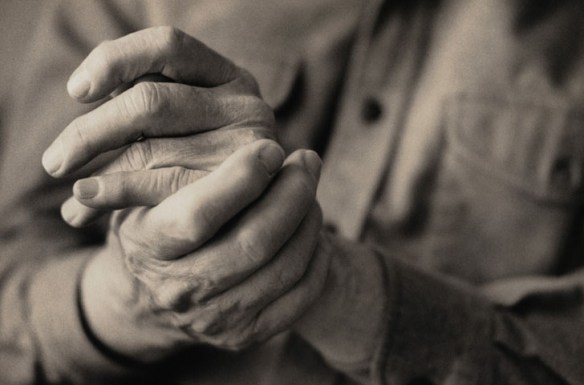
You know how those singular “moments” can sneak up and just surprise the heck out of you? Well, this was one of those for me. The cream, made with glycerin and an eclectic combination of flowers and herbs, was warm and soothing on my achy hands. As I rubbed it in, massaging them gently, it sank into my skin, so it felt silky and soft, but not greasy at all. For a brief time, the world slowed down as I took care of my hurts and the scent of the hand cream rose into my nostrils. Honey. It smelled like honey. It smelled like warm baklava tastes.

Well, that was it. I bought a tube of the stuff. I’ve rubbed it into my hands three times since yesterday, and each time it felt heavenly, though the sweet scent is a bit more overpowering here at home than it seemed in the shop. That’s all right, though. It beats the scent of Deep Heating Rub!

My hands are swollen and painful again today. I haven’t gone to the gym since last Friday. I can’t face using them to push and pull and brace myself on the exercise machines, though I have done some walking. But man, I’m just feeling flattened – I guess from not sleeping well and from the continuous, unrelenting pain, which is making me worry. I also feel guilty for letting the rheuma get me down and keep me from doing things I know I should do. This is not good.

The new meds my rheumatologist prescribed for pain and insomnia haven’t arrived in my mailbox yet. I hardly dare hope they’ll be there today when I check, but I do have a little more hope for tomorrow. And I’m hoping, too, that this awful, low-level but unrelenting flare will ease off soon. Some days I just don’t have the wherewithal to stay upbeat, hard as I try.

Yeah, I know. Stiff upper lip and all that. Nothing that a good night’s sleep won’t help! (That’s an absolutely truism, that one.) Well, I’m working on it, OK? But for the moment, I’m going to rub honey-glycerin cream into my hands and wallow. I’m sure I’ll feel better tomorrow.

Always do.

I heart my rheumatologist

I finally had my appointment with my rheumatologist on Saturday.

I get all of my medical care through the VA. I lost my private medical insurance when I was laid off from my job as a newspaper editor a couple of years ago. I’m an Air Force veteran, so once I was poor enough to meet theRA requirements, I was eligible for VA medical care.

Thank goodness.

 At first I was a bit apprehensive about the VA — we’ve all heard the awful stories — but I was even more apprehensive about being without any sort of medical insurance. As luck would have it, it wasn’t long after I lost my job that the rheuma came back, announcing its arrival by making my hands twinge and ache.

I told my new VA primary care doc about my old RA diagnosis and how it had been in remission for years, but was now showing up again, like attic rats you thought you’d gotten rid of for good. Although my medical records from the mid-to-late 80s, compiled by the U.S. Army medical facility I went to while I was in Germany, were long gone, she ordered up a blood test and referred me to rheumatology without a hitch. I was most grateful.

Dr. McA, my rheumatologist, has been wonderful. My blood tests came back showing the Rh factor and a high sed rate, both of which backed up my claim of RA. Although during that first appointment I wasn’t experiencing any pain at all, when Dr. McA examined my hands and said he could see they were inflamed.

“They are?” I was fuddled.

He nodded. “They are. Look at the spaces between your knuckles. They’re puffy. And they’re warmer than the other parts of your hand.”

Wow. They were. I promptly fell in love with my doc.

Dr. McA listens. He explains what he’s doing and why, in words I can understand, but he respects me and doesn’t patronize. He talks to me as an adult. This doctor taught me more about RA during that first visit than I’d learned on my own in the whole first 10 years I had the disease — and  believe me, I’d tried to learn all I could.

He always asks how I’m feeling. He reads my charts from the last time I saw him and asks specific questions relating to how I am compared to then. He discusses the results of the blood test I always have done a few weeks before my appointment, explaining what they mean and answering any questions I have.  

The VA has computerized all of its patients’ medical records, so Dr. McA can see all my other charts and prescriptions from the other doctors who are participating in my health care. The most recent appointment I’d had was with a VA endocrinologist. His report detailed the actions he’s taking to bring my very, very low Vit. D level back up to normal. Dr. McA asked me about the appointment, then pointed out that, according to his computer, I’m scheduled for a bone density scan on Dec. 2.

Wow. So soon. I hadn’t even been told yet.

Several weeks before my appointment on Saturday I started a list of questions I didn’t want to risk forgetting. This is the first time I’ve counted down the weeks, days and even hours before my time with Dr. McA; but then it’s also the first time in many years that I’ve had to battle constant, aggravating and disheartening pain.  I was a bit bemused over how many questions I thought of — probably none of which I would have remembered if I hadn’t written them down. 

The end result of my visit with Dr. McA? The RA is active and severe, and it’s obviously ramping up. So it’s time to armor up. I wondered about perhaps trying some different RA meds, but he feels the Arava is working, and since I’m tolerating it and the sulfasalizine so well, there’s no reason to change. Instead, he told me to start taking the full dose of Arava, rather than the half-dose each day I’d been taking up to now. He wants to give it a few months, and see if it helps. But in the meantime, he’s also putting me on Voltarin, a NSAID, as needed to fight inflammation and pain. And because my hands are keeping me awake so much at night, he’s prescribed Elavil in a minimal dose. He says it should help me sleep and, as a possible bonus, act as an additional pain reliever that can work in concert with the tramadol and Voltarin.

He’s also referring me to physical therapy, which pleases me greatly. I want to learn specific exercises that can help me keep the joints in my hands and wrists strong. Other joints too, but right now, my hands are my top concern.

And finally, when I mentioned that I’ve noticed more blurry vision lately, he referred me to the VA opthalmologist for another eye exam. It seems like my eyes have gotten a lot worse over the last couple of years; the blurriness corresponds to the behavior of the RA. So having them checked helps to put my mind at ease.

When I first met him, I asked Dr. McA why he’d gone into rheumatology as a specialty. He told me that while he doesn’t have RA, he has two brothers and two sisters who do. He knows the pain and disability of the disease intimately, and it was because of them that he became a doctor, then specialised in internal medicine and rheumatology. He wants, he told me, to do all he can to slow the progression of the disease in his patients. He wants to do all he can to keep us as comfortable as possible. He wants to help us preserve our independence and mobility.  And most of all, he hopes to be around when medical science finds a cure. That, he said, would be the greatest day of his life.

During my visit on Saturday he mentioned having visited Ghana in the past. I asked if he had relatives there. He laughed and said no, not directly, but that he works with Doctors Without Borders, bringing his expertise in rheumatology to the people of West Africa. That touched my heart.

So. I’m good for another three months. And you know? THIS is “socialized” health care. Sure, it’s not perfect, and there have been a few SNAFUS here and there since I started getting my care from the VA. Nor is it free — I pay an affordable co-pay for all my meds and if they asked me to, I’d try to pay even more. As much as I could afford.  The VA medical system is a vast, government-run bureaucracy — the very idea scares the bejesus out of a lot of Americans — but it’s also providing me with the best health care I’ve ever had in my life.

If this is what health care insurance reform will look like, I’m all for it.