Be careful what you ask for…

… because you may get it.

In the last post, regarding the snowfall that was imminent, I wrote “Bring it on” with blythe chutzpa. Heh:

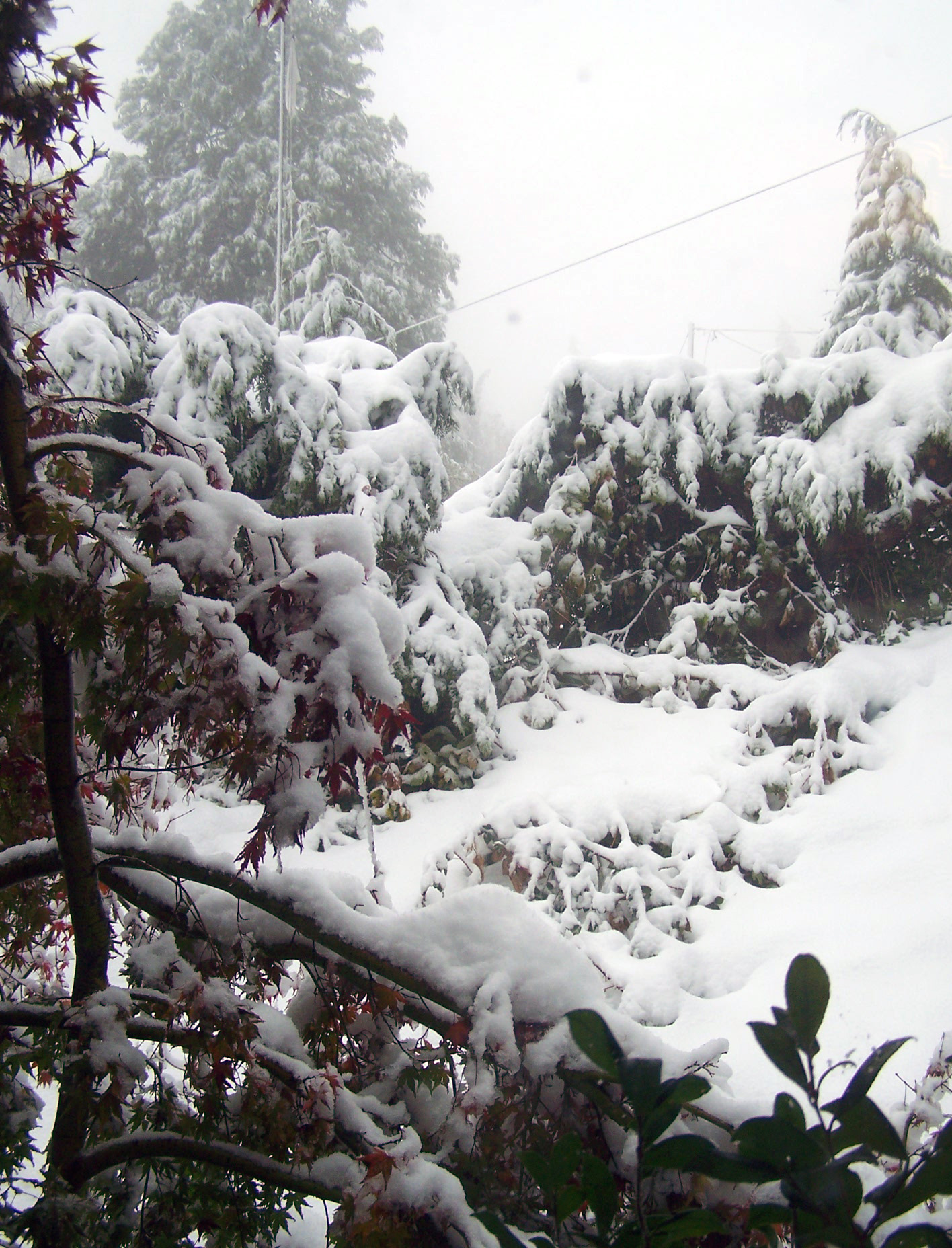
A VIEW THROUGH the Japanese maple leaves just outside my kitchen window to the embankment, hedgerow and tall evergreens beyond after the first snowfall of the season.

ALTHOUGH I EXPECTED the snow, by the time it started it was dark and enough had built up on the driveway that I didn't feel like moving my car up to the street. "I don't have anywhere I need to go," I reasoned, backing myself up by remembering how long it takes the county to actually make it out to our little neighborhood in the wilds to plow. Even with the cars up on the street, I wouldn't be going anywhere for a while.

As I write this, approximately five inches of snow has fallen. And it’s falling still, a misty, sand-like snow topping the layers of heavier stuff from the night. Forecast is for more today and tomorrow. I’m planning a rich, hot lamb stew for supper tonight, thick with carrots, corn, green beans and potatoes. And for dessert? An apple crumble, warm from the oven.

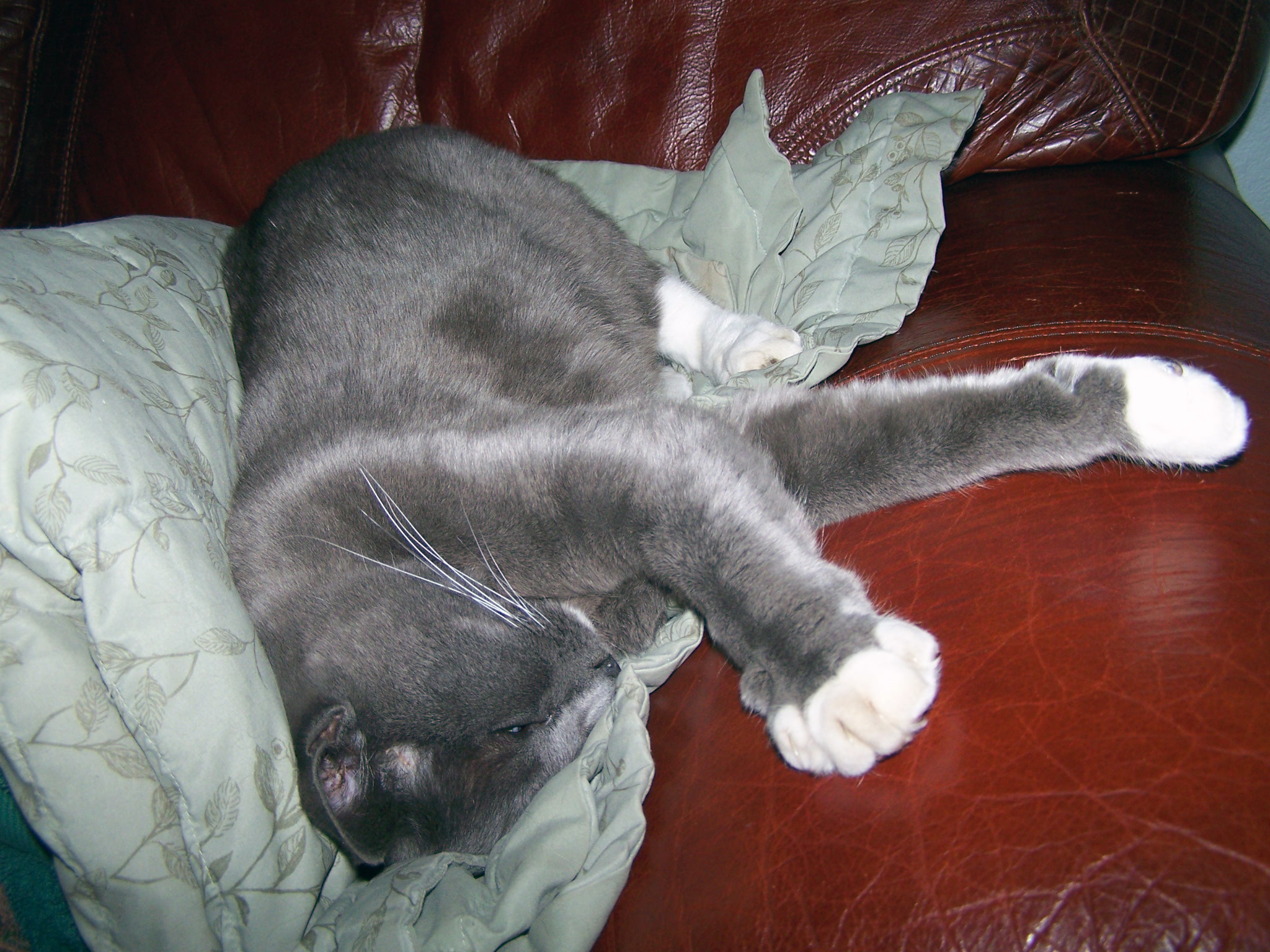
FINNY McCOOL and PIB (Puss in Boots) take their job of keeping my legs warm seriously.


UPDATE: More snow. And comfort:

Mr. Stubbs is now an indoor cat. He seems to like it.

First snow

It’s snowing!

Sure, it’s not sticking to the ground yet, (it’s about 40 degrees out there) but soft, fat snowflakes are falling from the autumn night sky, building up on branches and leaves, roofs and fenceposts. Finny McCool is snugged between my calves, radiating heat beneath the thick comforter that covers both of us, and PIB is purring, tucked meatloaf-style into my side. The woodstove is crackling and glowing. I’m warm. Outside, it’s snowing.

If you’ve read Rheumablog for very long, you already know I’m a sucker for snow. I look forward to the first snowfall of each season and then to all the rest that come as autumn becomes winter and winter becomes early spring. I love the clean whiteness of new snow. I love the way it transforms the outside world into an intricately simple contrast of light and dark, and how it makes me grateful that I can be cozy and indoors. I love the soft quiet of snow, and how if it snows long enough to form an inches-thick blanket, it silences the continuous roar of traffic on the freeway a quarter-mile down the mountain from my house. When snow makes the world silent, it brings a curious peace to my heart. This, I think, is how the mountains are supposed to sound in winter. This is how they sounded a hundred years ago; five hundred years ago; five thousand years ago.

Last summer, Mr. Wren found cross-country skis for both of us through Freecycle. All we need are the proper footwear and warm outerwear to go with them, and we can ski this winter. I love cross-country skiing. I haven’t done it since I was in Germany, when I skied the Harz Mountains, but I feel confident that I can do it again if I start out slow and easy and build up strength over time. It’s a good motivation to take wee Finny out walking again and re-strengthen the muscles in my legs and hips. Bursitis and rheumatoid arthritis be damned. I skied in spite of severe, active rheuma-flares in Germany. I’m older now, and less fit than I was then, but I know I can do it again. Will I hurt afterward? Probably, but it will be worth it.

It’s inevitable that there will be times that I’ll get tired of snow before the winter ends. Usually, it happens when I’m forced to drive somewhere on snowy, slick, icy roads, or when I have to shovel a half ton of the stuff just to get to the woodpile. I only grumble a little, though. I like snow.

This is a La Nina winter, which usually means it will be a long, wet one. Last time we had a La Nina, we had a lot of snow, and it brought us snowstorms from November to May. It was unreal. Will it be that way this time? I don’t know, but I say “bring it on.”

Sharing the pain

Wow. It’s Friday already and it’s been … um… a while since I last posted. Have I been too Seriously Busy? Not really. I’ve been spending my days and nights with my Mom, who’s still recovering from pulling a muscle in her low back last month. Well, actually, she was almost recovered about two weeks ago, but then her new, young, recently-adopted-indoor-cat, Kitty-Kitty, slipped out the front door one morning, and Mom went haring after her, terrified that her little friend would run off, get lost and get hit by a car. She caught Kitty without much effort, but lost her footing in the process. Down she went, Kitty-Kitty clutched to her heart.

The cat was fine. Mom, not so much.

We took another trip to the doc’s. While Mom’s in fabulous health for her age, she isn’t the spring chicken she once was. She has osteoporosis and the muscle pain tires her out. So, the doc was a little worried. He had her walk up and down the hall for him, and told her she looked like she was walking in a side-wind. He gave her a thorough exam, asking her to move this way and that, noting when she winced. His concern earned her an extended session with an x-ray machine, a prescription for Darvocet and a month-long round of physical therapy.

Fortunately, the x-rays showed no damage to bones or discs, but she absolutely pulled and really aggravated that nearly healed muscle all over again.

And so I packed my bags for another extended visit. I kept an eye on her when she was taking the painkiller (it can make elders, in particular, a bit wobbly on their pins), heated a rice pack in the microwave for her to keep snugged against the sore spot, cooked meals and wheedled her into eating them (just like she did me, a lifetime ago), did a little housework and generally kept her company. We even went out to eat a few times—one of them being her 79th birthday, a yummy dinner out with the rest of the family. She didn’t eat much that night because she was hurting so much. Did she say so? No. She only told me later.

So once again, it was nice to spend that time with Mom, giving back a little of the love and care she’s given me all my life. We exchanged mothering, this time, because I’m still gimpy myself, see. The cortisone injections just didn’t work, so my bursitis remains a daily, nightly aggravation. I walk like the Tin Man after a good rain. It’s amazing he was such a pleasant fellow. I’m still holding out some vague hope that they will work, eventually, but I have to be honest. I don’t really think they will anymore.

So it was nice to loll around a little with my Mom, awash in the kind of warm, concerned compassion that only a mother can give. If my late Dad had come through the door in the evenings with a coloring book and crayons for me and a big hug and kiss for her, it would have been perfect.

We both miss him.

Here’s the thing, though. While I was there we talked a lot, more and more deeply than we have in a very long time. We talked about everything. We reminisced. We told old stories and new ones. We laughed. We agreed to disagree about politics and the way our country is headed. We marveled over the antics and terminal cuteness of Kitty-Kitty, who lost her tail to a car and now has a tiny stump she wiggles when she’s watching the squirrels out the window. We talked about her pulled muscle and her frustration with it.

And we talked about my rheumatoid arthritis and the bursitis it’s causing. I realized as the days passed that although Mom knows have RA, she didn’t really know much about the disease or about how it affects me at times. I was an adult living in Germany when I was diagnosed, a long, long way from home. By the time I returned to the States, and later, to California, the disease was starting to go into remission. Mom has seen me go hiking, fishing and camping while limping along gamely. She’s seen me keep working and living as normally as possible while fighting flares, and she knew that my RA had gone into remission and, after a long absence, return. But she’d never seen me cry as I tried to walk, or attempt to pick something up with fingers rendered useless, or sit, rocking, on the sofa, lost inside myself while I waited in clenched silence for the awful pain to ease.

She still hasn’t seen that. I hope she never does. But because we had time to sit and talk, just let the conversation take us where it would, she knows now how RA has been for me. She knows how I’m struggling to cope with and accept this latest challenge, this bursitis. She’s informed.

Being able to just talk about it without trying to hide the details or act like I’m tougher than I am was cathartic. I write all the time about my RA here, but (like most of us, I suspect) I don’t mention it much at home or while I’m out and about. I just do my best to live and do like everyone else. RA is always the elephant in the room, studiously avoided but impossible to ignore.

And yet communicating to others our limitations, our pain and our fears is one of our deepest human needs. Why is it so bloody hard to do?

“[There is] no general theory about pain. Each patient discovers his own, and the nature of the pain varies like a singer’s voice, according to the acoustics of the hall.”

–Alphonse Daudet, 19th Century novelist and patient in his memoir, “In the Land of Pain”.

“Communicate” comes from the Latin “communicare,” to share. Share. This last week, for the first time in longer than I can remember, I had an opportunity to really share, face-to-face with someone I love, what it’s like to be me with RA. I shared my limitations, my pain and my fears with my mother. I also shared my hope for relief from the pain and disability, what I know about the medicines and treatments for the disease, how RA makes the body attack itself and cause all the troubles it does, and finally my dream that one day, medical science will find a cure and send it packing into history like polio and smallpox.

When I left this morning, we gave each other a big, tight, long, warm-to-the-heart hug. Mom is still having pain, but it’s less intense than it was. She’s gotten used to the Darvocet and isn’t wobbling from it. And she goes for her first PT session tomorrow morning. I wanted to go with her, but she said, “I can do it myself, sweety. Don’t worry so much.” Finally, my dear aunt is coming to stay with her on Sunday and Monday. Momwon’t be alone for too long.

I didn’t want to leave, but the weatherheads say our first snow of the season is coming this weekend—maybe by tonight—and it’s supposed to be a real doozy. We could get as much as 10 inches. So I had to come home to batten down the hatches. I had to make sure the fridge was stocked with food and the wood-ring next to the wood-stove was full. I needed to blow the danged leaves off our very steep driveway in preparation for taking the cars up to the street once the snow starts falling. (they’re slick as oil when they’re wet.) I needed to see the rest of my family, too: Mr. Wren, Cary and Matt, Finny McCool and Shadow, cats PIB and Stubbs, Goblin and Sister.

So I’m home. My hips still ache like hell, damn them. But I’m feeling very peaceful inside.

Thanks, Mom.

Bursitis update

I’m not sure what to say about how my hip bursitis injections went.

I had the shots on Saturday, but there was no change in my pain levels until Tuesday afternoon, when I suddenly noticed that my hips weren’t aching any more.  Wonderful! I slept that night through, only getting up once to use the bathroom instead of waking again and again to turn over in bed and ease my aching hips.

Wednesday was pain-free. So was Wednesday night. Really, I was delighted. I’ve had rheumatoid arthritis for a very long time; there’s never been any medication that simply stopped the pain. Bursitis, it seems, is a different beast. These injections might have taken a few days to kick in, but they did work.

Except yesterday afternoon my hips started aching again. By bedtime, I was in more pain than I’d been before the steroid injections. I was truly bummed.

And yet…  when I laid down to sleep, the aching eased. Whoa. I slept the night through, this time not even getting up for the bathroom. And when I woke this morning, my hips didn’t hurt.

So, I’m much better rested right now than I’ve been in a long while. I really appreciate the rack-time. And I surely appreciate the interrupted pain. But now—afternoon again—my hips ache, once again worse than they were pre-injection. Will they ache tonight? Will the pain interrupt my sleep? I don’t know, but I hope not.

Lots of you have had these shots in the past. Did their effects come and go, like they seem to be doing for me? I’m just curious. While I’m disappointed, I can deal with it if the steroids didn’t work on me. I’ve got my head together; I’m ready to accept it.

Still, I do wonder what comes next.

Veterans Day

It’s Veterans Day.

Here at the Wren’s Nest, this day represents more than a sale at TJMaxx. Mr. Wren and I are both veterans; he served in the U.S. Army, I in the U.S. Air Force. Both of us were fortunate that during the years we served, there were no active “hot” wars – only the long, ominous Cold War that began its end in 1989 with the fall of the Berlin Wall and finished, finally, with the collapse of the Soviet Union in 1991.

I’m proud of my military service. But to my mind, the real veterans are the Americans who’ve served in wartime, the ones who literally put their lives on the line to protect their country. I know many of them and met and worked with many more. Some of them were drafted, others were volunteers, like the men and women serving our country today in Afghanistan and Iraq, South Korea and Europe. Some saw battle, but many served in the “rear,” supporting the fighting troops. They were vital, each and every one of them.

One of the things I loved about the military was its diversity. People from all walks of life form the Army, the Air Force, the Marines, the Navy, the National Guard and the Coast Guard. Black and white, Asian, American Indian, Hispanic – the military is a compressed American melting pot working and living closely together, all over the world.

If you’re a bigot, you’ll find yourself at a loss on an Army post. Nowhere is it more crystal clear that people are people, no matter their gender, the color of their skin, their economic status or where they’re from. They have a job to do, a common cause, and they do it together. Their hearts all look the same.

For this white woman who grew up in a mostly white, California suburb – my high school class had one, single black student in it – the Air Force was an eye-opener. One of my favorite memories comes from when I was in training in Texas as an intelligence analyst. The tech sergeant in charge of a work detail I was assigned to one day asked me a question . I couldn’t understand what he was saying. He repeated himself, twice, and I still didn’t get it. Finally, he said, “Airman, where’r you from?” in a drawl that was as slow as cool honey.

I blinked. “California.”

“The laaaand of the frooooots an’ the nuts,” he grinned, as if that explained everything. “I’m from Miss’ssippee,” he said, relenting. “I’ll help y’out. Read mah lips …” It was the first time I’d ever heard that phrase used – and it was long before Bush 41 used it regarding taxes. Because the sergeant being very patient and speaking even more slowly than usual, I understood him this time, and before he was done giving me his instructions – where to go dig rocks out of a corner where grass seed would be planted — we were both laughing. He hadn’t insulted me, only teased, and it served to close the wide gap between our disparate cultures. I later learned that this man had served in Vietnam, a draftee, and when he’d come home, he decided to stay in the Air Force and make it a career.

Over the years I became very good at sussing out accents, drawls and colloquialisms. After I was discharged, and later went to Germany to work for the U.S. Army as a civilian, everyone sounded pretty much the same to me. My country, and the world, had become a much smaller place – a village.

I’m blathering on, here, so I’ll get to my point. Today is the one day of the year that America pauses to thank its veterans, our friends and neighbors who took an oath to protect our country in times of war and serve as guardians during times of peace. While there are as many reasons they signed up as there are colors, genders and cultures within the armed forces, all of them share a deep love for America – so deep, they were prepared to die for it. Many of them have seen war first hand, seen friends and comrades maimed or killed and have lived under dreadfully difficult conditions so foreign to American civilian life they might have been on another planet.

Many are still serving, all over the world. And there are thousands of soldiers, sailors, airmen and marines, right now, who are serving their country as volunteers – our future veterans.

All of them deserve our deep respect and our thanks.

Tough little bird

Well, it’s done.

Yesterday at noon my rheumatologist injected steroids into both my hip bursae, one for each side. To my relief, it wasn’t nearly as bad as I feared, though his pushing and pressing on the area beforehand, and the pre-injections of lidocaine hurt like a you-know-what. Ow, ow, ow! But once the anesthesia kicked in, I felt no more than a slight sting and a little pressure as he injected the steroids.

Whew.

I wish I could say that my hips are much better today, but so far, they’re not. Last night I tossed around as usual, watching the hour hand of my clock make it’s slow circuit through the night. Today, as I sit here writing, they still ache.

But I’m not giving up yet. The doc warned that it could take a few days before the steroids worked, and that it was possible I’d have even more pain before they do. So the jury’s out. I’m hoping for the best.

My rheumatologist said something interesting as he treated me. “’Arthritis’ is a misnomer for this disease,’” he said conversationally. “It’s Greek—‘arthro’ means joint, and ‘itis’ means  inflammation. Rheumatoid arthritis certainly includes joint inflammation, but it’s far more systemic. Your bursae are terribly inflamed because of your rheumatoid arthritis. It affects not only the joints, but the bursae, the tendons and ligaments, and the cartilage.”

I was a little surprised. You’d think by now I’d know just about all there is to know about RA, but I hadn’t really grokked that it affected all those things. Denial is strong even as we try to accept.

He went on. “And you know it also affects other parts of the body, as well. The heart, the vascular system, even the eyes.”

I told him I knew that part.

“For that reason, I think it’s misnamed. RA should really be called ‘rheumatic disease.’ It shouldn’t be confused with other forms of arthritis. They just aren’t the same thing.”

It was nice to hear him say this, and I told him so. I also told him it was nice to have a doctor who didn’t question my pain or try to tell me that I was imagining it. I thanked him for that.

He chuckled. “Look. If you’re in here asking me for steroid injections, your pain is real,” he said. “These are not pleasant. And not only that, but you’ve waited quite a while to ask for them—you first told me about your hip pain 18 months ago.”

“When it first started, it seemed mild,” I said. “I felt sort of embarrassed complaining about it, considering how bad the RA can hurt. This didn’t compare at the time. Now, it hurts a lot more. I broke down.”

“You are incredibly tough,” he said. “I’m often amazed at just how tough my RA patients are. They endure pain that most people can’t even imagine.”

Twenty minutes later I was on my way to have lunch out with my Mom and my aunt. I was smiling. My rheumatologist made me feel good about myself. He taught me something new and gave me confidence in my own perceptions. While the steroid shots may or may not work (I think they will), I feel better today even if my hips don’t, quite yet.

I’m tough.

The mad professor of pumpkin

One more day. One more night.

That’s until I can see my rheumatologist tomorrow and get steroid injections for the bursitis in my hips. The pain has gotten worse each day. I sure hope they work.

In other news, Mr. Wren has discovered the myriad joys of cooked pumpkin. He bought two very large pumpkins just before Hallowe’en, intending to carve scary faces in them for the trick-or-treaters. Well, he didn’t get around to it, and no kids dropped by to frighten us into parting with handfuls of candy, anyway. So there we were with two gigantic pumpkins. And all that candy…

He got online and started looking up recipes. I have to admit I’ve never had pumpkin in anything but pumpkin pie. I’m just fond enough of it to eat a slice at Thanksgiving, and if it’s served, at Christmas. I forget all about it the rest of the year. I’m just not big on pumpkin pie, or any pie, to be honest.

Well, OK. Maybe blackberry pie with vanilla bean ice cream. But I haven’t had any of that in more years than I can remember.

Anyhow, two humongous pumpkins. I’ve never had it as a main course or a side dish before, but I’m game. So Mr. Wren got the turkey roaster out, cleaned out one of the pumpkins, cut it in half, and roasted it a half at a time because it was so big. Both halves wouldn’t fit in the oven at the same time. He pan-roasted the seeds later, and the other pumpkin is currently doing duty as an autumn decoration on the hearth. Since it’s roughly the size of a beach ball, you can’t miss it.

The roasted pumpkin yielded about 20 cups of pumpkin flesh, which Mr. Wren pureed in his trusty, heavy-duty VitaMix blender (it sounds like a jet engine when he turns it on, so I retired to my den and put soothing music on to drown it out while the pureeing commenced). Two cups of the pumpkin went into a recipe called “Baked Pumpkin,” which turned out to be a sort of pumpkin custard. It tasted like pumpkin pie without a crust.

Then he went out and bought two frozen pie crusts. Four more cups of pumpkin was used to make … two pumpkin pies, sweetened with honey rather than sugar. I had a slice this morning for breakfast. It’s good. Tastes like pumpkin pie. It’ll do me until next fall.

We still have fourteen cups of pureed pumpkin, which we put in 2-cup bags in the freezer. We’ll probably use some of them in pumpkin bread. And pumpkin cake. Maybe pumpkin cookies. Pumpkin pops? Hmmm.

Upon further investigation, Mr. Wren discovered that recipes for non-desert pumpkin mostly call for the flesh to be cubed. So before we can try any of those, he’ll need to roast the other pumpkin and cube it. In the meantime, maybe we can use some of the pureed stuff for pumpkin soup.

Mr. Wren is a very large fellow. He has no concept of “small” or “moderate.” He doesn’t cook very often, but once he gets his mind set on it, he cooks enough for a battalion.  And, while he used recipes this time, he usually refuses to follow recipes when he cooks. Did I mention he doesn’t know how to cook? We generally end up with humongous quantities of … something… that we all gamely eat a little of (including him) and then, in desperation, freeze the rest in several gallon bags for “another time.” At this moment, I have many big frozen pillows of Mr. Wren’s cooking experiments in my freezer that have been there for … years. I don’t really know what’s in them anymore. I’m afraid to thaw them out.

I made him put the puree in smaller, more usable bags and write “pureed pumpkin” with the date on them, this time. We’ll use them, somehow. And I expect that we’ll use the huge quantities of cubed pumpkin to come, too, after a while.

I may turn into a pumpkin. I sure hope I like it.

“I need my rheumatologist.”

Congress enters its lame-duck session in two weeks. One of the issues our congresscritters (congressmen and senators) vitally need to address before the end of the year  is the Sustainable Growth Rate legislation, which determines at what rate physicians are reimbursed for treating Medicare patients.

If Congress doesn’t act to fix this legislation, on January 1st, 2011, Medicare reimbursement to all physicians will drop by 30 percent.

Such a drastic cut in payments will force many doctors to drop Medicare patients entirely. It could even force some doctors to close their practices. For those of us with rheumatoid arthritis, fibromyalgia, lupus, ankylosing spondylitis and other chronic connective tissue syndromes and diseases, this could mean the difference between being able to see the specialist with the best understanding of our conditions–a rheumatologist–or not.

For more information about this very important issue, click here.

Please call your congresscritters* on Nov. 10 and tell them not to let Medicare payments get cut by 30 percent. This matters whether you get your care through Medicare or not; many, many elderly patients on fixed incomes depend solely on Medicare for their treatment, and many of them suffer with RA, lupus, etc. We all grow old. Please help.

*To quickly and easily reach out to lawmakers, dial the AMA Grassroots Hotline at (800) 833-6354. Be sure to begin the conversation with, “I need my rheumatologist (or, “my loved one needs his/her rheumatologist”).” Please fix the SGR before November 30 to ensure access to my doctor.” For more information about the SGR and its impact on rheumatology, visit www.rheumatology.org or call (404) 633-3777.

Yes, I can

Argh. Another achy day. Hips, wrists, knuckles. None of it bad enough to justify any prolonged whining, but all of it bad enough to aggravate me and make me grumpy.

Because, let’s face it, it’s tiresome to hurt all the time. It’s boring. Pain—even the kind that hovers around the middle of the pain scale—affects everything in subtle ways. It doesn’t always stop me from doing the things I need or want to do. I can empty the dishwasher. I can chunk firewood into the stove. I can handle wet laundry and prepare a meal.

I just can’t do them without gritting my teeth or, in an unguarded moment, wincing.

It’s the sudden attacks that get me. Like when I’m picking up the heavy cutting board to wash it off, and the rheuma dragon viciously stabs the back of my left hand, making me nearly drop the thing on my foot. Or the way he randomly makes my fingers slow and clumsy as I reach down to clip the leash onto wee Fin’s collar.

Now, these are little things. They’re nothing like the pain I used to endure. That pain was huge and overwhelming. It forced me to limp, and sometimes, not to walk at all. Getting dressed was, well, a pain. Fixing my hair and putting on makeup before work was a mini-marathon and I hadn’t even left home yet, the long day of endurance stretching out before me. Driving my car, which had a manual transmission, required inner-strength and tenacity that, when I think back about it, amazes me.

Today I cuss quietly because I’m a little scared when I need to take Shadow out for a constitutional. He’s very big and very young, and while he’s good for me on the leash and restrains himself and walks slowly with me rather than leaping into a wild, energetic  gallop (sweet dog!), he still pulls hard enough to hurt. A few weeks ago, in a forgetful moment, he twisted and yanked—and my middle left finger got caught up in the leash. The joint at my fingertip bruised and hurt for days afterward. I was afraid I’d broken it, but it’s OK now.

Having rheuma means that I must do everything with care. That gets boring, too. And if I forget? Ouch.

There was a time, in the longago, that I was unwilling to believe that I would have RA for the rest of my life. I got lucky, too, and for a good long stretch the dragon hibernated. I lived for many years almost pain-free, like a normal person. But he woke up transmogrified into a different beast, one that was subtler, sneakier. My cane lives in the trunk of my car. I don’t use it—but I know where it is. I don’t have crutches in the closet anymore. I don’t make ED docs roll their eyes.

Today my defenses are smaller, but they’re no less intrusive. Supportive compression gloves that keep my hands warm (and hopefully, flexible). A paraffin bath, always switched on, ready for the moment I hope to soothe the aches. Tramadol rather than Vicodin, and a handful of other pills that I take religiously, praying to the disability gods for mercy as I swallow them and try to have faith.

And I tell myself, every day, to be mindful and grateful for the gift of less pain.

We are amazingly resilient, us human beings. We keep on keeping on even in the worst of circumstances. Mine are not “worst” right now. It’s good to remind myself of that on days like today, when all the small aches and sharp twinges make me feel worn down before the day has even got a proper start. Today I want to do some work outside, to get a start on the annual autumn raking and sweeping, pruning and neatening. The weather is perfect—cool and sunny—and the colors … oh, the colors. So I’ll get out there now. And as I do, I’ll remember to be grateful that I can.

Glass flakes in injectable MTX; drug recalled

Oct. 28, 2010 — Glass flakes have led to the recall of Sandoz and Parenta brand injectable methotrexate, a drug used to treat rheumatoid arthritis, cancer, and psoriasis.

The glass flakes “are the result of delamination of the glass used to manufacture the vials” of two dosages of the drug, the FDA says in a news release.

“There is the potential to develop adverse reactions in areas where the particles lodge,” the FDA says. “Injection of drug from the affected lots could lead to serious adverse events, resulting in disability and death. Additionally, neurologic damage could result from intrathecal [spinal] administration.”

For more information, click HERE.