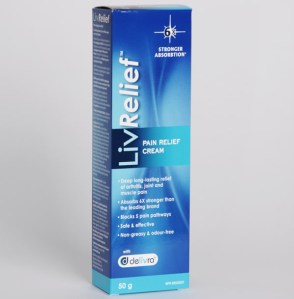
Review: LivRelief cream

LivCorp Inc’s Delivra, the company that makes LivRelief homeopathic pain relief cream, claims that its product relieves arthritis pain by delivering the active ingredient, a topical analgesic called Ruta 3X through a new process also called Delivra ™.

I’ll be upfront, here: I’ve always been seriously skeptical about homeopathic remedies. But I agreed to try LivRelief cream and review it because, well, as someone who’s lived with rheumatoid arthritis for close to a quarter century, I still dream of finding something—anything—thalivpainrelieft might relieve the pain this intractable autoimmune disease causes. Maybe, I thought, just maybe, LivRelief cream will be the one.

Since it came in the mail, I’ve used LivRelief cream several times on mild-to-moderately painful RA-inflamed joints in my hands, fingers and wrists. I’ve also used it at the base of my small toes on my left foot and on my right knee. Finally, I’ve tried the cream on both my hips. They ache frequently—and almost constantly—from RA’s co-morbid condition, trochanteric bursitis, and I figured why not?

That first time, I tried it on my hands and wrists. Within 10 minutes of using the recommended amount of cream—two short squirts from the pump-bottle—the sharp, twingy pain I was experiencing eased up. A couple of minutes later it was completely gone. As a nice bonus, the cream made my skin feel well-moisturized and silky-soft.

Whoa, thought I. This stuff works!

I was delighted—and genuinely surprised. I’ve tried and tossed out so many topical pain relievers over the years. Most of them had either capsicum (cayenne pepper) or menthol as the active ingredients in them. The menthol ones were pleasant but had no “relieving” effect on my pain. The ones with capsicum added the intense sensation of scorching, blistering skin to the already aching joints that lay just beneath it. I always ended up washing it off. Frantically.

So, discovering that LivRelief cream worked was wonderful.

Unfortunately, it only worked that one time. When I tried it again on my hands the next day, nothing but softened skin happened. LivRelief also had no effect on the small joints at the base of my toes, or on my knees. Finally, it did nothing for the bursitis pain in my hips.

Well, except for softening and moisturizing my skin.

Why did it seem to work that first time? I really don’t know. Maybe the pain in my hands would have gone away shortly, anyway. Rheuma is weird—the pain almost always comes and goes suddenly and without reason or warning. One time the flare will last three minutes, the next time, three-quarters of a day. Or maybe the gentle massage I gave my joints as I was rubbing the cream into my skin helped to relieve the pain.

Here’s what I know: the cream worked miraculously well once, but my wily old rheuma-dragon figured out how to overcome and disable the beneficial effect after that, no matter which joint or part of my body I used it on.

BobbyOrrSo, do I recommend that you try LivRelief cream on your achy, painful RA joints? The legendary hockey star Bobby Orr certainly does, stating on the website PRWeb that “LivRelief has improved my quality of life … I would recommend it to anyone suffering with pain.”

You can purchase the cream online in its 2 oz. pump bottle through Amazon for $27.86 or GNC for $29.99.

Cookware that’s made for rheuma hands

I’ve got a product review for you today: the Tremontina All Generations line of cookware. The company asked me to give their 10-inch Teflon©  Platinum Nonstick Sauté Pan a try, then write a review for RheumaBlog. The idea was to

THE TRAMONTINA All Generations 10-inch Porcelain Enamel Nonstick Saute Pan has earned the Arthritis Foundation's Ease-of-Use Commendation.

THE TRAMONTINA All Generations 10-inch Porcelain Enamel Nonstick Saute Pan has earned the Arthritis Foundation’s Ease-of-Use Commendation.

point out the pan’s pluses for people with diseases that attack the joints, making them stiff and painful. “Why not?” I thought.

When the pan arrived in the mail, I was impressed by its weight–and a bit worried. One of the biggest challenges I face when I cook is lifting hot, heavy pots and pans. I fear that the rheuma will make my grip suddenly dicey; I do not want to drop pans full of boiling or searing food.

I know I’m not alone in this.

But I do love to cook, and heavier, high quality cookware tends to stand up to frequent use and can last for years, even decades. A pan with a correctly made, heavy bottom conducts and distributes heat better, which allows the food to cook more evenly. This is a good thing, you know? It saves time. It means less stirring and less gripping of utensils in sore, twingy hands. And you don’t end up with some parts of the dish overcooked and some undercooked.

Still, maneuvering a heavy pan with arthritis-wracked hands can be truly daunting. But Tremontina planned for that. Instead of just the traditional, single long handle on the sauté pan, they’ve added a second, smaller one directly opposite the long one. I found that I could lift the full pan easily with both hands, dividing the weight evenly. It balances perfectly, regardless of the amount of food inside.

That is a big deal.

Here’s another really nice thing about the Tremontina sauté pan: it’s that smooth, Teflon© Platinum nonstick coating. You don’t really need any butter or oil to keep food from sticking to this pan, but if you do want to use some for flavor, a dab will do quite nicely. Watching your weight? This pan will make it a little easier.

And clean-up is simple. Just tip the pan and whatever remains inside will slide out smooth as a belly-down penguin on an ice-flow. Scrambled eggs, sautéed onions, reduction sauces and gravies–all come off the pan in a jiffy, without scrubbing, even if the food was accidentally overcooked and you expect it to be a real chore to clean the pan. I really appreciate this perc. Scrubbing can be downright painful.

You do need to season the pan before you use it the first time, but it’s a simple process that takes all of a minute. You should use wooden, plastic or silicone utensils to avoid scratching the non-stick surface. And to avoid damaging the pan, you must always cook on medium heat. No biggie, though: the pan conducts heat so quickly and evenly there’s no need to turn the burner up any higher.

The handles have comfy, ergonomic,  silicone-covered grips. You don’t need a pot-holder in each hand to avoid burning yourself. And the lid is made of clear tempered glass so you can see the food as it cooks. It also has a silicone-covered handle.

I’m trying not to gush. Really. But this is, honestly, about the best sauté pan I’ve ever used. There’s this, too: the Tremontina All Generations line of cookware Ease of Use Logohas been given the Arthritis Foundation’s Ease-of-Use Commendation.

You can buy Tremontina cookware at Target, Wal-Mart, and online. The seven-piece set runs about $60, which dropped my jaw, it’s so amazingly inexpensive. It comes with a lifetime warranty. And finally, it’s made in the USA. (cue the patriotic music!)

If you’d like to take a better look at this great cookware and learn more about it, visit this website. And don’t forget to scroll down and watch the short CNN news video on the right-hand side. It explains how products like the Tremontina All Generations line of cookware are tested for use by people with diseases that cause joint pain and weakness.

Next time:  my review of the homeopathic pain-relief lotion, LivRelief.

Sleeping dragon

I stand at the kitchen counter, looking at the array of pills laid out next to the sink. It’s dawn. My hips, aching with bursitis, have forced me out of bed once again and my RA is making my body feel as stiff as thick cardboard. Moving takes effort. It hurts.

I stand there, blinking at the pills. What do I take? My brain must be stiff too. Oh. Right. Take the ones from the daily pills thingy first. The morning RA drugs: sulfasalazine and plaquenil. They keep the rheuma-dragon drowsy and slow. There’s Ranitidine, toPill_Box quell the nausea the plaquenil invariably causes. Then the rheuma supplements: calcium and Vitamin D for strong bones (cross your fingers) and a multi-vitamin. Finally, a teensy loratadine tablet for the year-round grass allergy that living in the valley with Mom has so rudely reawakened in me. (At my home up in the mountains I only took the allergy stuff now and then. Here with Mom, I either take it every day or live with constantly clogged sinuses and itchy, red, watery eyes. Bleh.)

I run a glass of cold water, snap open today’s pill compartment and shake the fistful of pills into my palm. I swallow them all at once, then force myself to gulp down the rest of the water. There. Now for the pain meds.

My rheumatologist told me again last month that the RA drugs are keeping my dragon quiet and sluggish. I have to believe him–he has Scientific Blood Test sleeping dragonResults to back up his assessment. But I ache anyway. My rheuma-dragon may be much weaker than he was, but he’s still pushing hard against the bars of his medicated cage. Each push represents, to me, another throb of pain in my hands or my hips or both.

It may be only a shadow of what it once was, but it’s still pain. It dogs my existence. I gaze at the pill bottles. What to take?

There’s tramadol. It’s my favorite, a benign but fairly effective painkiller with no side-effects that I’ve noticed. Next to it is hydrocodone (Vicodin). It used to be my Number One pain med, an opiate I could count on to push the pain way back and send my mind floating sweetly away. But I didn’t dare take it if I had to drive or work or be responsible for anything, which naturally limited its usefulness.

Today, Vicodin is in definite second place. I’ve taken it for so many years, off and on, that my brain no longer reacts much to it. Its rarely any more effective than tramadol, and even the maximum dose doesn’t send me floating gently away from my misery anymore. My pain and I remain rooted firmly in reality.

This is the trap that narcotic painkillers set: to keep them working, over time you have to take higher and higher doses. Eventually, you’ll take a dose that will kill you. It’s the main reason doctors are so cautious about prescribing it, along with the fact that it easily makes the patient dependent on it.

I wonder, uneasily, what I’ll do if my dragon grows immune to the rheuma drugs and he wakes up? What will I do if my pain becomes huge again and the tramadol and Vicodin don’t work anymore? The thought itself makes me fearful. Memories of disabling pain flood my mind.

I push them away impatiently. Come on, Wren. Back to the here and now. We’ll deal with that when it happens. If it happens. Right now, though, your hips hurt. So, take some pain meds. Which should you take?

I refocus on the array of pill bottles in front of me.

Tramadol, Vicodin, and, finally, acetaminophen. You know that one: it’s Tylenol. I keep two strengths handy: extra strong (500 mgs per tablet) and arthritis-formula-strong (650 mgs per tablet). Alone, neither strength has any appreciable effect on even the sleeping dragon; I might as well pop a lemon drop and wish on a star. But they do boost the painkilling effect of the tramadol a little.

So, which is it to be this morning? Tramadol or Vicodin? Hmmmm. My mind does one of those odd little sideways slides: how about tramadol and Vicodin, it wheedles. And a couple of super-strong Tylenols, too? You know–the old one-two punch. That oughta shut the old dragon up for a while!

I actually consider it for a moment. But then I pull up short and tell myself not to be an eejit. Those two painkillers, taken together, could cause far more trouble than some bursitis pain. Both of them do their main work in the synapses of the brain, blocking different pain receptors, and each in their own way. Taken together, though, they could clash violently. They could cause my personal train to run right off the rails.

Visions of seizures and comas flood my imagination. Gods, no, I think.

Plus, I remind myself, taking that much Tylenol all at once (Vicodin combines 500 mgs per tablet in addition to the opiate) could do some serious damage to my liver. That poor, workhorse organ is already under stress, dealing with my RA meds as it does every day.

You don’t want to kill your liver, I mutter to myself, shuddering. Kill your liver and you die.

I decide to take the safest combination: the maximum dose of tramadol (two tablets) plus two extra-strength Tylenol tablets (1000 mgs total; 4,000 mgs per day, total). At this dose, I can take both pain meds three more times over the next 24 hours if I need to.

I usually do.

I take the painkillers with another full glass of water. And then I wait for the pain and stiffness to fade some. In an hour or so, I’ll be walking normally instead of stumping around like a miniature Frankenstein’s monster. The bursitis pain in my hips will still be there, but it will feel less intrusive, and the stiffness will mostly be gone. I’ll almost forget both–until I sit down for more than a few minutes and then need to get up. When I stand and move, the pain and stiffness will remind me yet again that I have an incurable autoimmune disease.

Both pain drugs will have mostly worn off in roughly three hours. I’ll start glancing at the clock, wishing I could take another dose. But I’ll have to wait six hours before I can, and by that time, the hip pain will once again be jostling for a place at the front of my mind.

Damn, I hate that.

All of what I’ve written about here took, maybe, a minute and a half in real time. Living with RA and its co-morbidities, such as hip bursitis, is a real, constant challenge. Even when the RA is “under control” there are symptoms of the disease that break through–and they’re just about impossible to ignore.

But I don’t want you to think I sit around every day whining and sniveling over my lot in life. I really don’t. Most of my days are just like anyone’s. I don’t work in an office anymore, but I do provide daily care for my elderly relatives. I plan and prepare meals, I shop for groceries, stop at the drugstore, run other errands as they come up. I take my mom and my uncle to appointments with their doctors and specialists and for blood and other tests. I spend, every now and then, hours and hours in the hospital emergency room with them, pacing or sitting on a hard metal chair. I take care of their pets, make their beds and carefully administer their medications.
holding hands
And I try to make them happy. To make them laugh, often. I admit that it’s all a lot easier to handle with my rheuma-dragon dozing. I don’t know if I could do it if he were wide awake, snapping and breathing fire in my joints. So I get on with life, telling myself it’s only the dragon’s dreams that ache in my hipbones and twinge in my hands.

I’m grateful.

Working nostalgia

The top layer of leaves is dry.

Lots of them are five-pointed like hands; back in late December they waved gayly at the breeze before dropping forty feet from the top of the skinny liquid-amber tree. Others are small, fat autumn teardrops from the ubiquitous, weed-like buckthorns, cedar-waxwingbeloved trees of cedar waxwings, quick gray squirrels and women called Wren.

The fallen leaves have filled up a corner of Mom’s back garden, carpeting the ripply pavers.  Messy, she says. So messy! So I reach out with my late father’s old steel rake and drop the tines where the wooden fence meets the ground. The leaves, five-pointed or teardropped, roll up as I pull the rake back.

The scent of rain and earth and clean decay rises to my nose and makes me suddenly, sharply homesick. My eyes tear up. I blink. Shouldn’t I be over this loss? The home I miss is twenty years behind me and hundreds—even thousands—of miles away. It’s history. That old world, filled with rain, wind and fog and green is long-gone.

Three weeks ago it stormed gently for three days. There was a mild wind and some rare, sweet, soaking rain. The TV weatherpeople were breathless and excited, and there were SEVERE WEATHER ALERTS on the computer. Most of the leaves fell from the trees back then. But it’s been California-dry ever since, so the top layer of the leaves I’m raking is crisp and crunchy.  The older, underlayer leaves are wet and heavy with rain-memories.

I scrape up three big piles with the old wooden-handled rake. Then, with rubber gloves protecting my hands, I scoop all the leaves, wet and dry, into three black plastic bags. I put those into a tall, green plastic bin with wheels. A truck will soon come to empty it.

I was surprised to learn that our local garbage collection company won’t take the garden leaves for composting unless they’re first bagged in plastic. It seems odd to me. Even counter-intuitive. Do they hire people to empty all those leaf bags into the composter and then send the bags away for plastic recycling? Or do they just grind the plastic bags up along with the leaves?

Someday, maybe the Earth’s soil will be made mostly of plastic. What will grow then? Will the waxwings have buckthorn berries to feast on each autumn? Will there even be waxwings?

When it rains, will the air smell of plastic instead of home?

The extraction blues

toothacheOh god.

In about three hours I’m having a tooth pulled. I’ve never had that done before, but I’ve had nightmares about it for several years—actually, ever since the night the tooth actually broke. It’s a molar on the bottom right; I was crunching on an antacid tablet, and suddenly there was something foreign in my mouth that I couldn’t crunch. It was too hard. I took it out and… wow. Part of a tooth.

I was shocked. There was no pain. I went into the bathroom and peered into my mouth. Sure enough, there was no tooth surrounding the visible side of one of my bottom right molars. The old filling, done at least 40 years before, was still there, though, standing tough and alone.

I’d been laid off from work a month before. I had no dental insurance and my budget was already as tight as it could go. Screaming, actually. I didn’t have the spare hundreds I’d need for dental work, and all dental work, even the most routine, costs hundreds.

The broken tooth didn’t hurt. I could live with it. Once I found another job, I reasoned, and had medical and dental insurance again, I’d get it fixed.

I’m embarrassed to say that was several years ago. I never found another job. I was able to get medical care through the VA, as I’m a veteran, but they don’t provide dental care.

So I waited, hoping that the tooth would just endure.  And it did—until about two weeks ago.  The pain was minor, at first, but as the days passed it got worse and worse.  Finally, I broke down and went to a dentist.

Let me say here that I have a lifelong terror of dental work. It’s lame, I know, but along with the cost, it’s the reason I let that tooth go for so long. I’d break into a cold sweat every time I thought about getting that tooth fixed. I had long, lurid nightmares about it. I’d wake up gasping.

And now, well, the tooth is sick. There’s an abscess at the roots. It hurts like you-know-what. So, the day has come. I’ll get through it; millions do.

Wish me luck?

Untamed, unfortunately

For the last three days I’ve been, like a lion-tamer with a whip and a woodenTamingLion chair, fending off a real lion of a cold.

The creature ambushed my aunt on Christmas Eve. She’s still got the cough. Then it jumped my mom on New Year’s Eve and flattened her for a week, making her feel so awful she was barely able to get out of bed. Today marks her first decent day since then.

So, hoping to keep myself from catching it, I’ve been drinking lemon-lime Airborne three times a day. I figure the mega-doses of vitamins, in addition to the multivitamin tablet I swallow every morning, can’t really do me any harm and maybe, just maybe, they might keep the cold virus from setting up housekeeping in my respiratory system. I’ve been drinking lots of water and washing my hands frequently, too. I’ve been doing my best to get plenty of sleep. I’m staying nice and warm.

But I have a sinking feeling that it’s all for naught. This afternoon my throat feels sandpapery. My head feels like it’s packed tight with cotton batting. I can visualize my sinuses. My eyes feel hot. My voice is going squeaky. And I’m tired for no good reason.

Sigh. It got me.

liontamer

To all my friends in this new year…

happyny1

May the blessing of light be on you, light without and light within. May the blessed sunshine shine on you and warm your heart till it glows like a great peat fire, so that the stranger may come and warm himself at it, and also a friend.

And may the light shine out of the two eyes of you, like a candle set in the two windows of a house, bidding the wanderer come in out of the storm, and may the blessings of the rain be on you — the soft, sweet rain. May it fall upon your spirit so that all the little flowers may spring up and shed their sweetness on the air. And may the blessings of the Great Rains be on you, may they beat upon your spirit and wash it fair and clean, and leave there many a shining pool where the blue of heaven shines, and sometimes a star.

And may the blessing of the Earth be on you — the great round earth, may you ever have a kindly greeting for those you pass as you’re going along the roads. May the earth be soft under you when you rest upon it, tired at the end of a day, and may it rest easy over you when at the last, you lay out under it, may it rest so lightly over you that your soul may be off from under it quickly and up and off, and on its way to God. And now may the Lord bless you all and bless you kindly.

– Traditional Irish Blessing,

from Wren

RheumaBlog’s been nominated

To my surprise, the editors of Healthline have nominated RheumaBlog for their second annual “Best Health Blog of 2012!”

healthline-logo

According to the website, Healthline’s mission is to improve health through information.

“We focus our efforts on offering readers and visitors to our site objective, trustworthy, and accurate health information, guided by the principles of responsible journalism and publishing,”

states the text on the “About” page.  It continues:

“Our editorial philosophy is to use relevant and accurate content to promote a healthy lifestyle and facilitate disease prevention, as well as to offer clinically significant, medically reviewed information for those who are seeking answers to their health questions. All original content is produced by highly skilled writers or experienced health professionals who are adept at researching a variety of topics and delivering concise, accurate, and engaging information in an easy-to-understand format.”

And so it does. I’m honored to be nominated for Best Health Blog of 2012. The contest runs from now through Feb. 13, 2013, and the winner is awarded $1000. Second place wins $100  and third, $50.

You can help me win by clicking on the “Cast your Vote” icon near the top of the left hand column. Under the “Alphabetical” listing you’ll find RheumaBlog on page 14.  You can vote one time per blog per every 24-hour period.

While you’re visiting Healthline’s website, do check out the many excellent articles about health (many subjects!) they offer. They’re right: Good information can improve your health.

Carrying on

In all the years I’ve had rheumatoid arthritis, I’ve never been able to get anyone keep calmto understand just how thoroughly the pain from the disease affects my life.

Sure, I’ve told my family and a few close friends about my flares, large and small. They know my history—the decade I spent nearly crippled and the one following, during which I enjoyed a long, near-complete, inexplicable but relieved remission. They know that the pain is back, too, and that while it’s frequent, it’s comparatively mild. Mostly.

But they don’t, of course, know my mind. They don’t know—or rather, they don’t comprehend—that the pain is always. Terrible or mild, it never really goes away. Even in the rare moments when the pain does actually disappear, there’s always that niggling question: when will it be back, and how bad will it be when it hits?

With rheuma, one is always in the various stages of girding one’s loins for the next skirmish, aware that it may quickly become a full-fledged battle. And while I’ve never lost a battle against RA, I’ve never entirely won, either. More often than not the rheuma-dragon and I limp, exhausted, to our opposite corners to take stock and rest up for the next fight.

And that long remission? Wasn’t that a win? Oddly, to me, it wasn’t. The dragon simply went into hibernation. He wasn’t gone. For about six years I got to live, pain-free, on borrowed time. But I knew down inside that he’d be back one day. He wasn’t done with me.

No one in my family is aware of how I perceive this disease. What I just wrote above would probably surprise them, even if only for a short time.  I don’t blame them for their lack of deep concern; after all, the Wren they see day-to-day is the Wren who’s coping with the pain quietly and getting on with things. You know: Keep Calm and Carry On.  (I’ve adopted the words from that famous British poster as my RA mantra.) Since my pain is (knock wood) rarely disabling these days, my family’s reaction to me and my RA is normal and acceptable.

And now I come to the point of this post. It’s hard for me to describe how glad I am to have found all of you, my fellow rheuma-fighters. It is such a comfort to read your posts and comments and realize that you get it, that you know the pain I’m writing about intimately, that you understand how embarrassing and even demoralizing it is to have to ask for help opening the jam-jar or, in bad moments, cutting up your meat.

You understand how the rheumatologist becomes the Rheumatologist, almost the most important person in your life, save significant others, and sometimes he eclipses even them. You get the resigned acceptance that comes with knowing He will not see you again for three months, and that feeling of hope, laced with despair, that comes with starting a new treatment. You understand the frustration of knowing that the new drug probably won’t show any results—except unpleasant side effects—for at least six weeks, and probably a lot longer, even as you hope against hope that maybe you’ll be the exception to the rule. Maybe by this time next week your pain will be gone and the disease under control.

And oh, your empathy. It radiates through the ozone from your supportive, encouraging, often humorous blog posts and comments. How do we do that? Where does that humor come from? Here we are, hurting and sometimes disabled (often permanently) yet we find the humor in the situation and share it with our fellow rheuma-fighters, hoping to buck them up a little, knowing how much it helps. What is that?

Grace?

I ‘m so glad I decided that day, about three years ago, to search “rheumatoid arthritis blogs” on Google. I never expected to find so many—and not just the blogs, but the living, breathing, people-just-like-me who write them. I count you as my friends, now. My fellow-travelers.

Thanks for being there for me. I’m doing my best to reciprocate.