Mindful awareness

The last time I visited my rheumatologist, I told him about the creeping, growing pain in my hands. I told him I was afraid of it; that this insidious pain reminds me, constantly, of how truly awful the pain was in the bad old days, back when my rheuma-dragon was black-dragon-sinister-evilyoung and impossibly strong and voracious. How the medications I was given to combat him were worse than useless. And how I fear that the ones I take now might be losing their effectiveness.

Is there something else I could try? I asked.

He acknowledged my pain and my fear, but counseled prudence. My sedimentation rate (which indicates levels of inflammation in the body)  was indeed higher than it had been in a long while, but not nearly as high as it had been when I first started seeing him in 2009. He said that should my RA continue to get worse, we could try a biologic DMARD. The VA currently offers Humira or Enbrel.

Switching to the heavies, though, he said, was a big step, and one I shouldn’t take lightly. I should read up on them, learn all I could about them first. These drugs, he cautioned, can have serious side-effects. They can be miraculous, but I should consider my options carefully before I make a decision to try them.

And then he said something I’ve never had a doctor say to me before. In the meantime, he said, looking directly into my eyes, I should “try to live each and every day to the fullest. Appreciate every moment.”

I assured him that I would. He wished me well, said he’d see me again in three months, and went on to his next patient.

Bemused, I drove home.

If you’ve read RheumaBlog for long, you know that I’m an avid advocate of mindfulness, of living in the now, the present moment. You know that I try to look for the gifts the world offers every day, and that I try to appreciate and be thankful for what I have rather than worry about what I don’t.

And while I’m only human—I sometimes get bogged down in the mundane, mucky swamps of life—I do try very hard to “live each and every day to the fullest.”

I really do. I discovered the value of mindful awareness back in the bad old days, when the pain and disability of my RA was so new and fearsome and devastating. I learned to look for the gifts of each day: the fairy ring of mushrooms hiding in the back lawn, the blackbird singing his trickle of liquid notes in the hedge just before dawn, the scent of gardenias in the air at dusk, reading “The Hobbit” aloud to my small daughter just before bed. Small things, all of them, but precious. Always precious and so fleeting.

Sabine, who writes the blog “Interim Arrangements”, recently wrote about another serious and important thing:  mindful kindness:

And she shared this, a quote from a medical expert she once interviewed :

“While modern medicine cannot cure your illness, understand that your most important human qualities – your personality, your feelings, your intellect, your memory, your ability to love and be loved – are not restricted by being ill, not now and not in future.“

Wow. I think that’s what my doctor really meant. What an excellent truth, an excellent gift, to step into the New Year with!

I wish that truth for all of you in 2014. May your New Year be filled with hope, with love, and with quiet happiness.


Knowing

You know, I hate not knowing.

I’m just about the most curious person I know, and I like to know. I like to know everything that I can know. Searching for answers gives me joy. When I find them, when I know … well, I just love that. I love knowing.

But there’s one big thing in my life that I don’t know. I never know. Even though I’ve searched and searched for answers, I just don’t know the answer to this one.

Grrr.

OK. By now you’re grinding your teeth. Come on, Wren! you’re muttering. What is this thing you don’t know? Tell us, already!

I don’t know when my RA will flare up.

I don’t know if my next flare will be a doozy or the kind I can shrug off. Sure, I know what causes the flares. I mostly know what to do about them, or, at least, how to treat them. Heat, ice, painkillers, range-of- motion exercises, distracting activities like reading or writing or listening to music. Easy-peasy.

And I don’t know when the flare will come. Will I wake up with it? Will it hit while I’m at the grocery store? While I’m pushing my uncle in his wheelchair around the VA hospital? When? Come on. I wanna know!

I don’t know which joint (or joints) will be affected, either. Will it be my right foot, while I’m driving in heavy traffic? My left hand, while I’m writing on deadline? (I’ve had nightmares for years about that one.) Will it be one shoulder or the other when I’ve got a busy day looming, full of errands and responsibilities I can’t reschedule or cancel without causing myself or others a lot of trouble?

That’s the thing about rheumatoid/autoimmune/inflammatory arthritis. You just can’t know. You can’t know when the flare will happen, which part of your body will hurt like a you-know-what, and you can’t know how long it will last. A few minutes? A few hours? Several hours? A day? Two days? A week?

More?

And finally, I don’t know what other people think about me when I gimp on the left foot one day, the right foot the next. And when they see me again, it’s my hand that’s bad. Anyone who knows me also knows I have RA, because I’ve had to tell them why I was disabled that way yesterday, this way today, and maybe that way tomorrow.

But I still wonder if they think I’m faking it, just for the attention (a worry that makes me cringe.)

I just don’t know.

Well, I’ll keep looking for the answer. I really, really want to know.

The ritual

This morning:

I wake up and, as I have since I was a child, immediately sit up and swing my legs off the bed. Morning is here—things to do!

Ow. Ow ow ow! The large joints in my shoulders, elbows, hips and knees growl in outrage at my sudden change in position. How dare I move without  warning!

In my mind, I growl back at them. And then I sigh. Right. I’m stiff from spending the long night in the basically the same position. Nothing new here, move along. I look at my hands. Yes, they’re swollen ‘round the knuckles.

This is my newish normal. I say “newish” because this pronounced stiffness in the morning only started about five years ago. Back then, I was only a little stiff in the morning. The first five minutes or so. But over the years it’s gotten steadily worse. I wonder if I’ll be able to get out of bed at all ten years from now.

But I don’t like to think about that. I’m taking powerful anti-rheumatoid arthritis drugs. Handfuls twice a day, every day. And there are more of them out there that I haven’t tried yet. They’re waiting in the wings, enthusiastic understudies, ready to step in should the principals stumble and fall.

Denial is a wonderful coping tool, isn’t it? Don’t let anyone tell you otherwise.

My mornings, while stiff and sore, are different to how they were when the rheuma-dragon first started gnawing on my joints, 26 years-or-so ago. Back then, my body wasn’t stiff in the mornings, but I often woke with some major joint or other badly flared. On top of that, putting my weight on my feet to walk first thing in the morning was always agonizing. I’d gimp grimly to the bathroom, teeth gritted, to get ready for what promised to be a very long day.

Now, all these years later, my whole body stiffens up overnight. I shouldn’t be surprised—my joints stiffen up these days every time I stop moving them for more than a couple of minutes. Yes, I’m a lot older now. But this daily physical impairment isn’t a a result of age alone.

It would be one thing if my joints were just stiff. But moving them hurts. And for an hour after rising—at least an hour—it hurts to move my whole body. It hurts just to stand in one place, let alone walk around.

But back to this morning. I go down the stairs slowly and carefully, gripping the banister with my left hand as tightly as I can. If for some reason I happen to trip and fall—a cat runs between my feet, maybe, or I put a gimpy foot too close to the edge of the riser and slip—my grip will not save me. My hand won’t hold. By the time I’ve tumbled down the stairs, I’ll also have wrenched every tender, grumbling joint in that hand.

In the kitchen, I take my morning meds, get my coffee, give Mouse the cat a couple of treats—she’s always right there, asking for treats and making me smile in spite of myself—and stump over to my favorite armchair. I sink down into it, relishing the softness of the upholstery and sighing with relief as my weight shifts off my complaining feet and legs and resettles on my behind. Whew!

(Let me pause here for a moment to say: I’m very aware of how lucky I really am. There are so many people with autoimmune inflammatory arthritis who cannot stand, cannot walk,  and cannot grip with their hands at all. They cope with far more pain every day than I do, yet they just get on with life.  I am awed. Humbled.)

A little later …

It’s amazing what a brief shower can do. As my muscles warm and relax under the spray, I do some gentle stretching and range-of-motion exercises.  But “exercises” is a silly word for them; they aren’t really that. I just force coax all my major joints—including the ones in my back and neck—forward and back, up and down, left and right a few times. Sometimes I have to grit my teeth, but the warm, soothing water generally wins out over any discomfort. When it doesn’t, I stop that nonsense right now.

I get out of the shower and pat dry carefully. My hands are still tender, even if they aren’t stiff anymore, and hanging onto the bath towel hurts. I dress without much trouble, though the bra clasps irk my fingers. Still, quickly done. Then I clean my teeth, grateful for my 10-year-old Sonicare® electric toothbrush. A tight grip isn’t required to wield it, and it’s not heavy. Technology at its finest! And if that’s not enough, that blurring, buzzing little brush also encourages any low-life gingivitis and periodontal disease that might think about settling in my neighborhood to move along.

I brush my hair this way and that, hoping I can get away without styling it this morning. Ugh. Nope—sleeping has made it stick out here and there without any sort of symmetry. Dang. I plug in my hair dryer, grab a brush and get started.

I bought a very small, very light hair dryer several years ago, when my hands first began their stiff-and-sore-act every morning. My old one was way too heavy, and with my diminished hand-grip, “fumbling” is the only word I can think of to describe my styling method. Oh–and painful.

My little dryer is a much better choice. The only trouble now is turning and rolling the brush under the dryer’s blast of hot air. Ouch! Ow! Grrrr … I manage to tame my goofy hair eventually. Good enough. It’s Sunday. I’m not going anywhere today, and Mom and the cats don’t care if my hairstyle isn’t perfect.

Thank goodness.

And now it’s time to get my real start on the day. I have some freelance writing to finish, work that challenges me and brings in a few occasional dollars. That I really love researching and writing—and get to do it for money!—is a gift to me from the world, and believe me, I’m grateful for it.

I just hope my hands keep working.

P.S.   1. I’ve changed my background color back to black because, well, I like it that way.

2.  Please excuse the blizzard. WordPress is behind it, not me. I like it, sorta, but it does quickly become tiresome. Be patient. It will be gone on Jan. 1, 2014. 😉

Aww, nuts!

nutsYes, nuts! Eating just an ounce of them a day—any kind of nut—could save your life. So said anchorman Brian Williams last night on the NBC news at 5:30 p.m.

I knew there was a reason I love cashews so much.

No, seriously: I googled this morning. And Williams was right: a study from Dana-Farber Cancer Institute, Brigham and Young Women’s Hospital, and the Harvard School of Public Health came to that conclusion recently. It was reported in the New England Journal of Medicine.

“The most obvious benefit was a reduction of 29 percent in deaths from heart disease — the major killer of people in America,” said Dr. Charles Fuchs of Dana-Farber, who led the team. “But we also saw a significant reduction — 11 percent — in the risk of dying from cancer.”

Even peanuts—a legume, not a true nut—works, according to the study.

The study found that nuts were helpful in keeping pounds off, too, though it didn’t get into why, exactly. But I have a theory: nuts are packed with protein, so they’re filling. A handful of nuts instead of potato chips or cookies not only gives you a high-protein boost, they satisfy that mid-afternoon urge to munch on something. But they’re high in calories, as well, so it’s best to limit the amount you eat to an ounce or so.

The other thing that caught my attention recently was this: taking aspirin atCoinToss-Aspirin-Cartoon night increases the likelihood that it might help prevent a heart attack or stroke.

Millions of people take baby aspirin or low-dose aspirin (80-100mgs) every day because it thins the blood and helps to prevent platelets clumping, thereby reducing the chance of having a heart attack or stroke. But according to a study  by researchers at the Leiden University Medical Center in the Netherlands, cardiac events are three times more likely to occur in the morning hours. By taking low-dose aspirin right before bed at night, you might reduce your chance of having a heart attack or stroke after rising in the morning.

Seems like an easy change to make for such a big benefit, doesn’t it?

In other news, it finally rained here in Northern California yesterday. Today, the clouds are gone, but it was very nice while it lasted. We got a decent (if wet and melty) snowfall at the higher elevations in the Sierras, too.

The quick changes in the barometric pressure have been irritating my ol’ buddy the rheuma-dragon—he’s been gnawing on my hands and hips with aggravated intensity since yesterday morning—but the good, soaking rain was worth it.

It’s supposed to be quite windy this afternoon and evening. I’d prefer more rain, but as long as the temperature stays below 70 degrees Fahrenheit, I’ll take it. Makes it easier to believe the holiday season is upon us, even without any actual wintry weather.

UPDATE:

“Studies have found that people who eat nuts have all sorts of biological benefits: less inflammation, which is linked to heart disease and cancer; less fat packed around the internal organs; better blood sugar levels; lower blood pressure — and even fewer gallstones.”

The pull-quotes above and below are from the NBC link in the early part of this post. And let us not forget that less inflammation could have a beneficial effect on those of us with autoimmune diseases, such as rheumatoid arthritis, too.

And

“[R]esearchers reported that people already eating a healthy diet who added nuts or olive oil to their diets were less likely to suffer memory loss and in February scientists reported that they cut the risk of heart attacks and strokes by 30 percent.”

UPDATE UPDATE: RheumaBlog has been nominated for Best Health Blog, 2013 by Healthline.com!  Wow! The contest ends January 20, 2014. First place wins $1,000; second place wins $100; and third place wins $50.

Click the Vote For Me widget in the right-hand sidebar to vote for RheumaBlog using your Facebook or Twitter account. You can vote once per every 24-hour period.

And THANKS!

Lightening up

As of yesterday morning (and minus half of the French Dip sandwich I ate last night, when neither Mom or I felt like cooking so we went out for dinner), I’ve officially lost 15 pounds.

Yep, 15. I’m dropping the excess baggage I’ve been carrying around for a while, now.  It’s happening incredibly slowly, but it is happening.

Five pounds a month. Yes, I know. Slow is good when it comes to weight loss. At least, that’s what all the scholarly science-noodles say. Lose weight slowly and it will stay off.

Well, I beg to differ. I’ve slowly lost, then slowly re-gained and slowly lost again a total of about 100 pounds since I hit my mid-30s. It’s a frustrating, aggravating and endless cycle, but it’s mine, dammit.

A week ago Mom and I started walking every morning. A mile a day. It’s good to see her feeling well enough to do this. In the nearly three years since she got sciatica, then had miserable gastric and heart problems, she’s lost a lot of physical strength and stamina. For example, she loves to shop, but these days she usually poops out after an hour or so of wandering around a store.

This is striking, because Mom used to be able to shop all day long. Literally. She shopped her way through entire malls, from one end to the other and back, then back to the other end again (because, as we all know, when we finally finish our shopping at the mall, our car will be parked at the opposite end. It has to be a named natural phenomenon, like Murphy’s Law or Schroedinger’s Something).

Anyway, we’ve walked five six miles this week.

Mom’s doing it because she wants to be able to shop like she used to. I’m doing it so maybe, just maybe it will give my somnolent metabolism a kick-start. You know: “Hey, Body-o-mine! Yes, YOU! I’m only feeding you 1, 100 calories a day! How ‘bout burning more than 50? Come on! Off your duff!”

While I’d like to reach my goal weight by Christmas, I know I can’t—and I shouldn’t. Thirty-five pounds, lost that fast, would be really unhealthy. I’d probably get rickets or something. Besides, the only way I could do it would be to go on a strict water-and-celery-only diet. I wouldn’t even last a day.

Even if I did manage it, I’d have to eat the Christmas feast with the family: mashed potatoes and gravy, cornbread dressing, pumpkin pie with whipped cream, Christmas cookies…

I’d gain it all back overnight.

I also want to lose that weight because of my ol’ buddy, the rheuma-dragon. The more poundage I carry on my smallish skeleton, the more stress I’m putting on my weight-bearing joints: my hips, my knees, my ankles and every tiny joint in both feet.

And walking—exercise—helps strengthen the muscles that support those joints. Or so they say.

Finally, there’s the Vanity Factor. When I’m fat, my face is like a long, puffy, vertical oval with eyes, nose and mouth all close together in the middle. If I don’t smile, I look like Mitch McConnell . Thankfully, the 15 pounds I’ve lost gave me my cheekbones back and erased the double chin(s). Whew!

And it is nice to find myself fitting into smaller clothing sizes. I don’t have to grunt and sort of launch myself out of the living room recliner. When I look down in the shower, I can see my feet. I don’t cut my own breath off when I tie my shoes, and I can walk between the parked cars in the garage without sidling along sideways with my belly sucked in.

Yes, 15 pounds is a very good start. And if I can lose the other 35 by oh, say, April, I’ll be happy.

And now, it’s time to take a walk.

The burning question

So as I was sipping my first cup of coffee this morning, trying to wake up and waiting for my joints to un-stiffen, I ran across this important news: “Kate Middleton Won’t Name Her Favorite Piece of Clothing.”

Blink.

Well, jeez, Kate! (I mean, Your Majesty!) Why not? The whole world, stunned and saddened by too many news articles about the terrible, heartbreaking, tragic and catastrophic devastation in the Philippines, waits with bated breath. We must know! Surely you have a favorite piece of clothing!

I know I do. Here, let me demonstrate how easy it is to answer this burning question.

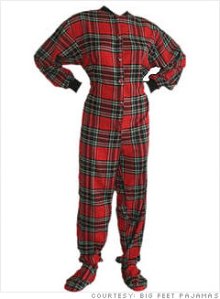
My favorite piece of clothing is—wait for it—pajamas.

Yes, pajamas. Really. Because, think about it, what article(s) of clothing is more totally comfortable than pajamas? Oh, the thin, soft knits. The cozy flannels.

Really, who could resist these?

Really, who could resist these?

The cool, slippery silks and rayons. I would never have known I look good in red if not for the gift of Christmas pajamas! And some pajamas are just so pretty! Oh, the nightgowns! The sleek loungers!

The only pajamas—and the word “pajamas” doesn’t quite fit them, anyway—I don’t like are those short, silly ones called “teddies.” They make grown women look infantile and ridiculous. And they usually have scratchy lace on them, which is a real no-no in my book.

So, stop being so prim and diplomatic, Kate! Tell the world what your fave piece of clothing is! We’ll try to muster up a little smile as we donate to the relief efforts in the ravaged Philippines. Because, really, what’s more important?

Gifts from the world

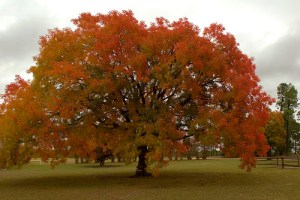
California-black-oak

California Black Oak

It’s been a long time since I mentioned “gifts.” Specifically, the everyday gifts the world offers each of us, if only we’ll take the time—even a few moments—to look for them.

Recently, I’ve not taken the time, except to briefly note the spectacular autumn display the many types of trees in this mature suburban community are giving us. Only a few of the local trees are native to the Northern California foothills: huge, elderly black oaks with vast, spreading branches; and the mostly smaller live oaks, whose twisted, rough trunks are gray as the fur of a Norway rat and whose leaves are small, quarter-sized and teardrop shaped, with tiny, startlingly sharp points along the edges. The black oaks’ leaves turn dull and pale brown in autumn before dropping and leaving the tree branches nude but delightfully haunting. The live oaks, though, drop their leaves and re-grow new ones year-round, so they are never bare. Their leaves, too, turn pale brown and rather uninteresting.

But oh, the non-native trees! This community is getting on toward 50 years

Chinese Pistache tree

Chinese Pistache tree

old—and so are many of the trees. There are several varieties of maple, including the tall, skinny liquidambers. There are aspens and willows, sweet-gums and Chinese pistache trees, whose leaves are simply spectacular in the fall. Taken all together, they form a striking canopy of fall colors—red, scarlet, orange, yellows pale and bright, and brown, of course. The trees are big, most of them, and old now. They line the neighborhood roads, decorating the front yards of house after house and the landscaping of nearly every local business and storefront. And set among them are my favorite trees of all: the evergreens.

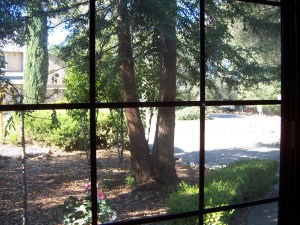
Like the Italian cedars that spike up here and there, four or five stories tall and skinny; sugar pines with big, splayed pine cones and long, thin, spiky needles; other pines of several varieties; firs that make me think of Christmas trees and the most magestic of them all, the redwoods. One of them, which has a double trunk and is almost 30 years old,

Mom's Redwood (Sequoia) tree

Mom’s Redwood (Sequoia) tree

lives right outside Mom’s front window. In a certain mood, I can gaze at it and picture a whole forest of sequoias whispering in the light breeze.

I guess I’ve been noting the gifts after all. I just need to remember to slow down every now and then and bring myself back into the present, the now, this very moment as I live my life and breath in this air. The result of such simple mindfulness is the greatest gift of all: peace.

Soothing RA pain

Sometimes—and I’m not alone in this—the medications we’ve been prescribed for our rheumatoid disease simply don’t do much in the way of pain relief.

That is not to say that RA medications don’t work. They do. But while most of them reduce inflammation and even slow the progress of the disease down to a crawl, they don’t always erase the pain. They also don’t always address the fatigue or that draggy, all-over-ill feeling so characteristic of RA.

Even the big guns, the narcotic analgesics, aren’t always reliable against pain. Like RA itself, these drugs often affect each one of us differently. Some can’t tolerate them because of allergic reactions (common with codeine) or because we dislike the disorientation, the “high” and/or drowsiness they can cause. Or, if you’re like me, you’ve taken these potent painkillers for so many years that you’ve built up a rather formidable resistance to them. They still work, but not nearly as well as they once did.

So, as the old saying goes, what’s a girl (or guy) to do?

Fortunately, there are a lot of things we can do to soothe—if not eliminate—the symptoms of rheumatoid arthritis. Let’s start with the basics:

First, eat a healthy, nutritious, balanced diet, one that helps you stay light on your feet (thus taking the stress of extra poundage off your weight-bearing joints) and helps your body function at its best. I always feel better when I’m eating meals that are high in protein and moderate or low in carbohydrates, with plenty of vegetables for their vitamins, minerals and fiber. I try to satisfy any sweets-cravings with fresh fruit instead of cookies.

Another basic: Get plenty of sleep. It’s hard to cope with pain and stiffness when you’re exhausted right out of the gate every morning. Make sure you stick to a sleep schedule—go to bed at about the same time every night, and get up at about the same time in the morning, even on weekends. Try for seven or eight hours each night.

Next up is exercise. Our bodies need to move. Everything works better when it’s kept strong and supple; exercise is the best key to that. It doesn’t have to be like boot-camp. Gentle movements like stretching and resistance exercises, including isometrics, go a long way toward helping us feel better.

Hot baths and cold/hot packs can be very soothing to painful joints. So can creams and lotions that mimic hot or cold sensations.

Assistive devices like jar openers and two-handled cookware, and mobility aids like canes, crutches and wheelchairs can help keep joint pain at bay or to a minimum.

For more ways to combat RA pain, click here.