A welcome watering

Oh, my. It’s storming outside the window. Rain is pummeling the roof, spattering against the window-glass, driven by the wind. It’s hitting the ground so hard it’s bouncing back up three feet into the air, creating a waist-level mist. Tree branches drip and sway. RainEverything is moving in the storm, reveling in the much-needed water.

Later, I’m taking my uncle to his physical therapy appointment. For the first time in a year we’ll be driving in the rain, parking in the rain, being dampened as we trot into the building. Oh, how good this will feel!

And, unbelievably, my rheuma-dragon is quiet. My always-swollen knuckles are still swollen, but they’re not painful. A gift, this is. Just like the rain.


Posted in RA

A Day in My Life (with Autoimmune Arthritis)

This post will be included in the International Foundation of Autoimmuneleonardohands.jpg Arthritis’s World Autoimmune Arthritis Day Blog Carnival.

I am so lucky.

A day in my life today (with rheumatoid arthritis) is, first and foremost, not as painful as a day in my life was when I was first diagnosed in 1987. Since then I’ve experienced years of truly awful pain, years when my RA seemed to go to sleep and I was blessed with the elusive “remission” we all dream of, and finally, the recent years, when the “dragon” woke up again.

Today, when I wake up in the morning, my body feels stiff, sore and sludgy. The knuckles of both hands are swollen, so I have to be careful not to drop my handful of RA meds when I take them. I pour myself coffee (one hand grasping the handle of the glass carafe, the other supporting it with a potholder) and gratefully, I settle into my armchair. I pick up my laptop computer, open it, and sip coffee while I read over the news of the day, enjoying the peace of the morning—and the fact that I don’t have to rush around anymore …

Not like the old days, when waking up meant stiffness and sludginess, just like now, but it also meant that standing up from bed gave me my first breathtakingly sharp, rude jolt of pain for the day. My RA attacked joints in my feet all day, almost every day. It made every step I took painful. Some days my joints swelled, and I’ve have to wear loose, slip-on shoes. And if I was lucky, that was all I’d have to deal with. If I was unlucky, another joint would be flaring as well: a knee, an ankle, a shoulder, the pointer-finger of my right hand…

Today, by the time I’ve been up for two hours the worst of the stiffness has gone. The Tramadol I took first thing has sent the pain in my hands to a back room in my brain (though they remain swollen and a bit clumsy). By 9 a.m. I’ve finished my coffee and had a little breakfast. I go back upstairs to take a shower and get dressed, and now I can walk up the stairs comfortably. Going to work is a breeze: as a professional freelance writer, my workplace is my desk upstairs.

What a difference! In the bad old days, there was no time to wait for my meds to work. (And since they consisted of NSAIDs alone, they didn’t work anyway.)I was into and out of the shower first thing. Dressing could be interesting; putting a shirt on over a flared shoulder or tugging my slacks up with flared fingers was an exercise in stoic determination. I tried to keep any moans and groans to myself, not wanting to worry my daughter. She was seven. Once I was dressed, I’d wake her up, get her dressed, comb her hair… all those things moms do on school-day mornings. I’d get us some breakfast and pack her lunchbox. Some days that was easier than others. Somewhere in the middle of all that, my husband took off for work …

Today the knuckle at the base of that same index finger is fairly painful—it’s just annoying, though. It won’t slow me down much. At my desk, as I wait for my laptop to boot, I put both hands through a series of exercises, warming them up, getting the joints moving more smoothly. That one knuckle is going to be aggravating.  I take a deep breath, accept it as it is, and get to work.

Back in the late 80s, getting to work meant driving my little stick-shift car. Work wasn’t far away, but driving could be an agonizing—and dangerous!—undertaking when my left knee, or my big toe on my left foot, or any joint in my right hand flared. Some days instead of risking my life or the lives of my fellow drivers, I’d take the city bus instead. But that meant walking several blocks to the bus stop, and then standing there for 10-15 minutes waiting for the bus. Walking and standing were dreadfully painful every day. It felt like I was walking on gravel. And once on the bus, which was always crowded, I’d usually have to stand, hanging on to a hand-strap. By the time I got to work, I couldn’t wait to get to my desk so I could take my weight off my throbbing feet.

Today, my days are pretty darned good in comparison. My feet hurt sometimes, but never as bad as they used to. I generally don’t have flares in any of my larger joints anymore, either. Because my hands are swollen, a bit stiff, and sometimes painful, I can never really forget that I have RA during the day. It’s not like breathing, which we mainly do without even thinking about it. But I’ve got to say right here that I realize how lucky I am. I realize how fast things could change for the worse.

It could happen overnight. Just like the onset did. Just like the remission, when it came in the mid-90s. And just like the way my RA returned after a six-year nap. Like Jack Nicholson in The Shining, there it was, wielding its wicked knife to thrust into my joints. I’m b-a-a-a-a-k!

By tonight’s early evening my hands are a little more swollen. They’ve become more painful, too. The Tramadol isn’t working so well anymore. But usually by then my work is done for the day. No more typing. I can relax, dip my hands in the paraffin bath or microwave my lavender-scented gloves and slip my hands into their soothing, moist warmth. When I go to bed, if I’m lucky—and I usually am—I’ll be able to drift off to sleep without too much trouble.

I try not to remember those miserable, countless nights in the old days. I was often in so much pain there was no way I could sleep. I can remember nights when I stood crying at the bedroom door because it hurt too much to open it. Nights spent sitting on the sofa, rocking, trying to concentrate on the book in my lap instead of the monstrous pain. And other nights spent floating gently in a narcotic fog, aware of the pain that lived in it, somewhere, but thankfully locked up for a few hours.

They’re behind me, those times. And if my luck holds, that’s where they’ll stay.

Posted in RA

Drama queen

“If aches and pains are like a light summer rain, arthritis is like a storm, and rheumatoid arthritis is like a hurricane.
–from “Conquering Rheumatoid Arthritis”
by William Bensen, Wynn Bensen, and Martin H. Atkinson

What an elegant description!

Now, maybe this sentence didn’t stun you like it did me when I read it for the first time last night. I just sat there, breath caught, and contemplated it for a while. It’s … it’s … it’s … a perfectly elegant analogy for a rheumatoidhurricane-RA arthritis flare.

For me, RA is the physical equivalent of monster-size clouds and gale-force winds; of slashing, drenching, merciless sideways rain that just goes on and on and on until …

suddenly, it’s gone. And the sun comes out.

And you’re left with the ruins.

When I look at my hands, I see hillocks between my knucklebones where valleys should be. The small, tough muscles feel turgid and feverish, and my skin, which has always been a perfect fit, has somehow shrunk a size. And yet, someone other than me looking at my hands probably wouldn’t see anything “off.” They’d just think I was, maybe, a bit of a hypochondriac. A drama queen.

The damned hurricane is invisible, too.

Busy hands are happy hands. And achy hands ….

WritingMickey

I just realized that February is almost over. Tomorrow is it. Buh-bye, February 2014.

I’ve been so busy, so full of things to do that it barely registered. And I gotta say here: I’m glad. I’ve finally put unemployment behind me—I’m freelance writing and bringing in about the same income that I did right before I was laid off.

I should probably qualify that a little. It is freelance work, which means it could dry up anytime. But I don’t think it will, at least, not right away. And in the meantime I’m racking up experience and a useable portfolio for the day it does dry up.

February. Gone. Amazing. Did I mention how pleased I am? How good it feels to be paid for work well done? And to be so lucky and blessed to be working at what I love. Incredible.

Okay, back to Earth. My poor hands are not so good. Swollen, achy, some days worse than others. The medication change and addition of an NSAID don’t seem to be having much affect, but as we all know, when you’re dealing with RA meds, changes take time.

In the meantime, I’m using my paraffin bath and my cinnamon-scented, microwave-heatable mitts and squeezing a squashy exercise ball in spare moments. Oh, and typing all day. 😉

The next time I post here at RheumaBlog, I’ll be doing so from my new laptop, which I am able to afford because of that stuff I wrote about above. I’m very relieved, because this old one (seven years last month) presented me with a Blue Screen of Death last week. Fortunately, it seems it was only kidding, since here I am. But my previous experience with the B.S. of D. (when the laptop before this one went belly-up) tells me the first B.S. of D. is a warning. The second one is Real.

I should have my new laptop by the middle of next week.

Here’s hoping that everyone is feeling decent and in good spirits. The seasons are changing, whether we want to believe it or not. The Endless Winter is going to end. (Like the Endless Summer here in California, at least for a few days. It’s raining! And it’s supposed to keep raining into early next week! Water from the sky! Whoopeee!!)

My best wishes to all.

Bad toebelly

What is this nausea in my big toe?

On my left foot. Right

Now. How dare that toe mimic

The sickness of my hands?

This toe-nausea burps memories

All buried in the far deepest

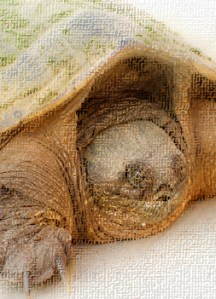
this turtle looks like how my toe feels.

this turtle looks like how my toe feels.

pit of my mind. I’ve

dreamt-begged the source

To never never return never.

But now I have this big toe that

longs to puke. I move it, slow

With my breath held but it

Rewards me with pulsing throbs

And I cannot believe it.

I cannot.

Ahem.

I visited my rheumatologist last Saturday morning. My blood tests finally match how I feel, with a wildly elevated sed rate and CRP levels. Seems stupid to feel so triumphant, but I can’t help it because now there’s proof the pain’s not all in my head.

So much for that remission I already knew I wasn’t “in.”

My doc, a bit subdued, is increasing my Plaquenil dosage. It’s the only one of the three DMARDs  I take every day that isn’t already maxed out. And I’m to start taking Lodine, an NSAID I’ve not tried before, as soon as it arrives in the mail.

Then I wait three months. Or maybe six, if I’m feeling exceptionally patient and brave in the face of growing pain and danger of disability. And then, if I still have belly-aches in my hands (and toes … sigh), we’re loading for bear. I’ll start shooting up Humira.

I’m shaking the threat of it at my grubby old dragon like a shaman’s rattle, hoping to scare him back into his pit again.

Shaking … from the threat of it, too.

Please forgive the bad poetry. Sometimes the ol’ mood demands it and I just have to give in.

Winter on my mind

polar vortexSo, is everyone warm? Are you sipping hot cocoa laced with whiskey? Are you bundled up to your eyebrows? You did get your best, warmest knit cap—yes, that one, the one that makes you look like a demented elf—back out of the hall closet where you chucked it after the last polar vortex?

Believe me, I feel your pain. I feel your pain as I gaze out the living room window at my quiet neighborhood street, watching a girl in a powder-pink parka walk her French bulldog. The parka looks… um… ridiculous. Because this is California. We’re having a drought—Scott Pelley, the anchor on the CBS evening news actually said we were, so it must be true—and we’re in our 48th day of what we so fondly call “the rainy season” but there hasn’t been a drop of rain. The girl in the parka looks ridiculous because, though the calendar says it’s winter, it’s not cold.  Sure, it’s cool early in the morning, like it is right now, but no self-respecting world traveler—such as myself—could call it cold and hold her head up. Why, I remember (she adopts an old crone’s trembly-but-petulant voice) when it was so cold in Germany that ice formed on the cobblestones and stayed for a whole week! We had to dress in so many layers that it took ten minutes to get them all off! A cup of hot gluwein (spiced wine) cooled right down in mere minutes, so you had to drink it fast. Such a hardship! I remember my fingers would get so cold they went numb, and then it hurt like a you-know-what later, when I was back indoors and they started to warm back up.

And here, at this moment on a droughty California morning, a girl is walking in the bright, 61 degree F sunshine  and wearing a parka over her pedal-pushers. It’s enough to make a crone cry.

To all my friends suffering through 34 degrees below zero windchill and shoulder-level snow: my thoughts are with you. I’m worried about you. I know how painful your RA can get when it’s that brutally cold. So I’m mentally sending you visions of California sunshine and warmth and dry, clear streets without ice. I wish you shorts, sandals and sunglasses.

Please stay warm. Please stay safe.

And remember: this, too, shall pass.

*Live* tonight on Facebook!

Hi, everyone!

I’m going to be *live* on the International Foundation of Autoimmune Arthritis’ (IFAA’s) Facebook page this evening at 5:30 p.m. EST. (Ignore the time in the poster, below–it’s wrong.)

Wren Blog Leader Facebook Announcement

That 5:30 EST. I’m really looking forward to chatting with you! 😉

Introducing: HealClick!

A new, really unique health website launches this morning!

HealClick is a warm, social, friendly website. It matches patients who have similar medical conditions up with each other. The idea is to make sharing treatment experiences easier, then to use the resulting online data to fuel new medical research.

The founders of HealClick believe their platform will be most beneficial for poorly-understood, frequently-overlapping neuroimmune and autoimmune conditions. These include lupus, rheumatoid arthritis, ME/CFS (myalgic encephalomyelitis/chronic fatigue syndrome), fibromyalgia and Lyme disease.

When patients share information about their condition with each other on HealClick, the data goes to medical research.

Patients who share medical details and post content on HealClick agree that other HealClick members can view their information.  Before any data is shared with researchers, HealClick de-identifies it according to HIPAA guidelines. And usernames, pictures, and profiles will never be public.

HealClick’s goal is a patient-driven revolution of personalized research and health. They hope that with a large enough database, they can create new research opportunities and data to help doctors improve early diagnosis and treatment outcomes.

Membership on HealClick is free. There is no advertising, and the site is funded only by the founders and stakeholders who share their vision and aren’t interested in milking patients.

The HealClick story in 2 minutes: http://vimeo.com/80001271

Go ahead! Check it out. Become a member. I did.

An interview with author Lene Andersen

Back in 2009, when I searched the Internet for RA blogs, hoping to discover a community of people who shared this disease with me, The Seated View was one of the first I found.

Lene Anderson, author of "Your Life with Rheumatoid Arthritis: Tools for Managing Treatment, Side-Effects and Pain."

Lene Anderson, author of “Your Life with Rheumatoid Arthritis: Tools for Managing Treatment, Side-Effects and Pain.”

I was hooked instantly.

Lene Andersen is natural writer, one of those magical scribblers who can make you feel treasured , cozy and comfortable in just a few sentences. You settle right down to read, and before you know it you’re there with her in Toronto, shaking your head over how her windows freeze shut in the winter, and about how Spring melts the ice and softens the air. You grin at her cat’s goofy antics, share in the joy she feels for her family, marvel at the beautiful photographs she takes and …  well, you catch my drift. Lene makes you feel like a friend.

But she also writes about rheumatoid arthritis, the proverbial elephant in the room.

Lene doesn’t sugarcoat what she writes about her RA—or the facts about RA, period. She writes about it calmly, with open eyes. When she says that starting one of the biologic DMARDs saved her life, she isn’t exaggerating. She means exactly that: the medication saved her life. When she writes about the physical and mental pain RA causes, you get exactly what she’s talking about. Her description fits like a glove.
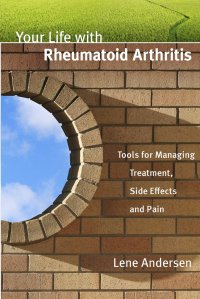
Lene-Your Life with RA book coverAnd so does her empathy. When I learned that she was writing a book about RA, I was intrigued. When she announced that it had been published, first as an e-book and then later, as a paperback, I was delighted. I bought the Kindle version of “Your Life with Rheumatoid Arthritis: Tools for Managing Treatment, Side-Effects and Pain” the same day.

And you know what? It’s good. Really good.

I’ll be posting my review of “Your Life with Rheumatoid Arthritis” soon. But first, I’d like to share my recent e-mail interview with its author, Lene Andersen.

Wren: First, a quick bio: Where were you born? When did your family move to Canada?

Lene: I was born in Denmark and lived there for the first almost-20 years of my life. At that time, my father had been working for the Canadian branch of the Danish company for a few years and my parents decided they would like to actually live in the same country (I know… How radical). The whole family moved to Canada for what was supposed to be a year or two. Thirty-one years later, I’m still here.

Wren: Having a disability makes the everyday logistics of attending college and going to school a real challenge. How did you manage it?

Lene: Juggling parallel transit with homework and RA-related fatigue and pain was a real challenge. By the time I went to graduate school, I finally figured out that I didn’t have to do things the same way and on the same time line as everyone else. I did my Masters degree part-time and it was a tremendous help. I had more energy, could focus better on homework and assignments and got better grades.

Wren: What career did you choose? (and “Why?” again…)

Lene: I’ve wanted to be a writer ever since I knew what one was. However, my practical side insisted on a “real” day job. For a long time, my career goal was to help teens with chronic illnesses or disabilities, so I majored in psychology and did my Masters in social work. Halfway through the latter, I discovered policy development and realized that I was much better suited for that. I ended up working in employment equity and human rights and loved every minute of it. That is, until the employment equity law was repealed by a new provincial government and I lost my job.

Wren: What do you do today, work-and-career-wise?

Lene: I’ve come full circle and returned to my lifelong dream of being a writer. I had a huge RA flare in 2004 and came very close to losing my life. Thanks to the Biologics, I got a second chance. You can’t waste a gift like that, so I decided to live more authentically. And that meant being serious about writing.

Wren: Another big challenge: writing a book. How did you do it?

Lene: There’s a wonderful joke that sums it up perfectly:

Q: “how do you eat an elephant?”

A: “one bite at a time.”

Writing a book is very much like that. You show up every day, you write one bit at a time and if you keep doing that, sooner or later, you’ll have a book. It takes discipline and perseverance and being really stubborn about your goal. That will get you in front of the computer during the periods where it’s a mindnumbing slog. Even during the gazillionth rewrite when I’m sick of my own words, there’s nothing else I’d rather do.

Wren: Seems like all of us with RA can name a “worst” experience with the disease. What was yours?

Lene: The 2004 flare. I thought I was going to lose my life, it felt like I had terminal arthritis. I reached a point where I gave myself another six months to find a solution and if I didn’t, it would be okay to kill myself. It wasn’t that I wanted to die, it was because the pain was unbearable. Luckily, I started a biologic and everything got better.

Wren: RA often causes depression. Have you ever been depressed?

Lene: I’ve been depressed on and off for years. Growing up with a chronic illness and disability wasn’t easy. I’ve struggled with finding meaning in it, but didn’t have much luck for a long time.

Wren: How did you recover from depression?

Lene: I’ve seen several counselors in my “career” with RA, starting at age 18. The most helpful approach was cognitive behavioral therapy, because it helped me think differently about my disease and how I live with it. But more than that, it was recovering from my 2004 flare that changed my life. Coming that close to losing everything has given me a different perspective and I haven’t been depressed since. No matter what happens, I have an awareness that nine years ago, I truly believed I wouldn’t be here past the summer of 2005. That puts everything in perspective. I’m living a miracle every day and it’s done wonders for my ability to cope. I also work very hard to focus on what I have, instead of what I don’t have. Practicing gratitude has been key for me.

 Wren: Any suggestions on how people can deal with RA-related depression?

Lene: One of the things I realized when I was seeing my last counselor in the early 2000’s was that sometimes depression is because your disease isn’t well controlled. Although I’m a big fan of counseling, especially cognitive behavioral therapy, there are times when the appropriate expert is not a psychologist, but a rheumatologist. Antidepressants can be an excellent tool to helping you cope better, but so can effective RA medication. If your RA is well-managed, it’s a lot easier to find joy in life.

Mindfulness can also be tremendously useful. Practicing being in the moment makes it easier to see all the things about life that are still wonderful. There’s a profound quote in Mindfulness for Beginners by Jon Kabat-Zinn about living with a chronic or serious illness. He says that as long as you are still alive, “there is more right with you then there is wrong with you.” That’s a terrific bit of perspective.

Wren: Special diets and other alternative “remedies” for RA are as popular today as they ever were. Have you tried any alternative remedies? Did they work?

Lene: I tried acupuncture for the first time when I was 13 and have been a huge fan of it since. For years, acupuncture and shiatsu massage were essential parts of my pain management toolbox. I’ve never adhered to any particular diet. When I was a child, a rheumatologist told me that becoming vegetarian might help my symptoms. I told him that my life was already crappy enough and I had no intention of giving up steak. That said, before I found a medication that worked for me, I did notice that certain foods — tomatoes, fried foods, sugar — exacerbated my symptoms, so I tried to steer clear of them.

Wren: The daily small aches, stiffness and pain of RA can be almost as frustrating as big flares. How do you get through each day with them?

Lene: I take meds on a schedule, which allows me to stay ahead in the race against the pain. I also rest for 1.5-2 hours every afternoon. When I got tired of people telling me how nice it must be to nap every day, I changed the name to Mandatory Rest Period. This emphasizes that it’s an essential part of managing my pain, rather than an indulgence. I’ve also developed really effective mental filters to block out a fair bit of my pain. I think that’s something all of us do. When you live with chronic pain, you learn to ignore it until it really starts interfering with your ability to get things done.

Wren: You’re a vocal advocate for accessible design. Was there any one situation that prompted you to speak out?

Lene: I started using a wheelchair when I was 16 and very quickly became aware of the extra planning and additional steps involved when you travel seated. There was a difference, though, between being aware of barriers and the feeling you get when you experience discrimination. I remember flying somewhere in my early twenties, using a particular airline for the first time. I’d flown several times before, but this was the first time an airline required a letter from my doctor stating it was OK for me to travel. Needing a doctor’s note to go on vacation just because I used a wheelchair was my first experience of discrimination. No one else needed a doctor’s note. Young as I was, I still knew it was wrong that a disabled person had to provide documentation, but someone else with an invisible illness, such as a heart condition, didn’t. Years later, I worked in human rights and became much more familiar with the laws against such treatment. Combining my personal experience with discrimination with my knowledge of legal rights was a very empowering experience.

Your Life with Rheumatoid Arthritis: Tools for Managing Treatment, Side Effects and Pain is available as an e-book on Amazon, Barnes & Noble, iBooks and Kobo Books. The paperback is available on Amazon.

For further information, visit the book’s website.

And hey! Don’t miss Lene’s personal blog, “The Seated View. “

There’s tender, and then there’s “tender” …

I have reason today to meditate upon the word “tender.” Usually, I reserve its use to describe grilling chicken breasts to the perfect point of done-ness, when the meat is neither undercooked and still slightly pink, or overcooked so that it’s tough and stringy. “Tender.” Cooked through but still moist and piping hot, firm to the bite but eminently chewable … you catch my drift.

I also frequently see the word used to describe gentle affection, as in “the

I prefer this perception of "tender," personally ...

I prefer this perception of “tender,” personally …

mother gave her little girl a tender kiss.” Lovely. We all get that one.

And then, there’s tender. As in sore. As in … ow. That’s the best way to describe how my hands have been feeling the last few days. They’re … tender. They ache, but it’s a low-level ache, hardly worth noticing most of the time. But then there’s that tenderness… like when I pick up my coffee cup and the joints in my knuckles and fingers feel like they’re being pulled apart, with the accompanying sharp, poking pain. Ow.

Or as when I’m typing, like now. Mostly, it’s not bothering me much (or I wouldn’t be doing it). It’s just that when I stretch my fingers to reach certain keys, I get that mean, pulling sensation again. It takes my breath, forces a frown and then it’s gone.

Tender. As in painful under slight pressure.

I do get weary of the sensation. And, of course, I worry about it. This is happening while I’m taking a big handful of DMARDs (disease modifying anti-rheumatic drugs) every morning and every night. It’s happening even though I’m taking Tramadol every six hours, rarely missing a dose. It’s happening in spite of the odd Vicodin here and there, when tender turns into “holy s**t that hurts!”

And despite all the medications, anti-rheumatic, pain-killing, etc., my knuckles are still swollen. Day and night, every day.

In a few days I’m going to the lab for my quarterly blood tests. I’m really curious to see how the sedimentation rate, which measures the level of inflammation in the body, looks. It was somewhat higher (for the first time in a couple of years) last quarter. I’ll be floored if it’s not higher still, this time.

But I’ve been disappointed surprised before. Perversely, sometimes lab tests simply don’t reflect perceived pain levels or actual disease activity. I guess that’s why “healing” when applied to medicine, is an “art.”

Hmm. Two more words to meditate upon …