
Last week I received a bubbly email from Jenny. She asked me to review a product she represents because, she explained, she thought it might be helpful for people with arthritis in their hands and fingers.
Hmm, thought I. And what new, wondrous, why-didn’t-I-think-of-that product might this be? I read on.
Key caps. Yep, little colored caps for your house keys, mail keys, office keys, you-name-it keys. With stick-on labels.
Now, these are handy in their own right. But how in the world might they help people with rheumatoid disease, lupus, psoriatic arthritis, osteoarthritis, and any of the other 100-or-so types of arthritis? Jenny piqued my interest. I had to know, so I replied to her email, agreeing to try her key caps and review them for my RheumaBlog readers.
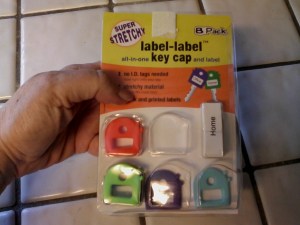
Nice, neat, easy-to-open packaging. I just taped the top closed again so I won’t lose my key caps.
My set of Label-Label Key Caps—that’s the brand—arrived on Saturday. I immediately set to liberating a few, along with their labels, from the package*. There were eight (8) key caps in a variety of both bright primary and pastel colors, and two sets of 16 labels (eight printed with HOME, GARAGE, OFFICE, and GATE, and eight blank, for each key cap.)
*Anyone who has arthritis in their hands knows the blood-pressure-raising fury that takes hold when faced with that Horrible Plastic Eggshell (HPE) packaging. It can’t be pried open without amazing, muscle-y gyrations (maybe a very large octopus could do it) and cutting the stuff requires ultra-strong, sharp scissors—or better, a terrorist-style box-cutter with a brand-new razor blade. Not only are HPE packages dreadfully painful for anyone with arthritis to open, the cut edges of the plastic casing are dangerously sharp and poke-y. There. Will. Be. Blood.
But I’m off on a tangent-rant. They don’t package Label-Label Key Caps in that bloody HPE!
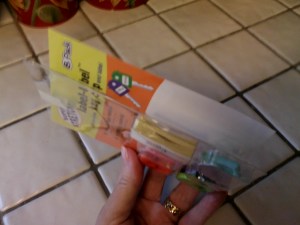
It was super-easy to access the key caps and the labels.
Instead, the clear plastic package is thin and molds around the shape of the key caps, yes. But it’s attached to the thin cardboard backing (not more cursed HPE!) by three simple, narrow folds and a single staple, not that aggravating Eternal Adhesive from Hell (EAH). The top of the packet is open. It was too tight for me to slide a finger down into, but I was easily able to unfold one side of the plastic to access both the key caps and the labels.
None-to-minimal pain, people. This is important.
I hand-lettered one of the sticky labels “Mom” and stuck it onto my house key (which I washed off first with a little soap and water, as per instructions, which were simple and clear). The label stuck tight and stayed when I stretched the key cap over it. The letters fit into the little window perfectly.
The rubbery key caps themselves are thick, soft, and grippy. And they’re amazingly stretchy. Mom’s condo key is easily the largest of the keys on my key ring, other than my car key, but the bright yellow Label-Label Key Cap stretched neatly over it.
There was one drawback: putting the rubbery cap on the key was tough for me. My hands and fingers have been particularly tender and swollen because of an ongoing flare and a rapidly rising barometer. Working the cap over the key and snugging it down elicited a fair amount of wincing and groaning. It hurt.
However, I did it. It took only about 30 seconds and was absolutely worth the discomfort.

Success!
Because now, Mom’s bright red house key is easy to see and pick out from among all the others on my ring. Not only that: because of the thick, rubbery cap, it’s easier for me to grip and turn when unlocking and re-locking the door (I tried it). So in spite of that one wee drawback, Label-Label Key Caps are a Label-Label win-win, just as Jenny promised they would be.
I wanted to use another key cap for my aunt’s house key, but because of the “ouch” factor, I asked my 82-year-old mother to put it on for me. She did it cheerfully–and easily–in no time. Nothing wrong with her fingers!
So, see, if your hands are too sore for you to put your Label-Label Key Caps on your keys yourself, then anyone standing around handy nearby can manage it for you, if they’re nice like my mother. It will make them smile—it’s sort of fun to put the cap on the key. Plus, they get to help someone they like and admire, and this little good deed adds a few more degrees of positive energy to their life-karma. Another Label-Label win-win!
And since we’re speaking of wins, Jenny from Label-Label Key Caps informed me that the company would be delighted to invite RheumaBlog’s fans to win some free key caps of their own. She wrote, “…in order to win a package of key caps, they must go to our Facebook page at http://on.fb.me/1rnMrdd, like our page, share one of our posts, and comment below the color of key caps they like best!”
Sounds pretty easy to me. 😉
Label-Label Key Caps really are a fine little product. I had fun trying them and writing about them. And they’ll make unlocking the door just a little less “owwww-y!







 make the disease (I know it personally as my rheuma-dragon) sleepy and sluggish. It’s the main reason that so many of us who have this disease end up running through so many different drugs.
 “winter” still hadn’t arrived in northern California. (So far, it still hasn’t unless you count a few short days of rain with temps in the mid-50s here and there as winter.)
 Year-round. Seriously. So, I thought, maybe socks called Heat Holders will thaw them out!
 rheumatology course in medical school.
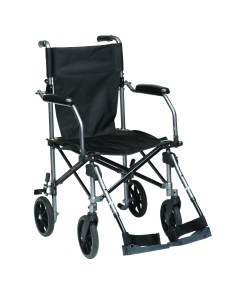 me to hurt my back trying to lift his regular chair into and out of the car. The new chair has small wheels, footrests, and handles on the back for pushing. It moves easily, but is harder to push overall because of the small wheels.
 I hadn’t taken into account the continuing construction work going on all over the campus. Our local VA medical center has, over the last year or so, added several new buildings, a covered parking garage, and covered outdoor parking (which was all full when we arrived!). And the work is still progressing. As we came out the far door of the main building, we discovered that the usual walkway was blocked off with barrier fencing, forcing us to go all the way around what was once a parking lot to the new physical therapy building. Our first try for the entrance was a dead-end sidewalk. We turned around and went back. (cue in wind and rain here.) To my further dismay (and Uncle’s), we discovered that the only way to gain entrance was to walk all the way around the building so we’d be approaching it from the opposite direction.
 RheumaBlog