Slapped

“Ow!”

I’m sitting on my sofa, my laptop on my lap-desk. I shift to get more comfortable. Now the computer is too close – my elbows are sticking out. I stop typing, grasp the laptop and lift it up to move it back a little.

Although I’ve been typing for quite some time without pain, the slight weightarthrits flare up of the computer on the joints in my fingers make them feel like they’re being shoved rudely sideways inside my skin. I yelp and let go of the laptop. I stare at my fingers. They look the same as always. Of course.

“Ow!”

Last night. Supper time. My sweet son-in-law-to-be, Matt, has prepared a lovely rack of barbecued ribs, baked potatoes, green beans and toasty garlic bread for us (he’s a keeper, that young man). I pick up a knife to slice between two of the smaller ribs. I start to cut. Pain – instant, shocking – shoots through my knife hand. I yelp. Drop the knife. OK, I give. I ask Matt to cut my meat for me. He does it cheerfully, but I’m humiliated. I feel like a child.

Is this disability? While the pain in my hands is mostly mild today, it feels disabling even though it hasn’t really stopped me for long. Had I been alone at supper time last night, I could have gritted my teeth and cut my meat myself (or I’d have skipped the ribs altogether). Today I was able to move my laptop even though it hurt. So what’s the big deal?

See, that sudden, wrenching pain, even after years of dealing with it, always catches me by surprise. It’s like a slap out of nowhere, for no reason. It reminds me that I’m not right, that I have to be careful or I’ll get smacked again. It hurts. It makes me tentative about just doing.

And, it’s insidious. My apprehension builds up over time, under the surface, working quietly but treacherously just like the rheuma itself. Not only do I become tentative regarding how I use my hands, my mood shifts. I get grumbly, at least to myself. And I also start to fear that a larger, more severe flare in my hands (or whichever joint is “twinging”) is imminent.

Sometimes I’m right. Sometimes I’m not. I’m grateful when it doesn’t get worse, but the harm to my psyche has already been done. I’ve been cowed again. Slowed down. The smile has been wiped off my face, even if just for a moment. And I’ve been reminded again (as if I’d forgotten) that even when the rheuma isn’t so bad that I want to cut the offending limb off entirely, it’s doing its sneaky, silent work, slowly breaking down and ruining my joints. It has one goal: to truly disable me.

I talked with my mom on the phone this morning. She asked how I was, so I told her. My hands hurt. She asked, “isn’t that medicine you’re taking helping at all?” Yes, I said, the doctor says my sed rate is lower than it was. He says that means there’s not as much inflammation in my body as there was before, which in turn indicates that the drug is doing what it’s supposed to do, which is slow the progression of the disease and perhaps save me from disablement down the road.

What the drug doesn’t do is relieve the constant pain, whether it’s low grade, like now, or terrible, which it has been in the past and I know will be again. Maybe later today. I never know, really. It’s like limbo. And that constant reminder, that knowledge, that big pain is waiting in the wings eventually starts grinding me down. It affects how I make my plans for the day, for the week. It affects my mood. I do my best to grin and bear it, but sometimes my grins are more like clown masks. They don’t reflect how I’m really feeling because to show that would be to give in, to let the hurt, crying child I feel like down inside come out into the open.

I don’t tell my mom all of this, of course. I don’t want to worry her any more than she already is. She’s long familiar with my disease, though she doesn’t understand it very well. “Can’t you take something for the pain?” she asks.

Yes, I can. I can take Tylenol (which I have, today) and tramadol, which blunts mild to moderate pain (which I haven’t, yet). If the rheuma decides (yes, I think of it as a thinking, malevolent, sentient being) to gift me with a really severe, nasty flare, I have a bottle of Vicodin in my medicine cabinet. It helps some, but not as well as I’d like, and it comes with a dark price. It makes my brain floaty. Drowsy. I don’t dare drive in that condition. I don’t dare pick up a sharp knife for fear of cutting my fingers off by accident. I also dislike the after effect they have on me. I feel like I’m slow and foggy-brained for half a day after I take them.

But worst of all, even though they work the best to relieve the pain, opiates like Vicodin are addicting. We build up a resistance to them after a while, so we need increasingly higher doses or more powerful drugs in the same family to get the same effect.

That scares me. How will I cope with severe flares when opiates don’t work anymore for me? As a result of that fear, I take them as seldom as I can.

I know this post is whiney. It helps, though, to put my feelings about rheuma and its affects on me in writing. It’s a rant, I guess, and there’s some relief in ranting, even just to myself and the few people who happen to read this blog. If you’re reading this, at least you probably know exactly what I’m talking about. It’s nice to know that we’re not alone in battling this disease, isn’t it.

About courage

One of my best friends — one who understands rheuma and who always listens when I need to vent — frequently tells me that I’m brave. That she admires my courage.Leonardohands

It embarrasses me a bit. It’s true that dealing with varying levels of pain on a daily basis takes a stiff upper lip.  It takes a certain determination, a sort of bulling on through the pain. I’m not sure that’s courage, however. And I sure don’t feel very brave most of the time.

Instead, I simply do because, honestly, what’s the alternative? Sitting around moping, hiding under my covers or letting my aprehension toward pain hold me immobile just isn’t doable. I don’t feel particularly special just because I endure rheuma’s persistent pain. That’s not bravery — it’s pragmatism. I have a life to live, and I intend to keep living it the best I can.

That said, perhaps “courage” does fit in there somewhere. This is an excellent post about rheuma and courage, and how the two can intertwine. Do read it. It’s worth a few minutes of your time. And take a look at the website it’s part of as well. It’s called “Creaky Joints.”  Cute.

Soup

My hands hurt. My fingers, when I try to use them to pick things up, feel like they’re coming apart. I grit my teeth and cuss, soft, beneath my breath.

But I’ve promised my daughter and her fiance a steaming hot pot of my homemade Hungarian goulash tonight. It’s been fallish around here lately — cool, crisp, bright days and increasingly chilly nights. Soup that’s thick with vegetables, potatoes, bits of meat and spices, mopped up with chunks of warm, crusty bread, will warm our bones and make us smile. Since I’m the only one around here who knows how to make it, here I go, off to the kitchen, achy hands and all.

Yes. There is joy in this.

I’m b-a-a-a-a-c-k …

I’m back from the family reunion. The aircraft I flew in didn’t crash on take-offs or landings, and they didn’t fall out of the sky. No wings tore off, no engines caught fire, no landing gear stuck. In fact, the flights to Tulsa, Oklahoma via Denver, Colorado and back to California were some of the gentlest I’ve ever been on. There were hardly even any turbulence bumps, and only a couple of those stomach-tickling little swoops in mid-air.

I think I’ve finally gotten over my life-long fear of flying. I have only one thing I can attribute this to: the iPod Touch my family gave me for Mother’s Day last May. Really. As soon as my daughter tapped my arm – the signal that we were well off the ground and at cruising altitude, so I could open my eyes and start breathing again – I stuck my iPod’s earbuds into my ears, cued up some soothing music and started playing Wordology. And then Solitaire. I even watched an episode of a PBS Mystery series I’d downloaded.

I wish I’d had an iPod when we flew to Europe and back in the late 80s and early 90s. I wouldn’t have needed those tranquilizers.

The reunion itself was a hoot, just like I expected. Mr. Wren’s family is pretty large. His dad had eight brothers and sisters, and they all went on to have large families themselves. Mr. Wren was the middle child of five. While not everyone in the extended family showed up at Feyote Park in Cleveland, Oklahoma for the reunion, 93 of them did. They ranged in age from just over a year to ninety years. And with the exception of us, the California branch, they all live within a hundred miles of each other in Oklahoma.

It was fun – and a little bit disconcerting – to have everyone I met that day share my last name. I got to meet a brother-in-law and three sisters-in-law that I hadn’t been able to before. I met nephews and nieces, and my first grand-nephew. There were so many names that I gave up trying to remember them all, but they were such nice people – they were smiling and friendly and as pleased as I was that we finally got to meet.

The weather in OK – hot, a bit humid, and breezy – made the rheuma nasty all four days I was there. Hands were constantly sore, and my right knee kept getting stiff and achy. But when a volleyball game was suggested, I surprised myself and joined it. I haven’t played volleyball since high school (when I was very good at it), and while I was less than competent playing it now, I did have a lot of fun. At first, I was berating myself, anticipating severely aching hands and wrists after the game, but that didn’t happen. Isn’t that something? I also tossed a Frisbee around with my nephew, my daughter and two of my sisters-in-law. We had a blast. I haven’t played with a Frisbee in years, either, but I did just fine. I even ran! And tripped and fell! And had to have a bunch of wicked little stickers plucked off the back of my shirt and jeans…

Since coming home, I’ve developed an itchy rash on my forehead next to my hairline, at my jaw line and along my neck. Annoying. I’m pretty sure it’s because of the sulfasalazine I’m taking for the rheuma. Photosensitivity is a pretty common side-effect. I knew that, but I wanted to play. I needed to play.

And that’s a new experience for me. I’m almost 53. Running, jumping, playing with balls and tossing Frisbees weren’t part of my repertoire any longer, and hadn’t been for many, many years. But my weekend in OK taught me something new and joyful – I CAN play, at least sometimes. I’ve lost a lot of weight during the last year, and I’m sure that’s one of the reasons I felt like I could – and I want more. I’m going to buy a Frisbee one of these days soon. My daughter and I plan to walk to the local park – and we’re going to play Frisbee. The idea just delights me. It will be good exercise and a great stress reliever for both of us.

Outahere … for a while

flying_c5Yep, once again I’m about to board a jet plane and zoom away for a while.
It’s funny, but for almost 15 years I managed to do all my traveling on the ground. I was in a car or on foot, period. Then in 2007 I flew to Washington, D.C. In 2008 I flew to New Mexico. And this year — tomorrow morning, in fact — I’m flying to Tulsa, Oklahoma. Haven’t been there since 1980.

A long time ago.

The occasion is my husband’s gigantic family reunion. It’s going to take place this coming Saturday and Sunday at a local park; there will be pickanicks, barbeques, frisbee games, a few scratch softball games and who knows what all else. Three-legged races for the kiddies?

Certainly, there will be a lot of meetings and greetings, coversations and laughter. I’ve met most members of Mr. Wren’s immediate family, of course, but I’m given to understand there will be many more people there bearing his Americanised, Dutch patrinomic name. People he hasn’t seen since he was a child; others he hasn’t seen since they were children.

Should be a hoot.

So, send courage through the ether at me one more time. I’m a huge coward when it comes to flying. I hate it. I spend the entire flight in a state of clenched-jawed non-movement, as if my moving will somehow cause the aircraft to fall out of the sky. It’s an old, old phobia, this one, connected directly to an irrational childhood fear of heights.

I’ll get through it, just as I have before. This time, I’ll be on the ground just long enough for my stomach to settle down, and then we’re flying back. On Monday. Early, early in the morning.

I’m taking my camera. We’re also visiting a place called “Woolaroc” on Friday, which I hear is rather wonderful. I’ll shoot some photos and, if they turn out OK, I’ll share them here.

Bye, gang. Back next week as long as the airliner doesn’t lose a wing or something. In which case, well, it’s been fun …

Under pressure

My hands are stiff, achy and swelly tonight. There was a time when I’d have had no idea what could have brought on any particular flare — they all seemed incredibly, frustratingly random.

Sometimes they are. That’s just how rheuma is.

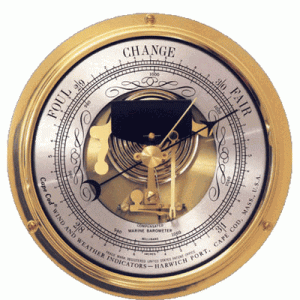
But I know why barometermy hands hurt.  The barometer is rising, and a high pressure area is settling in to the west. That’s all it takes.

Although tomorrow is fall equinox, I live in Northern California, and it’ll be hot outside for the next several days. Temperatures generally stay quite warm through mid-October around here, then it cools down slowly and gently after that. November and December finally feel sharp, crisp and autumny. If we’re lucky, the rains come. My home is in the Sierra mountains about 50 miles west of Lake Tahoe. Even at 3,200 feet above sea level, it usually doesn’t get truly cold until January.

I’d always heard that older people moved to warm, dry states because the higher temps and lower humidity helped their aches and pains. So it always puzzled me that it never seemed to matter what the weather was like when my joints flared. When I was first diagnosed with RA, I lived in Northern Germany, right at the edge of the North Sea. It was damp, windy, cold and rainy about nine months out of the year. Summers were pleasantly warm, never hot, and sometimes humid. The rheuma attacked all year ’round. I absolutely loved it there.

When I returned to California in the early 90s, I thought the warm, dry weather here might help. It didn’t. Wet and cold, warm and dry, it made no difference at all.

I lived here for five years before the RA finally went into remission all on its own. I wasn’t taking any medications for it; I’d gotten tired of popping pills and dealing with unpleasant, risky side effects while never getting any relief from the flares or the pain. I’d given up. I was living with it.

… More to come …

Rheuma semantics

I have rheumatoid arthritis.

I’ve had it for 22 years. Our relationship has never been friendly.

On some blogs about this disease people state “I take X for my arthritis,” or “I couldn’t go to the party because my arthritis flared up.”

There were so many statements like this, on so many blogs, that it started to bother me. “My arthritis is worse in humid weather.” “It’s hard to explain my arthritis to others.”

What bothers me is not what medications the writers are taking for the disease, or what it does to limit their lives, or how it’s worse at one time than another, or even how difficult the disease is to understand and explain. All of those things are part of having rheumatoid arthritis. I can identify and empathize with each one.

What I can’t figure is the “my” part.

Rheumatoid arthritis is a disease of the body’s autoimmune system, which for some reason sets up a continuous attack against its own tissues, treating them as if they were a foreign entities that must be destroyed. Rheumatoid arthritis causes the synovium, a sort of fluid-filled capsule between the joints, to become inflamed, which makes the joints painful – often excruciatingly so. Over time, this constant attack on the joints causes them to distort or freeze up. The disease eventually disables and cripples its victims. Sometimes it does it fast. Other times it can take decades.

Rheumatoid arthritis can attack other organs in the body, too. It can affect the lungs, the heart, the circulatory system and the eyes. It can make the sufferer feel as if they have the flu all the time. It can make them feel worn out, fatigued for no good reason. It affects each individual differently, so it’s very difficult to treat. A drug that works for one person won’t necessarily work for another.

And the worst thing is that rheumatoid arthritis is incurable.

So where do semantics fit in with all this?

Well, I have it, but damn it, rheumatoid arthritis is not “mine.” I don’t own rheuma and I don’t want to. It’s a malevolent stranger, a sneaking dark enemy that’s attacking me. It’s a disease I must fight against and even learn to cope with, but it sure as hell isn’t “mine.”

I believe the words we choose to use in our thinking conversations with ourselves and in our everyday conversations with others have a profound effect on us. If I start talking about the disease I’m afflicted with as “mine,” then I believe that I’ve accepted it. That I’ve learned not only to cope with it but to live with it, even to nurture it. After a while it really is “my” arthritis. Like “my” cat or “my” shoes, “my” house or “my” daughter. It’s as if it’s an old, familiar but not particularly pleasant friend.

So I fight against using those words. Rheuma is not my friend, will never be my friend.

It’s out to stop me from moving. To stop me from cooking, or sweeping the floor, or driving to work. It’s determined to make me sit still and suffer, not daring to move any more that I must. It means to keep me from playing, from sleeping, from making love. Ultimately, it’s out to cripple me and someday, to kill me.

Why in the world would anyone want to accept that? To own it? To nurture it? Rheuma is absolutely not “mine.” I will not claim it.

But I will fight it.

As in any war, I win some battles and lose others. There are times when I have to retreat, wounded, and take the time necessary to recover my strength, my courage and my will to go on.

I’ve been lucky. It retreated – went into remission – for about ten years. Or at least I thought it did, since I was no longer hurting every day. My life went back to normal. I could walk without pain. I could open doors without pain. I could sleep. I went hiking, started gardening, went camping and fishing. I worked. And oh, I was relieved and thankful, but ever mindful of the fact that there was no reason rheuma couldn’t come back anytime and ambush me, just like it did in the beginning.

I was wrong, though. It wasn’t gone. It was still in my body, working slowly and quietly to undermine my foundations. And about four years ago, it began attacking openly again.

Today I fight rheumatoid arthritis every day again, but this time, I have a variety of weapons. I have medications, I eat mindfully, I get plenty of sleep during the lulls between battles, I drink lots of water. I’ve lost nearly 50 pounds and I’m keeping it off; to me, that’s like taking and holding a major strategic city. I’m working on losing another 20 pounds. When I reach that goal, I’ll be at the optimum weight for a woman of my height and build. Why do it? Less stress on my joints. Less stress on my body, period. I’m stronger. It’s like armor.

This blog is about my battle with rheumatoid arthritis. At the moment, I’m writing it for myself, mainly, but if you’ve found me and you’ve read this far, I’ll be delighted if what I learn and write about helps you as well.

We can’t cure rheumatoid arthritis. But we sure as hell don’t have to surrender to it.