Soul friends

When I was sixteen, all zits and teen-aged angst, the one person who understood and comforted me better than anyone else was Hector.

When I was 25 and pregnant with my daughter, Annie was always around to make me laugh.

In Germany, when I was 33, my friend Max was the one who made me giggle. He also forced me to walk and move in spite of terribly painful rheumatoid arthritis flares, but always snuggled with me afterwards, soothing my pain and frustration and touching my heart with his kisses and devotion.

Back in the States again, when I was 40, Logan warmed my aching fingers and kissed them gently. Pib comforted me when my hips hurt, and when I was 53 years old, Finny cuddled me and, like Max, pressed me to walk and move when I didn’t really want to.  Like the others, Finny also made me chortle.

Who were these people? They were dogs and cats, of course. Hector was a brindle Boston terrier with a certain expertise regarding adolescent girls.  When the inevitable teenage traumas hit, Hec  was right there to demonstrate his deep understanding and loyal

Not Hector, but much like him

solidarity with me and Bobby Sherman time and time again). He frequently tipped his head back, rounded his lips and sang along with me as I played music on my little organ-piano, particularly inspired when I hit flats and sharps at the same time.  How we laughed, Hector and I! And man, could that little guy play a wicked game of backyard tetherball. If Hector had a vice (other than occasional nose-hair-curling attacks of flatulence), it was streaking out the front door to find another dog—always a much, much larger dog than himself—to pick a fight with. By the time we tracked him down, he usually had his unfortunate victim cowed or even running for its life, tail tucked tight. Hector strutted his stuff all the way home in spite of being scolded, a big, goofy Boston terrier grin on his face. He was obviously not in the least bit sorry for being naughty.

Annie was a miniature smooth-haired Dachshund, barely 14 inches long from the tip of her delicate nose to the end of her little tail. We joked that while she might be a little too big for a hot dog bun, she’d fit perfectly into a hoagie. One of my dearest memories of her is of when, one evening when I was sitting on the sofa watching TV, she climbed up onto my very pregnant, very round belly and stretched herself out across the top of it for a little nap. Suddenly the baby kicked, hard, raising Annie’s hind end about an inch before dropping it back. Annie gazed at her bottom, her little brow wrinkling, and then up at me. She had such a quizzical look on her face I busted out laughing. She just sighed, put her head back down on her teensy front feet, and went back to sleep.
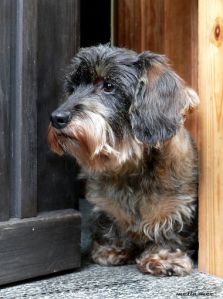
Not Max, either, but very close.

Max was a standard wire-haired Dachshund (born as he was in Germany, I’m sure he spoke Deutsch far better than I did, even though he was a dog). We lived in a third-floor flat, so it was necessary that we take him outdoors for a walk two or three times each day and a couple of times each evening. My  husband and I took turns when we were both home at the same time, and he usually took my turns for me when I had a bad flare going. Even so, there were many, many times when I limped slowly along behind my little dog, willing him to just get on with it, please? my teeth gritted against the pain. Sometimes I counted cadence under my breath (HUP-two-three-four!)\. I even sang childhood songs (The ants go marching one by one, hurrah, hurrah) in time with my steps, distracting my panicky mind from the awful pain. When we climbed all the way back up the stairs to our flat, Max snuggled up next to me on the sofa, transferring his warmth and yes, his love, to me. I’m convinced that he knew; that he wanted to comfort me in any way he could. And he did.

Logan was much larger, an unexpectedly gorgeous cross between a border
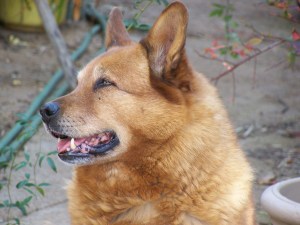
Logan in 2007

collie and a Queensland healer. He had long, thick russet fur—fur so luxurious the full length of my fingers would disappear in it. It was incredibly soft and warm, and it felt so good on my flared knuckles. Strange and a bit addled from puppyhood, Logan was nonetheless tender and devoted to me and the other members of the family. He always sat patiently as I warmed my fingers in his fur, soothing the dreadful aching. Often, when I took my hand away, he’d turn around and nudge at it with his nose until I let him kiss the affected fingers, his tongue soft and infinitely gentle. This from a dog who, from the time he was about eight months old, was so dangerously aggressive with strangers we had to keep him locked away from visitors throughout his long life. Logan was the most difficult dog-friend  I ever had, but I loved him completely.

PIB (Puss in Boots) was a tuxedo cat. He spent the first eight years of his life as an indoor/outdoor cat, always friendly and affectionate but, like many cats, very independent and frequently standoffish. Though he’d been neutered, he still guarded our property as his own territory and defended it
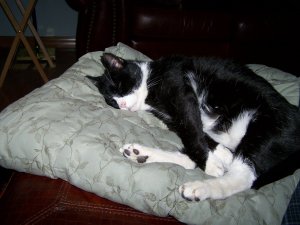
PIB, snoozing.

fiercely against other feline intruders. Finally, his over-inflated sense of duty just about killed him. After much home nursing and veterinary expense, PIB recovered after a long battle against a terribly infected, abscessed wound in his belly, presumably the result of scrapping with someone who had much larger teeth than his own. The result: when he healed, PIB became an indoor cat.

Though he perceived his confinement as an undignified insult at first, eventually PIB decided that his new life of leisure was pretty darned comfy after all. When I was laid off from my job and began spending great swaths of time at home in the daytime, PIB became my 24-hour-a-day companion. Where once he’d enduredthe indignity of being held and petted as part of his job as family cat/property guard, now he sought it out, spending a great deal of time on my lap, purring when he wasn’t actually snoring. He didn’t mind if I slipped my hands under him for the deep warmth his little body radiated. And when I got hip bursitis, he made it a habit to meatloaf on my hips at night, once again sharing his magical cat-warmth. As time passed

Sweet Nessie.

we became closer and closer, PIB and I. I brought him over to live at my mom’s house with us once it was clear she shouldn’t live alone anymore. And when PIB died at 15 years old last fall, I simply crumbled with grief. That sweet old cat was my brother.

These wonderful animals—and all the others: Jake, Petey, Mugs I and Mugs II the boxers; Albert the Boston terrier; Winston the English bulldog; Spinner
Mugs II near the end of his life.
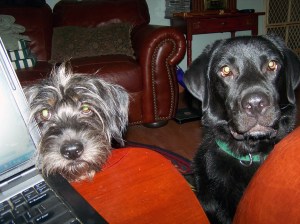
Finny and Shadow.

the Siamese cat; Alex and Merlin the marmalade tabbies; sweet Nessie the Doberman mix; Finny McCool the Scottie/Schnauzer (Schnottie?); Shadow the Labrador retriever; and now, Mouse the Maine Coon cat—each gave or still gives me love and devotion, laughter, comfort, my Beloved Friends and Companions. Brothers and sisters, even. As Adrienne, the writer of the blog You Don’t Look Sick wrote yesterday, “Dogs are so intuitive.  My doggies know when I am ill and won’t leave my side.  When I am in bed sick, they don’t even want to leave me to go eat.” Adrienne gets it. She obviously has some dear animal friends, herself.

Dogs surely are intuitive and deeply empathetic. Cats are, too. I can’t imagine my life without the selfless, unconditional love, sweetness and joy my companion animals have given me. It would be a barren, much less joyful life without them, I think. My hope is that I’ve fully returned that same generousness of spirit to them as I’ve cared for them, gave them a warm, comfortable home and even gave each of them a comfortable bed (usually mine). I’ve done my
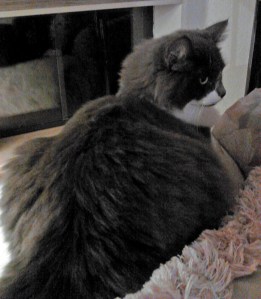
Mouse the Cat

best to freely give them back all the love and comfort they’ve given me to me.

Big, fluffy Mouse is becoming more and more comfortable with me and her new home as the days pass. She’s goofy, sweet and heartbreakingly affectionate—just exactly what I hoped she’d be like when I adopted her two weekends ago. My achy fingers sink to the palm into her thick fur, and she likes it. She purrs and rumbles and bumps her head into my hand, reminding me of my old buddy PIB and bringing tears to my eyes.

He, Max, Logan and Hector would be proud.

Getting serious

Twenty minutes on the recumbent bike, pedaling, pedaling and pedaling as I watched, on a flatscreen TV set high up on the wall, a mindless but beautiful couple blather on about Demi Moore and her mystery illness.  I moved on to the weight machines, set up in a circuit. Mike, the middle-aged fitness trainer, showed me how to use them and then encouraged me through 20 repetitions on each one.

“Tomorrow,” he said, “we’ll do this all over again, but work on breathing, too.”

I nodded, pleased with myself for having done all that sudden exercise without weeping.

“Have a nice evening. Eat carefully,” he said. “Drink a ton of water. Get a good night’s sleep and I’ll see you tomorrow.”

And with that, I completed my first workout at a gym about a mile from mom’s place.  It’s something I’ve been mulling over (instead of just doing) for way too long. This last year or so of caring for my mom—coupled with RA and hip bursitis pain—has left me fatter and much less fit than I was. So yesterday I finally gathered up all my courage and walked my blumphy self through the gym’s doors, where I asked Mike the trainer if he could help me, a 55-year-old, post-menopausal woman with rheumatoid arthritis, hip bursitis and osteoporosis, get fit.

Yes, he said, he probably could, as long as I was willing to do my part. I asked what it would cost, and to my surprise, discovered that I could just afford it.

Until the bursitis attacked a couple of summers ago, I walked for exercise, usually two or three miles three times a week. But when I went to physical therapy for the bursitis, I was told to walk only short distances or I’d make it worse.

I didn’t argue. I couldn’t even grocery shop without my hips aching, the joints feeling as if they were coming loose. Still can’t, most days.

So here I’ve been, living with and caretaking my mom, who loves cookies and candy and ice cream and, for most of the last year, who’s been ill and housebound. It wasn’t long before my willpower, never terrific to begin with, gave out and I was enjoying those sweet, carby things with her. My weight ballooned, and in February I got scared and went back on a serious diet, dropping 30 pounds over six months in spite of getting no exercise to speak of.

Then Halloween arrived. There was candy. Then Thanksgiving got here, filled with cookies, pies and cakes. In between were restaurant meals and fast food. And then there was Christmas. More candy. More cookies and pies and mashed potatoes and gravy and stuffing and dinner rolls…

Throughout January I told myself to stop eating crap—my clothes were getting really tight again. I told myself, but I didn’t stop. Mom bought bags of cookies; I helped her eat them. And then I had my rheumatology appointment. The nurse weighed me. I was shocked and appalled: I’d put all those hard lost pounds back on. No wonder nothing fit me comfortably anymore.

I went to the gym again today. It was a little harder—my muscles were a bit tired from yesterday—and this time, I broke a sweat. Mike told me to expect to be very sore tomorrow. “So when you come in, we’ll see what you can do. The plan is for the bike again, the machines, and then, if you can, the elliptical.”

Wow. The elliptical. I’ve never used one of those before. I hear they’re… awesome.

I’m looking forward to making exercise each day into a habit. I need to. I simply can’t afford to get heavier and put more stress on my joints. I need to build and maintain stronger muscles to support my joints, too. And now that I’ve been diagnosed with osteoporosis, it’s vital that I do weight-bearing exercise to build up all the bone strength I can manage. Rheumatoid arthritis is hard enough when I’m at my fighting weight and fairly fit. If I’m obese and weak, I’m setting myself up for more pain and disability. And chances are, I’ll end up breaking bones doing normal everyday things like standing  up.

And frankly, setting my will on exercise is something I need to do for my self-image and my self-confidence. When I’m heavy and weak I feel unattractive and lumpy. But when I’m eating good, nutritious foods and moving my body, I feel better. I’m more positive. I have more energy, even when I hurt. I can smile easier and more often.

It’s not a walk in the park, this exercise thing. I’ve got to go to the gym early tomorrow morning, before heading over to my aunt and uncle’s place for the day. That means I need to push myself away from my laptop and get myself to bed. At the moment, losing those 30 pounds—and then, 20 more—again seems impossibly daunting. But I know I can do it, probably by June and maybe sooner, since I’m exercising this time.

Who knows? Maybe I’ll kill off the bursitis while I’m at it.


Pressure’s up …

First, I must ask you to indulge me in a brief but heartfelt rant:

Sea surface temperature anomalies in November 2007 showing La Niña conditions. Blue=temperature below average; red=temperature above average

Our weather, which was so wonderfully and painfully wet and stormy just last week, has reverted back to ridiculously mild.  There’s another gigantic high pressure area plopped on top of us, keeping anything that even hints of rain diverted northward. It’s all caused by La Nina, the powerful and infrequent cool current out in the Pacific that, like it’s “brother,” the warmer current called El Nino, affects global weather in strange ways.

Right now, here, La Nina is making what should be the depths of winter look and feel like mid-spring. I should be pleased—most normal Californians love this weather, after all. It’s why they live here. I’m an aberration. See, after the interminably long summer, I was really looking forward to winter. I wanted the change. The opportunity to wear different clothes. This winter, which actually began, unofficially, in November, has brought real rain (by which I mean more than a moist drizzle) twice. Yes, you read that right. Two times.  The first, in early November, was a brief but satisfying soaker. The second rain was last week’s chain of storms. The change in barometric pressure from high to low brought the storms in and made my rheuma-dragon cranky and restless, but it was so nice to see and hear, taste and smell the rain and wind. It felt like an old friend had come to visit.

La Nina closed the storm door up tight again, though. On the valley floor they’re socked in with pea-soup fog each night and morning, but we’re not even getting that here in the foothills. The days are stuck, again, in the mid-to-high 60s, mostly sunny, and clear. Blah. Boring. Dull.

I know. I’m crazy to perceive gorgeous weather like this as distressing. But dang, I miss winter. It’s a very short season in California anyway. I’d like to see at least a little of it.

All right. Enough carping.

RA-wise, I’m back to my personal normal: Mildish aches in my hands and wrists, punctuated by sudden, unexpected twinges as I use them. The @!#*!!  bursitis is also active, causing my hips to ache dully and constantly. Both conditions are completely bearable and completely annoying. But if I keep my mind focused on other things, I can mostly ignore them. Blessings come in strange packages sometimes.

The big news concerns my new cat-friend, Mouse. She’s an eight-month old Maine Coon with long, fluffy fur that’s mouse gray and white in a tuxedo pattern. I adopted her last weekend from a cat-rescue organization in my aunt and uncle’s town down in the valley.

My old buddy PIB (Puss In Boots), when he died last October at 14 years old, left me grieving and with a big empty spot in my heart. He was, truly, a dear friend. I’ve missed him deeply, particularly at night, when he’d snuggle up close and purr me to sleep. And if I sat down for more than five minutes during the day, PIB would appear out of nowhere and ask to be lifted onto my lap for a stroke, a long purr, and a nap. That sweet ol’ tuxedo cat was the very embodiment of the phrase “companion animal.”

On Christmas Day, I opened a card from Mom. In it she’d written that her Christmas gift to me was another kitty, if I wanted one. I was touched and surprised, as she’d been clear after PIB died that her two remaining cats were more than enough for one house. It had saddened me. Kitty-Kitty and Emma are nice cats, but neither of them is cuddly like PIB was, and they’ve both bonded with her. I glanced over at my sister, who was home for the holiday from New Mexico. She grinned and winked at me.

Sweet sister. She’d persuaded mom to relent and let me find another kitty.

Mouse weighs nine pounds. I’ve long had a wish for a Maine Coon cat, as the breed is characteristically very affectionate, calm and, yes, big. It takes three to five years for a Coonie to reach her full growth, and females average about 14 pounds. The males can weigh up to 25. As I write this she’s still a bit shy, getting used to her new home and her new cat companions. But when I coax her close to pet her, she bumps her head into my hand and her purr-motor starts. She snuggles and snorgles and rumbles.

The best news is that mom likes her, too. It’s gonna be all right.

Pain and memory

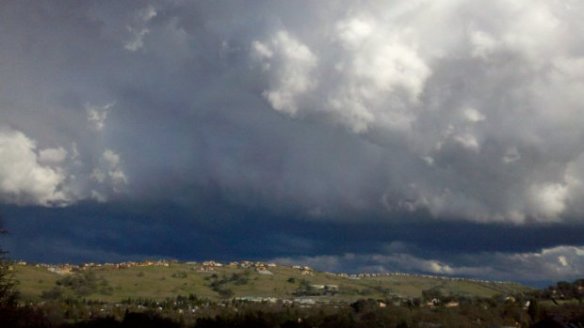
On Thursday last week the Pacific “storm door” finally opened up to a chain of wet, blustery storms. They’ve swept into California one after another to give us a thorough, desperately needed soaking in the valley and foothills—and multiple feet of snow in the Sierras. It’s Monday now and still raining. It’s just lovely.

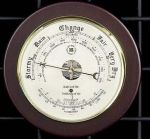
The bottomed-out barometer that unlocked the storm door has been wreaking havoc with my RA and hip bursitis, though. I felt the inflammation start building up early last week, so it wasn’t really a surprise.  The only thing new about this pain is that it’s worse than it’s been in a long, long time. It sort of blindsided me. And suddenly, I’m finding it difficult to cope.

How can this be? After 24 years of rheumatoid arthritis, you’d think that I could deal with pain without a lick of effort. But here I am, once again stunned at how much my hips hurt, how much my knees and fingers ache, and how impaired, how profoundly weary the combination makes me feel.

Yes, it’s been worse. Much worse. I can recall times when the pain of moving an intensely flared joint—a finger, a shoulder, a knee—made me moan and cry out like a child. I can remember when a badly flared joint in my foot made every step I took an act of extreme bravery, of stubborn determination. The flares happened over and over again. The only variation was which joint was involved and what day—even what hour—it was.

So even as much as I hurt right now, this pain is nothing like it was in the old days. Why is my breath held, waiting for it to get even worse? Why am I so shocked?

Well, those bad old days when my rheuma pain was awful left me with some trauma, as stress and pain can do to anyone. With that in mind, I’ve done a little research into trauma and how we remember things.

According to a website Google directed me to called Human Priorities:

“(T)he conscious memory system keeps its memories pretty much out in the open, and we can usually find them when we choose to and ignore them if we want to. But the unconscious memory system keeps its memories tucked away until our brain systems tell it we need them for survival purposes (to pull us toward things that will bring us pleasure, or warn us about things that will cause us pain). Then it pulls them out and puts them right in front of us where we can’t ignore them—as images, sounds or smells ‘in our heads,’ strong emotions, or sensations in our bodies .

[snip]

“But why do we sometimes forget times of extreme pain and danger—like the women who forget the pain of childbirth, the adults who don’t remember bad things that happened to them as kids, or the veterans who can’t remember firefights or explosions they were in?  That’s because of the way our different brain chemicals work together under stress and threat.  In some cases, our brains may “record” intense unconscious memories of sights, sounds, smells, and feelings, but have trouble recording the conscious memories that would help us piece together what happened.  In both cases, this is the body’s best guess at what will protect us and help us survive.”

This makes sense to me. When my rheuma symptoms hit a certain way—a sudden, sharp twinge in my fingers as I’m lifting my coffee cup, for instance—I instantly flash to a time, years ago, when my bad flares would begin with just that ugly sensation. So my current nerviness is a result of my unconscious mind warning me that worse pain may be on the way. It allows me to prepare, at least mentally.

Most of what I’m feeling right now is hip bursitis, which makes me gimpy, sore and grumpy. But the last storm in this cycle is slowly moving eastward, and there are no more storms in the immediate future. The barometer is already rising, so tomorrow will bring partly cloudy skies, no rain, and warmer temperatures.  The rheuma symptoms may wane. And perhaps it means waning bursitis pain as well.

Fingers are crossed.

It’s a lift

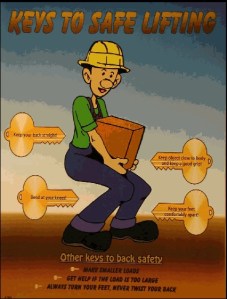
For all of my adult life I’ve been admonished, from one job to the next, to lift boxes, etc. properly to avoid injuring my back. And all my adult life I’ve met other adults who did hurt their backs, presumably because they foolishly ignored the warning. I’ve seen posters, illustrations in employee handbooks and fliers from safety briefings that employ stick figures or models demonstrating the safe and proper lift techniques. I’ve always taken note, and I’ve always tried to comply.

You can see where this is leading, yes?

On Thursday, as I was taking my uncle’s collapsed wheelchair from the back of his gigantic SUV, I injured my back. I didn’t notice at the time. I’ve lifted that bloody wheelchair into and out of that car dozens of times in the last year. Each time—including this one—I tried to be careful, even though the wheelchair is awkward and unwieldy.

I’ve always been a lot stronger and tougher than I look. I’ve moved furniture, hefted boxes full of household items, pitched hay, cleaned stalls and lifted heavy saddles onto the backs of tall horses. To get into the Air Force I had to dead-lift 60 pounds from the floor to over my head. I’ve generally managed to lift or move heavy stuff whether there was a man with larger muscles than mine nearby to help or not. Usually there was not. I’m used to getting an astonished “you moved that?!” from friends, family members and colleagues, after the fact. And I’ll be honest. I’ve always taken an odd sort of pride in my 5-foot-4-inch Mighty Mouse prowess.

But this time, I did myself in. Two hours after the fateful lift I started feeling some unaccustomed pain in my lower back and across my hipbones. I’ve only very rarely experienced low back pain; it’s always been mild and fleeting when I have. This time, I noted it and went on with making supper. The hip pain didn’t feel much like my usual bursitis pain, and it didn’t feel like my old nemesis, the rheuma-dragon, either. Ominous.

By the time I got home to my mom’s house, the pain was deeper and more insistent. Uh-oh, thinks I. I’ve screwed up my back. How…?… and then, of course, I remembered muscling that folded wheelchair into and out of the back of uncle’s tank-like SUV.  Just like I always do. Why did I hurt myself this time? What did I do wrong?

I’m not sure, but I bet it had something to do with straight legs, a bent back, and a quick, twisting heft. All wrong.

I slept rather poorly Thursday night. No surprise, really. I pushed myself through the day yesterday at aunt and uncle’s place again, making breakfast, grocery shopping and preparing meals for evening and the weekend. At one point in the mid-afternoon I took more pain medication and snatched a gel pack from the freezer, plopped myself into a chair, put my feet up and iced my furiously complaining back. It helped for a while. And last night, I alternated ice and heat all evening long. Naturally, by that time the bursitis had gleefully joined the chorus, and the rheuma-dragon, not to be outdone, was gnawing hard at my knuckles and wrists.

Add to all that the annoying, intensifying cold symptoms I’ve been successfully fighting off the ramparts all week, and you get a pretty good idea for how I felt last night.

And this morning? I got up this morning with the Cold From Hell having totally breached my defenses. I’m nose-clogged, weepy-eyed, tickle-eared and croaking. My head feels like it’s packed with dirty wool. And my back? Dang that hurts.

So today I’ll keep icing, take my blessed pain meds on a strict schedule, do some low-back stretching exercises (I know them from coaching Mr Wren over the years) and resting. I’ll keep drinking Airborne for the cold. I know all it has in it is vitamins and herbs, but I swear that even though it didn’t stop the virus in its tracks this time, it has several times in the past. This time around it helped my Terminator immune system to hold the CFH off for several days, long enough for me to help mom through the worst with hers and help my uncle get to his eye doctor and his appointment with the blind services lady out at the VA hospital. And I got a few meals made ahead for him and my aunt. I feel rather accomplished.

After all that, it’s almost a relief to succumb to the inevitable and let the CFH run its course. And though my back hurts, I feel sure that it’s healing. With luck and care, it should be better in another day or two. I’m just going to lean my recliner back a bit, put my feet up, keep the tissue box handy and relax for the weekend. Netflix, here I come.

The Terminator

I haven’t got time for a lengthy post, but I’m making time for this:

When my sister was here from New Mexico for Christmas, she brought the Cold From Hell with her. A week or so after she went home, my aunt came down with it, and a couple of days after that, my Mom caught it. She’s basically been laid up since last Thursday, though she’s feeling much better today.

Now, I haven’t caught a bad cold in—literally—years. I’ve had the occasional 24-hour stomach bug, but even when everyone around me was dropping like flies from the annual everybody-gets-it crud, I powered on. It’s been at least since 2003. I’ve thought for a long time that if there’s an upside to having a supercharged autoimmune system—one so hyped up it attacks the body it’s supposed to protect—it’s this. Your garden-variety rhinovirus simply hasn’t got a chance against my autoimmune superpowers.

I thought that when I started taking DMARDs for my rheumatoid arthritis, I might start catching colds again.  After all, DMARDs do suppress the immune system, which is how they work against RA. But since I started them in 2009, still no colds.

So. Even though I seem to be immune, since mom came down with the Cold From Hell last week, I’ve been guzzling down Airborne. Just in case. And for the last three days, I’ve awakened in the morning with had that odd, thick, swollen feeling at the top of my throat that heralds an oncoming bad cold. But it hasn’t progressed. Instead, that swollen feeling lessened as each day went on. My sinuses have been sort of clogged, too, but I have a grass allergy that pretty much stays active year-‘round, so I’m telling myself the congestion is from that, not the Cold From Hell. I feel like the Cold is trying to break down my defenses, but each time it manages to breach the wall, my brave, muskle-bound immune system fights it off and rebuilds the wall.

I’m not writing this to brag. In fact, I have a feeling that I will, finally, catch the Cold From Hell this time. It’s a doozy. I know from reading your blogs that many of you catch colds with frightening ease, thanks to the DMARDs and biologics (especially those) you take for RA. I feel for you, believe me. But is there anyone else out there like me? Whose immune system thinks it’s the Terminator?

Okay. I’ve got to run—my uncle has appointments today with the eye doctor and Blind Services at the VA hospital. Here’s wishing all of you a terrific day and an even terrific-er (!) weekend.

Pain-scale purgatory

I managed to miss RA Warrior Kelly Young’s blog carnival about the pain scales doctors use to assess our pain and how effective they are, but I’d like to put my two cents worth in, anyway:

Imagine—or recall, since we’ve all experienced this at one time or another—a dull headache.  Think about how that headache influences your day: You continue to interact courteously with others as your day and your headache progress, but each interaction—normally effortless—requires your full attention. The headache is distracting, too. It prevents you from focusing the way you’d like to on each task. You begin to get frustrated.

As time passes, the dull pain in your head doesn’t get worse, but its steady persistence starts to wear you down. You think more and more often about the pain and how you’d really like it to go away. You wonder why the Tylenol you took for the headache isn’t working and whether if it would be safe to take more, or perhaps to take something else, something stronger. You decide not to take the risk, but the decision makes you feel hopeless.

The way you deal with others—family members, co-workers—starts to suffer. Your pain now colors everything, and you get cranky and critical in spite of yourself. Worse, the headache is now causing other parts of your body to react. Your neck and shoulders stiffen up.  You’re hungry, but you feel a little nauseous. Your eyes feel hot.

Somehow, you’ve made it through the lunch hour. The headache remains: it’s still a dull, throbbing, un-ignorable presence in your skull. Now you find yourself constantly checking the clock, longing for the moment you can stop for the day. Though you’ve stayed doggedly busy, you haven’t been able to accomplish nearly as much as you’d planned, thanks to this miserable headache. You wonder if it’s maybe, actually, a brain tumor. Maybe you should see the doctor. Even if it’s not a brain tumor, maybe she’ll prescribe something that will actually work so the headache will go away! You check your schedule. You’ll have to defer a couple of tasks, sure, to go to the doc, but the hope of beating the headache overrides your caution. You’ll just work harder  and catch up tomorrow, when the damned thing is gone. You call the doctor’s office for an appointment. And to your relief, they can work you in today if you get there as soon as possible.

You arrive at the clinic. The nurse calls you in to have your blood pressure and temperature taken. That done—and both are perfectly normal—he asks why you’ve come to see the doctor today. You tell him about the dull headache that won’t go away. He nods, jots something on your chart, and asks, “On a scale of one to ten, what number would you rate your pain?”

You hesitate. At this very moment, your first answer would be a forceful “10!” You’re perfectly miserable and have been all day!  The thing is, though, you’ve had worse headaches than this one. You’ve had headaches that, in retrospect, you’d rate as eighters or niners. If you’re honest, this dull headache isn’t even close to an eight or a nine. In fact, it’s probably closer to a five. But if you choose “five,” that number doesn’t take into account how stiff and sore your neck is, now, does it? You remember the way the doctor blew you off the last time you came in to see her. You don’t want her to think you’re exaggerating your pain; she obviously did that last time.

“Um,” you say weakly, “a three.”

The nurse writes the number down, takes you to an exam room and leaves you to wait for the doctor. Your head feels like it’s going to explode. Why did you say “three” when this pain is obviously a bloody 10? Why are you embarrassed? Is your pain a three or a ten? How can you even answer that stupid pain-scale question?

So. The above is all about a regular, garden-style but persistent headache. Now imagine that you have rheumatoid arthritis, and it’s not your head that has that dull headache, but your hands. Or your right knee. Or your left shoulder. How about your jaw? Or one of the many joints in your right foot? Or your ankle? Or maybe the “headache” is all over your body, making you feel as if you’ve been battered like a tennis shoe in an all-night clothes-dryer. You’re miserable and desperate to somehow get the pain to stop, because even though you can’t honestly rate it more than a “three” on a scale of one to 10, after enduring it for most of the day, it feels like it’s a 12.

And if you tell the doctor that, he’ll think you’re exaggerating wildly. When you ask for pain relief, he’ll think you’re drug-seeking. If you were him, given your normal stats, you’d think that, too.

But you are drug-seeking! You desperately want him to prescribe something that will, without delay, make your pain go away. For good. But if you tell him how you really feel (12 going on 15 on a scale of one to 10), he’s not going to give it to you, you junkie!  If you under-rate the pain, he’s going to give you a prescription for Tylenol and act like you’ve wasted his time. Which you have—both his and yours, since you already know Tylenol won’t work.

Sigh. Pain scales. They’re too subjective to be very useful, but I understand why doctors use them. They need some way of understanding their patient’s pain levels so they can treat them successfully. But somehow, someone needs to come up with a better scale. I’m afraid I don’t have any answers, but I absolutely relate to the problem. I have headaches in my hands all the time. Some days are worse than others, but no matter how hard I try to ignore them, they sometimes color my otherwise rosy view sludgy and gray. Like a dull headache, the pain in my hands, while initially not high on the pain scale, gets worse as the day passes so that the pain I’d initially rate as a “three” is a “ten,” in my perception, by the time I see a doctor.

Sigh.

Please don’t forget to visit RA Warrior to read other RA blogger’s takes on the ubiquitous pain scale. They’re all excellent.

Note: Edited to correct the silly misspelling of “purgatory” in the title. Heh.

To all my friends …

May the blessing of light be on you, light without and light within. May the blessed sunshine shine on you and warm your heart till it glows like a great peat fire, so that the stranger may come and warm himself at it, and also a friend.

And may the light shine out of the two eyes of you, like a candle set in the two windows of a house, bidding the wanderer come in out of the storm, and may the blessings of the rain be on you — the soft, sweet rain. May it fall upon your spirit so that all the little flowers may spring up and shed their sweetness on the air. And may the blessings of the Great Rains be on you, may they beat upon your spirit and wash it fair and clean, and leave there many a shining pool where the blue of heaven shines, and sometimes a star.

And may the blessing of the Earth be on you — the great round earth, may you ever have a kindly greeting for those you pass as you’re going along the roads. May the earth be soft under you when you rest upon it, tired at the end of a day, and may it rest easy over you when at the last, you lay out under it, may it rest so lightly over you that your soul may be off from under it quickly and up and off, and on its way to God. And now may the Lord bless you all and bless you kindly.

– Traditional Irish Blessing

Living in the fast lane

Sunday morning, Christmas week. It’s early, quiet, no sounds but those of thundering cat’s paws up and down the carpeted stairs as they play a rousing game of tag-you’re-it. Mom’s sitting up in bed with her coffee, reading the newspaper. I’m sitting propped against the headboard too, but I’m tapping on the computer, and I’m waiting the prescribed half hour for my weekly osteoporosis pill to dissolve in my stomach before I get a first, heavenly cup of coffee for myself.

I love that first cup of the day. When I read the directions for taking that first Fosamx pill I was appalled.  “Take with at least 8 oz. of water. Do not eat or drink anything else for 30 minutes. Remain upright; do not lay down during that 30 minute period.”  What? I couldn’t even have coffee?

Not even coffee. Eight weekly doses later I know that 30 minutes passes quickly if I absorb myself in a book or reading the headlines on my laptop. It’s not so bad.

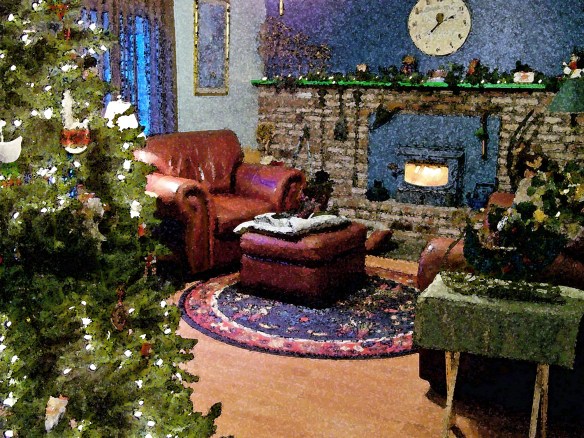
My Mom is doing great. What a difference from last Christmas, when she was totally knocked flat by sciatica, weakness and nausea, far too ill for holiday company. Today she’s busy and bouncy and so jazzed by the idea of Christmas that the whole house is decorated with Santas and reindeer and poinsettias and ornaments and twinkling lights. Yesterday she came skipping downstairs with a stack of kitchen towels in her arms. “Look what I found!” she said, smiling. “Christmas dishtowels!” Sure enough, they were all covered with snowmen, Christmas trees and elves. “I had them put away in that trunk upstairs,” she said, pleased as punch. “I’m so glad I found them!”

She’s eighty.

And I’m doing all right. Hip bursitis continues to have me firing on three cylinders most of the time, but after consultation with an actual orthopedic surgeon, I’ll soon be starting a new round of PT, focusing on ultrasound therapy. If that doesn’t work, I’ll either learn to accept this constant, variable pain and its corresponding limp as a forever thing, or be bold and go with The Knife (surgical trochanteric bursectomy of both hips). I’m not sure which I’ll choose in the end, but I’m not really convinced that more PT will make any difference. Fingers are crossed.

And my ol’ rheuma-dragon? He remains sleepy, only occasionally chewing on the odd joint like a drowsy baby gumming a pacifier. Of course, unlike a baby my dragon has sharp teeth, so the gnawing isn’t particularly pleasant. It’s generally confined to my hands, though, and it’s bearable. It only slows me down a smidge. I remain deeply grateful to my rheumatologist for the cocktail of DMARDs he’s having me swallow each morning and night. Without them I’m sure I wouldn’t be enjoying this current freedom from agony. I’m distinctly aware, too, that it can change at any moment.

So why haven’t I been posting here at RheumaBlog? Until this moment, I’ve still been fighting an ugly bout of writer’s block. You know how it is. You start writing with enthusiasm, stop to read what you’ve written, and notice that your words are about as airy, warm and spirited as thick, cold mud. So you go back and change a word here, another word there. Nope, doesn’t help. The graf still plods like a half-dead mule. You rearrange a sentence. Another. Oh, cripes–now it’s worse than it was when you started! You delete the whole thing in disgust and start over again. A few minutes in, you hear those famous, ominous Borg-ish words in your mind: “Resistance is futile.”  Great. Fine. I’ll just play some Solitaire, get my mind off writing. I’ll tackle it again in a while, when I’m fresher.

Four or five days later you try again, only to find your mind and your words still hopelessly mired in muck.

So there’s that. And, with Mom feeling so good, I’ve been, well, kinda busy. There’s just not much time to spend in prosy contemplation when she’s on her feet with her key wound up tight. There’s always something she needs to do—and that she needs my help with. When she finally rests, she immediately turns the TV on. Since Mom’s hard of hearing (and like most elderly folk, unwilling to go to the trouble and expense of hearing aids), she turns the volume on the thing way up.  This is not conducive to writing anything more complicated than a grocery list. It’s funny. I used to write news stories with phones ringing constantly, reporters asking me questions, editing other stories, deflecting locals with complaints… and all of that while the police scanner on my desk blatted assault and mayhem. On deadline. Now I need silence and time to write? Sheesh. I’m pathetic.

Finally, I’ve been spending two days and a night each week at my aunt and uncle’s house, where I’m too busy to sit down and write. Last week, I also took another elderly family friend to and from his appointment for laser cataract surgery and then, the next day, the follow-up appointment. Oh, and did I mention? My Mom’s brother from Washington, DC was here a couple of weeks ago for a five-day, whirlwind visit.

And now Christmas is nearly here, full of last-minute-shopping, gift-wrapping, and the day itself filled with family and feasting (which I need to plan, grocery shop for and cook while trying to keep Mom from overdoing it).

Hmmm. Now that I’ve written all that down, I’m not as embarrassed about not posting to RheumaBlog. How ’bout that?

I promise I’ll write about Sir Peter in Cologne and Cessna-landing before too much more time passes. After the holidays, okay? In the meantime, please know that I’m thinking about all of you, reading and commenting at your blogs when I get a few minutes free, and wishing every one of you warmth, peace, comfort and joy, not just during the holiday season but for always. I’ll be back soon.