Trudeau Stress Less review and giveaway

Did you know that you have 27 separate joints in each hand? And eight in each wrist?

I didn’t either, but it’s true.

Those 35 tiny joints, several of which may be inflamed at any given moment, explains a lot of the pain and discomfort I’ve had in my hands and wrists off and on for the last … well … several years, now. Not to mention the last several months and weeks, when the pain started ramping up and sticking around full-time.

So perhaps you can understand why, when Trudeau, a maker of high quality kitchen products, emailed and asked me to review their new Stress Less line, I agreed to help them out. Hmm, thought I. Anything that stresses those 35 wee joints less as I prepare meals each day will be greatly appreciated.

Before I gave Trudeau an answer, though, I had a look at their website. I wanted to be sure that I wouldn’t be wasting my time—or theirs. To my pleasant surprise, the Stress Less line looked and sounded like capital Q Quality products. I emailed back to Trudeau and agreed to write the review.

Several days later a largish package arrived in the mail. Gently nestled inside cushiony swathes of bubble wrap were large, matching salt and pepper mills, a can opener, a pizza cutter, a garlic press and a cheese shredder.

My first impression? How absolutely well-made these kitchen gadgets were! Each one felt smooth and solid in my hands. Initially, I wondered if their weight might be a problem on bad-hand days, but as I discovered later, the products’ slight heaviness is an advantage. They’re beautifully designed and perfectly balanced. They feel good and they look good.

The first products I tried—at supper that evening—were the Stress Less Easy Grind Salt Mill and the Stress Less Easy Grind Pepper Mill. With their modern, ergonomic design, both mills are easy to grip—and they’re easy on the eyes. They’re made of tough, crystal-clear acrylic and shiny stainless steel. The big knobs on the cranks are made of a nice, grippy black rubber.  Unlike other mills, which require that you twist both hands in opposite directions (a maneuver that can be excruciating for someone with sore, tender joints) to work the grinder, I found I could gently grasp the narrow-waisted middle of the Trudeau mills with my left hand and turn the crank almost effortlessly with my right. A separate knob allows you to choose the fineness or coarseness of the grind. The grinding mechanism is made of stay-sharp carbon steel and has a lifetime warranty.
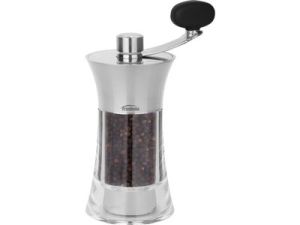
Trudeau states that these mills are four times easier to use than other mills, and I have to believe it. They’re useful, functional, beautiful tools. I loved them from the start and have used them daily ever since they arrived.

It wasn’t until a few days later that I tried the Stress Less Pizza Cutter, mainly because it wasn’t until then that we had an actual pizza to cut for supper. The Trudeau version of the gadget looks just the same as any other pizza cutter except for one thing: the cutting wheel is about 50 percent larger. At first I wondered what the big deal was. So the wheel is bigger, so what? When the pizza came out of the oven, I compared the Stress Less cutter with our old one.
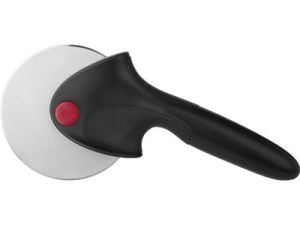
Well! To my surprise, I had to press down much harder on the older, smaller cutter and roll it back and forth several times to get a full diagonal cut all the way through the pizza crust to the board.  The Stress Less Pizza Cutter, however, needed little downward pressure. The oversized cutting wheel meant that I didn’t need to roll it back and forth more than a couple of times. In addition, the Trudeau pizza cutter’s ergonomic handle (with a finger guard) can be gripped and used at a 45 degree angle to the pizza or gripped … hmmm … forehand, with the cutter upright and at right angles to the pie. The wheel is made of stainless steel, can be detached from the handle for easy cleaning, and comes with a lifetime warranty. It’s a keeper.

Like the pizza cutter, the Stress Less Garlic Press doesn’t look much different from other garlic presses. Maybe it’s a little larger. But here’s the key difference: the Stress Less Garlic Press has been uniquely designed so that it can rest on the counter. The garlic clove can be pressed using your body weight rather than squeezing the handles in your hand! If you’ve ever needed to press garlic when your hands are hurting, you can appreciate this. All by itself, it makes the Stress Less Garlic Press a valuable gadget for your kitchen. Other nice features: the handles are comfortable and non-slip, there’s a built-in cleaner, the press is dishwasher-safe and it comes with a five-year warranty.
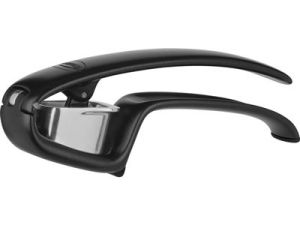
We don’t use a lot of canned goods around here, so it wasn’t until Mother’s Day that I finally tried the Stress Less Can Opener. The egg casserole I prepared for our family brunch required a can of diced tomatoes. Ahah! thought I. Finally I have a reason to try that Trudeau can opener!

Except I couldn’t figure out how to use it. It’s the sleekest, prettiest can opener I’ve ever seen, but if I can’t make it open a can, it’s useless. Frustrated, I pulled our old, manual rotary can opener out of the drawer and got to work.

Today, however, I decided to check the Trudeau website, hoping it might have instructions for that lovely can opener. Better than instructions: it had a video of someone demonstrating how to use the gadget. I watched, rolled my eyes at myself and went to the kitchen to open a can of tuna for my lunch.

With its ergonomic handles, the can opener fit the can just as shown in the video. Easy. I turned the crank, and wow, gang. Trudeau states that “An easier and safer can opener is a convenient kitchen tool for anyone, and for those with reduced hand strength, a must-have essential. The rotating cranking arm provides increased leverage, requiring 50 percent less effort.”

No kidding. That mighty little can opener took the top off that can so smoothly, and with so little effort, that I could hardly believe it. I don’t know about you, but I always dread having to twist the traditional can opener crank with my sore fingers. The Stress Less can opener requires almost no pressure. Another nice thing about it is that there’s a tiny gripper jaw to lift the top of the can away, which is handy. The removed can-top has no sharp edges. And the final cool feature? It folds nearly flat to fit neatly into your kitchen utensils drawer. I heart this can opener (now that I’ve got the hang of it).

I used the Trudeau Stress Less Cheese Grater in preparing our Mother’s Day brunch casserole, too. But I’ve got to be honest: this particular gadget wasn’t as easy on the hands as the others were, and I found it awkward to use.

That isn’t to say that it’s not a great gadget, because it is. States Trudeau: “[The] Rotary Cheese Grater requires minimal effort to grate cheeses and chocolates. Ergonomically designed to reduce pressure on fingertips and eliminate wrist torsion, the cast iron handle rotates easily which activates the stainless steel grating drum to turn. The vertical design allows cheese to fall directly on food.” This is all true. But on Mother’s Day my hands were (as they often are these days) pretty sore. I cut an inch-and-a-half thick piece of sharp cheddar cheese and put it into the grater. Holding the grater shut with my left hand, I turned the crank with my right. It was pretty hard to turn while holding the grater over a bowl to catch the shredding cheese, and as the chunk inside the grater grew thinner, holding the gadget tightly shut took more and more hand strength. With a couple more similarly sized chunks of cheese left to grate, I gave up using the Stress Less Cheese Grater and went back to that old kitchen stand-by, the box grater. Mom happened by at just the right moment and took over the cheese-grating duties for me, saving my hands from further cheese-grating aggravation.
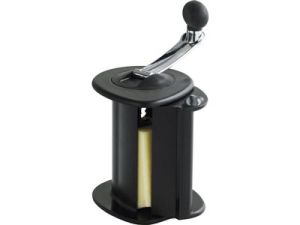
Trudeau states that the grater is designed ergonomically, can be used by both right- and left-handers, has a spring-loaded door and a stainless steel drum. It also has a lifetime warranty. All true.

I liked how finely the Stress Less Cheese Grater shredded that cheddar cheese, even though I had trouble using it. I think that it might work better on harder aged cheeses, such as parmesan or romano. Maybe the chunk of cheddar was too thick? I was also concerned that it might be difficult to clean the grater after use, since it doesn’t come apart. But a good rinse and a short soak left it nice and clean. I’ll certainly try it again when my hands are less sore.

Trudeau is offering two free sets (total retail price of each set is $143) of the Stress Less kitchen gadgets I’ve reviewed today. If you’d like a chance to win one of the sets, email me at bluewren56@gmail.com by midnight PST on May 20th. I’ll put all the names into a hat and ask my Mom to close her eyes and draw two at random on May 21st. Be sure to include your contact information in your email so I can reach you if you’re a winner. Trudeau will send the kitchen gadgets at no cost to you by mail.
 
Note:  Trudeau sent me their products to try, review and keep, but I was not paid nor did I promise Trudeau anything in return but an honest opinion about the products.  The opinion expressed above are mine and mine alone.

Changes …

Three days ago I made the decision to eat healthily and mindfully again. By that I mean I’m staying away from junk foods, those simple carbohydrates like candy and cookies, potato chips and crackers, white bread and pasta. They all convert directly to glucose after you eat them, causing a sugar surge in the body that can cause all kinds of damage over time.

Oh, my, what a temptation. Oh, my, how unhealthy this stuff is!

I’ve always had a really hard time not eating these foods when they’re readily available. They’ve been especially difficult for me to ignore since I’ve been staying with my mother. She loves them all and can eat them without gaining weight or having other problems.

I’m not blaming Mom for my own gobbling of foods that I know are bad for me. Just because they’re handy is no excuse. So, after several false starts, I’ve dumped that feeling of hopelessness and finally reached the mindset I need in order to eat better.

Why am I telling you this? Well, to share some goodish news. For last few days my long-term, RA-flared hands and wrists have been a little less painful. Does consuming fewer carbs have anything to do with this pleasant turn of events? What about eating lots of leafy greens and other veggies?  Or the fresh fruit I’ve been eating instead of handfuls of cookies or (hangs her head) jelly beans? Could those healthy complex carbs I’ve stuck to, like wholegrain bread, pasta and brown basmati rice, be having an effect on my RA?

Maybe. But even if not, there are a lot of other benefits to eating with care.

Kate, who writes the blog “Cooking with Arthur” is a clinical nutritionist in the UK. She has psoriatic arthritis and osteoarthritis in her lower back. Kate notes that for each pound of weight lost, you reduce the stress on your knees by four pounds.  And it’s been proven that eating with care so that you reach a healthy weight (not necessarily the bantam-weight society dictates) makes you feel better and reduces your chance of getting diabetes, cancer or heart problems, as well.

I don’t know if suddenly changing my diet is why my hands feel a little better,

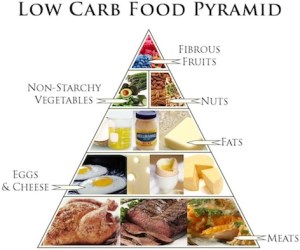
This is a much healthier way to eat. Note there are not even any wholegrain foods in this pyramid. I haven’t been able to do that well, yet, but I’m working on it.

particularly since the response came so fast. But I do believe that it can’t help but be helpful over time. Although I’ve given up a lot of ground in the weight loss battle over the last eight months, I’m finally back on the wagon now. I know from experience that I’ll feel better physically as the weight slips away again.

And I’ll feel better mentally, too. When I’m overweight, I feel blumphy, sludgy and slow. I dislike the way I look and the way my clothes fit (or don’t fit, unfortunately). I’m uncomfortable and uneasy in myself, if you know what I mean.

As those extra pounds come off, though, my spirits rise. I feel better overall. I know I look better, which makes me feel more confident. More cheerful.  Getting back to a healthy weight makes me stronger. Tougher.  More resilient. I move more, but with less effort. It’s a win-win situation.

Do check out Kate’s blog. She offers autoimmune arthritis-friendly recipes that are chock full of vitamins, fiber and protein. That’s wonderful by itself, but even better, her recipes are simple and delicious.

And I’m making some changes.


Riding the carousel (and get ready for World Autoimmune Arthritis Day)

I’m stuck, it seems, on the RA roller coaster. (Do check out RA Guy’s breathtaking video animation about that particular analogy. It’s quite fitting, except, unlike RA, the ride finally ends …)

Personally, I’ve never been fond of roller coasters. Too scary. To much harrowing anticipation, too many heart-stopping falls and jarring, jerking turns. Instead, I always preferred the carousel with its sweet, cheery music and brightly colored galloping horses and exotic wild animals. The carousel was perfect for a child with an overactive imagination. It never bothered me that my steed was only going in circles.  I was always sadly disappointed when the ride ended. If I’d had my way, I’d have stayed on that carousel all day long, lost in my imagination while the rest of my family got the daylights (and the carnival food) scared and shaken out of them on the roller coaster and bumper cars.

I was an odd child.

I was forced to ride the RA roller coaster for the first 10 years or so following my diagnosis. It was miserable. Jarring. Scary as hell. And then suddenly, without warning, I was allowed off the ride.  I went into complete remission—for about six years. It was nice, being back in the non-carny world. I was able to get on with things at a time in my life—late 30s, early-to-mid 40s—when careers typically take off. I was a professional journalist with a job I loved. In my off-work time, I enjoyed hiking, backpacking and camping in the wilds with my family. Things were going very well. I began to forget the roller coaster years.

Of course, my RA woke up and became active again. I was back at the carnival, but instead of being forced into a seat on the roller coaster, I was allowed to ride the RA carousel.

This analogy works for me when it comes to how my RA has been over the last seven years. (I am always a bit stunned when I realize how many years have passed since I was in remission!) My less-than-trusty steed is the rheuma-dragon, slick, shining, blood-red and oozing black.  He slithers around in a wide, continuous circle, never really reaching a goal (either remission or cure). Along the circuit he rises and falls. For the first couple of years, the ups and downs were gentle, sometimes almost imperceptible apart from the sharp-toothed, nibbling fear that the dragon carousel might transform into a roller coaster. The ominous symptoms of the disease were back, but they were mild, easy to deal with and sometimes, even easy to ignore. So I did, as often as I could.

Over time, though, the dragon’s ups got steeper and scarier, and the downs more like free-falling. The carousel started speeding. I started thinking about getting off the ride while I could (found a rheumatologist and began drug therapy).

Today the carousel whirls and the dragon leaps and falls, leaps and falls, with only a few, unreliable hours of level motion in between. The ride isn’t quite a roller coaster , but I can feel it wanting to be. My hands and feet are bound to my rheuma-dragon’s saddle as he leaps along in great, fast, blurring circles, and the sweet, tinkling music has become something strange, cacophonous and shrill …

Sigh. Silly, overdramatic Wren. She’s gliding gently into old age, but she still has that long-ago child’s overactive—no, hyperactive—imagination. If there’s a consolation it’s that she rarely get bored.

One day, perhaps, medical science will allow me to climb off my dragon and walk away from the evil RA carnival, once and for all. I no longer think it will happen soon, but I do think a cure for autoimmune rheumatoid arthritis will be found in my lifetime. And if it doesn’t, I believe it will happen for all you younger folks out there.

World Autoimmune Arthritis Day

May 7th is the first birthday of the International Autoimmune Arthritis Movement, and May 20th the first ever World Autoimmune Arthritis Day. From IAAM’s website: “IAAM introduced the term “Autoimmune Arthritis” to the community in 2009 … [to create] awareness about these misunderstood diseases by differentiating them from the other 100+ arthritis conditions.  The term originated in medical journals but was never defined.  Therefore, IAAM worked with a Rheumatology Board to determine an official definition and to select the main diseases that would fall into this category. In 2012, “Autoimmune Arthritis” has developed into the politically correct phrase to describe a specific group of illnesses.  By differentiating arthritis instead of lumping all types under one umbrella, awareness is finally happening.”

The specific illnesses that IAAM feels should fall under the Autoimmune Arthritis umbrella are: Rheumatoid Arthritis (RA), Psoriatic Arthritis (PsA), Ankylosing Spondylitis (AS), Sjogren’s Syndrome (SS), Systemic Lupus Erythematosis (SLE), Still’s Disease, Juvenile Arthritis (JA), and Mixed and Undifferentiated Connective Tissue Diseases (MCTD/UCTD).

 “World Autoimmune Arthritis Day (WAAD) was established in 2012 by IAAM and will be celebrated each year on May 20th,” states the WAAD website. “Because the term “arthritis” covers over 100+ conditions that involve joint pain, Autoimmune Arthritis Diseases are a small group of like illnesses that share both symptoms and treatment methods.  By creating a separate day for this group, awareness about these specific, systemic, and sometime deadly diseases can finally be brought to a global level.”

According to IAAM, they have “established World Autoimmune Arthritis Day (WAAD)  … on May 20th, online and during all time zones, [thereby]making it a 47-hour online event.  This Virtual Convention will unite patients, supporters and nonprofits from around the globe, inviting them to participate in both live and on-demand presentations, scheduled live chat sessions, surveys, live Call to Action posts and access to an online library of downloadable resources that can help them and their supporters in managing their diseases. Thus far, WAAD is registered on 16 health calendars internationally and has already received nonprofit support from over a dozen organizations, including the American College of Rheumatology, the Spondylitis Association of America, Arthritis New Zealand, the International Still’s Disease Foundation and Lupus UK.

“As the official Host of this historic event, IAAM invites YOU to be a part of it too. Best of all?  It’s FREE to register!”

You can do so by clicking this link.

Education about RA and other autoimmune diseases is vital and needed by those who have the disease and—just as importantly—by their caregivers, families and the world at large. IAAM has created an excellent way to learn about them and, perhaps in time, help to find better treatments and—dare I say it?—a cure.

Working on it, Part 2

This morning I was reading ­­­a long and fascinating article in the New York Times, How Psychedelic Drugs Can Help Patients Face Death, by Lauren Slater. As I read, I began to compare the fear that patients with terminal illnesses have of their impending deaths and how I feel these days about my rheumatoid arthritis. No, rheuma pain doesn’t begin to measure up to actually dying. I don’t mean to trivialize the concept. But as I read, my recent, distinct dis-ease with my own RA joint and bursitis pain suddenly clarified: I fear the return of the much worse, frequently disabling and mind-jarring pain I lived with during the first 10 years following my diagnosis. It tints my every waking moment with niggling worry.

Fear. Dictionary.com defines it as “a distressing emotion aroused by impending danger, evil, pain, etc., whether the threat is real or imagined …” That’s clear enough. I’m experiencing that “distressing emotion” far more often than seems healthy.

Really, there’s nothing wrong with being afraid. Without fear, humankind wouldn’t have survived and I sure wouldn’t be around to write this today.  It’s fear that compels us—involuntarily, more often than not—to run to safety, to take shelter. Fear compels us to be cautious. It urges us to prepare against future threats by creating safe havens or, perhaps, by arming ourselves in one way or another. And if we’re cornered, fear for our very lives can compel us to turn and fight savagely. It’s a useful, efficient, even life-saving emotion.

But fear does have its downsides, too. I live in constant fear of my returning rheuma pain. Every movement of my fingers reminds me I have the disease with small tweaks and larger, sharp stabs. Underneath those lays the mean, low, throbbing ache. Dealing with it—okay, trying to ignore it—can be exhausting all by itself. “Don’t dwell on it!” I mentally shout at myself. “Just move on!” And indeed, I do. I lift the coffeepot with both hands, the left protected with a potholder. I made a loop with a dish-towel and hung it on the refrigerator handle so I can slip my forearm through it and pull the door open that way, instead of with my hand. I’ve gotten so that I pause to think, even if it’s just a moment, before I do anything. Don’t dwell? Please.

To keep the pain tamped down and tolerable—so I can get on with the rest of my life—I take prescription painkillers. But even as I swallow them my mind flashes ahead involuntarily to wonder—fearfully—how I’ll manage when this current pain gets even worst and my painkillers don’t keep it under control anymore. I’m acutely aware that the drugs will lose more and more of their efficacy as my brain learns to override them. And even as I worry, I remind myself that I should be grateful for that. My pain has an ancient, instinctual, vital purpose: to help me survive. If these drugs totally masked it, I’d be in far worse shape than I am.

It’s funny. My family thinks I’m like old shoe-leather, scuffed but tough. Mom tells me about once a week that she doesn’t know how I do it, staying active and cheerful each day when I’m struggling with so much pain. I tell her I’m not really all that tough. If I didn’t have my pain meds I’d be whimpering damply and surely disabled to uselessness nearly every day. She frowns. She asks why “they”—my rheumatologist, actually—don’t give me medicines that work better. So I explain, once again, that “they’re” doing everything “they” can. That RA is incurable, and how our bodies learn to get around the various meds over and over again, always pushing us back to square one. “Well, you’re sure stronger than I am,” she says finally. “I don’t know how you do it.”

I smile and remind her just who my mother is, and how tough she’s always been. The branch doesn’t fall far from the tree.

Back to the point, though. I’m afraid  of the rheuma and I’m afraid that my fear is beginning to disable me as much as the rheuma itself does. It keeps me cowering in place, too fearful to upset the status quo.

See, my pain ramped up so much after I started working out at the gym in February that now I’m afraid to go back for fear of making it even worse. But I’m also afraid (sigh) that I’m deceiving myself. My health depends on exercise. I need it.

It’s beneficial and, I’m beginning to understand, it’s as vital as eating, sleeping and breathing. It will strengthen my muscles so they can better support my joints. It helps my body to shore up and rebuild the bone that the osteoporosis is so busily undermining. Exercise burns a few calories, which can only be beneficial considering that I can’t seem to find the courage to give up peanut butter on my toast each morning. It increases my lung capacity and toughens my heart. It burns unneeded fat. It gets me out of my normal routine for an hour or so and puts me in contact with people outside my immediate family. At the gym, my fellow exercisers feel like a community, even if it’s a small one.

I need to overcome this creeping fear for all those reasons. But just as important, I need to overcome my fear of rheumatoid arthritis and the increased pain and disability it threatens me with. Those, I think, may be my lot no matter what I do, so it can only be to my advantage to face the future with a healthier body and mind.

Now I just need to figure out how. I’m still working on it.

Working on it

I’m tired of having only negative things to say when I post to RheumaBlog. After all, there are lots of positive things that happen in my life every day; it’s not all doom and gloom. But the fact is that I wake up each morning stiff as a corpse. The first hour of each day aches, literally; the dose of painkiller that I took before retiring the night before has worn off completely. The new, first-thing-in-the-morning dose takes about an hour to work. My creaky joints loosen up some. Even then, the pain isn’t gone. The drug dulls it and sends it into the background, but it’s still there, mocking me, reminding me each time I move that I have rheumatoid arthritis and its co-morbidity, trochanteric bursitis, and that the many therapeutic drugs I take to keep it under control don’t seem to work very well.

That fact aggravates and frustrates me. I think, “why take them, then? They have all those dangerous, toxic side-effects! They could shut your liver down! What then?” But on the heels of that thought is this one: “Yeah, but if I stop taking them my RA might be a whole lot worse. Wanna risk that?”

No. I don’t. I remember rather clearly how bad it feels like when it’s worse. I’ve been there.

It’s easy to say “Don’t be your disease. Don’t dwell on it. Don’t allow it to define you.” The blogs about autoimmune arthritis are full of this advice—the last phrase in particular, lately. As advice goes, it’s all wise and good. I try my best to follow it. But the fact is that when every motion I make causes a jolt of pain, it’s impossible not to notice. Like it or not, it colors my day. I catch myself pre-planning the most efficient route around the grocery store based on my list, hoping to save myself unneeded steps—and then I berate myself for my laziness almost involuntarily. I’m not lazy! It just hurts to walk for long. Is planning that way “dwelling?” Does basing my decisions on how sore I am, on any given day, allow these unwanted conditions to define me? Or am I just being practical?

I get irritated with myself for hoping that new therapies will make a difference. The recent failure of the steroid patches to relieve the bursitis hit me hard even though I’d tried not to hope too much. A further, almost embarrassing irritation: knowing that when Joe the physical therapist writes his treatment notes in my medical chart, he won’t write that the patches failed me. Instead, he’ll write (using standard medical jargon) that I failed the patches, just as I failed the ultrasound treatments and the stretching exercises and the previous steroid injections.

This failure—whether it was mine or the therapy’s—leaves me with only a few options. One is to have the trochanteric bursae in both hips removed (bursectomy)—and accept the fact that I might fail that, too. Some people have this surgery only to have the pain stick around anyway.

Another option is to request a change in RA meds, hoping that by more successfully suppressing my RA, I might also suppress the inflammation that causes the bursitis pain.

The third option is to simply learn to live with this constant background pain in my hips; to accept that I will never again walk without becoming quickly fatigued by the increasing pain the bursitis causes.

I guess I can do that. I do it now as I try various cures. I hope each time that it will work. This third option, though, accepts that there is no hope. That this is my new reality. I hate to admit it, but that just bums me out.

So for the moment, I’m going to place my hopes on a med change. I’m going to talk to my rheumatologist about it when I see him in early June. In the past he’s acknowledged my reports of slowly increasing RA pain but pointed out that my blood tests show notable improvement, particularly since we added plaquenil to my existing cocktail of Arava and sulfasalazine. So pleased was he with the lab results the last time I saw him, he lengthened the time between my appointments with him to six months from three.

Which makes me wonder if this misery is really just all in my head.

I know better than that, of course. But like so many other people who cope with the symptoms of autoimmune arthritis—pain, fatigue, occasional mental vagueness—I can’t help but question my sanity when my doctor doesn’t seem to share my concerns about my general well-being.

So, we’ll see about that option come June. Patience, Wren. Patience.

Choosing bursectomy to relieve the pain and disability is about as attractive to me as accepting this bursitis as a forever thing: I really, really don’t want to. Along with the fear that the end result might not change anything—that I’ll fail it (as opposed to it failing me)—is the knowledge that the surgeon likely won’t remove both bursae during the same operation. Doing so could put me off my feet completely for a while. Instead, they’ll likely remove the bursa in one hip, let that heal, and then remove the other. It could mean months and months worth of healing, increased disability and even more physical therapy. How could I take care of my mother? My aunt and uncle? There isn’t anyone else in the family who can take on those responsibilities, let alone help me, too. Realistically, bursectomy can’t be an option at all.

So. I’m down to two options rather than three: change my meds and hope it works, or find a way to gracefully accept this additional condition as a permanent part of my life.

And then find a way to not let all this define me, not to dwell on it or allow myself to become my disease.

I’d better get to work.

Yes, I’m griping.

I wanted so much for those steroid patches, stuck for 14 hours each on two separate days like limpets to my hips, to work.

I really, really did. I wanted the stuff to KO the bursitis inflammation and pain.

But they didn’t. It sounds nuts, but my hips actually hurt worse while I wore the patches, as if the imperceptible electrical impulses that drove the medicine through my skin and down into the inflamed bursae irritated and aggravated them instead. I even had had ominous RA pain in my groin (originating in the ball-and-socket joint of the hip) when I walked, and at times my bones ached from my hips to my knees down my shins to my ankles.

Just shoot me.

I didn’t mean to pin so much hope on this new therapy—by now, I ought to know better, after all—but I’m so disappointed. And I’m embarrassed, too, a reaction I didn’t expect and which makes me a little angry at myself. See, I have to go back to PT on Wednesday this week and tell Joe that his miracle cure didn’t work on me. That nothing sees to work on me.

Pity-party, anyone? Sheesh. I know I shouldn’t be embarrassed; it’s not my fault that the patches didn’t work. Besides, he already knows the first round failed. I gave him the news on Friday when I went back to the PT clinic for round two of the patches. He said we’d try them one more time, then. If they still didn’t help, we’d stop that particular therapy.

They didn’t. So much for that.

I’m bummed, gang. The ultrasound treatments ordered by the orthopedic surgeon (also as a last-ditch effort) aren’t having the desired effect, either. I do the stretches I’ve been assigned three times a day, but for nothing, it seems. Well, okay, I’m a bit more flexible than I was before I started them, for what that’s worth.

Finally, I haven’t been back to the gym since mom had her emergency stay in the hospital last month. I don’t know if working out is a factor or not. To be honest, I’m sort of afraid to. This current bout of greatly increased bursitis pain started after I began working out at the gym. It might have nothing to do with it, or it might have everything to do with it.

Indecision is my middle name.

The only thing that does work—briefly—is icing. I dread it every time. The icepacks hurt like the blazes for the first five or ten minutes, but by the end of the 20 minute sessions my hips go numb and I can’t feel anything for a half-hour or so.

I’ve got to get my mind around either learning to live with this hip bursitis pain and disability for the foreseeable future or seriously consider surgery to remove the inflamed bursae once and for all. My mind cringes away from the latter, but if I’m honest, the former doesn’t sound like a better option. Sigh.

Okay. Enough. On the bright side, Mom has been feeling fairly well; my cat, Mouse, is a goof, a true clown who makes me laugh frequently; and the deep rose-pink camellias in the back garden are in full, gorgeous bloom. A skunk waddled across the front garden in full daylight one day last week (I thought it was a very large black cat until the big white stripe registered); and my aunt and I named one of the feral cats she feeds on her front porch every morning and evening “Richard Parker,” after the Bengal tiger in The Life of Pi. The cat is a pretty orangey-brown tabby. The name fits him and makes us both chortle. Finally, it rained yet again today, an all-day, soaking downpour that fell as feet of snow up in the high country. This one may have just squeaked us out of a drought summer. My fingers, sore as they are from the roller-coaster barometric pressure ups and downs, are crossed.


Hoping to patch things up …

At physical therapy yesterday morning, Joe the PT gave me some good news: my rheumatologist has approved his request to try using steroid patches on my hip bursitis.

I was pleasantly surprised. Dr. McA had previously nixed any further steroid injections or oral steroids, even in short, tapered doses, citing his concern about my active osteoporosis. Corticosteroids cause bone-thinning; with osteoporosis already doing a bang-up job on my bones in that regard, adding even more is a little counter-intuitive.

I completely understood his reasoning, though I was sad that I had to rule out the oral steroid tapers, which had actually provided some relief from the bursitis inflammation and pain, even if it was relatively brief. This most recent decision made me wonder what was different about the patches, which would still put bone-killing steroids into my system?

I asked Joe. He didn’t know—he was just pleased we’d have a chance at perhaps getting this miserable pain under control for me. He’d seen it work before, he said encouragingly. Sweet guy.

The drawback? Although Dr. McA had approved the patches, the pharmacy hadn’t yet filled the prescription—and they could only be applied at the PT clinic. Joe said the time I could wear them for each treatment was strictly limited.

So, I won’t be able to start the patches until next Wednesday. After that, along with my weekly Wednesday appointment, he wants me to come in without an appointment two other days. That way I’ll get three controlled steroid treatments each week.

Cool. The VA medical center is about 20 miles from Mom’s place and less than 10 from my aunt and uncle’s house. So, I’ll be burning a little more gasoline, which will sting a bit with prices rising like they are. But sheesh. If the patches work and I can walk, move and sleep without so much pain, a little more money spent on gas will be totally worth it.

I continued to wonder why I couldn’t use the patches at home, though. Certainly, I could watch the clock and take them off at the prescribed time limit by myself. So might it be because of the amount of steroid in the patch? Might there be so much of it that to risk accidently wearing them too long could seriously harm me? Hmmmm…

I decided to Google.

(Note: As a journalist, I’m very aware that it’s smart to take what you learn on Google with serious skepticism. Not everything you read is correct or—unfortunately—true, and there are lots of less-than-ethical companies and individuals out there who’re ready and willing to lighten your wallet by convincing you that their product will work veritable miracles. There are also a lot of well-intentioned people who write passionately about things they believe to be true which actually aren’t backed up by facts, scientific or otherwise. To protect myself, I try to read no fewer than five different sources of info on the same subject, rejecting any website focused on selling me something, before I accept what I’m learning as fact. My point? The Web is a great source of information, but buyer beware.)

All that said, I love Google. Never before in my lifetime has so much good, solid information been available so quickly and easily. I wish it had been around 25 years ago, when I was first diagnosed with rheumatoid arthritis. I’d have been so much better informed about the disease—and, just as important as far as I’m concerned—I’d have run across blogs written by others with RA. I’d have been able to read their accounts of their daily lives, their frustrations, their hopes and fears, the impact of the disease on their work and families and relationships, and how they coped. I wouldn’t have felt so completely isolated and alone with my pain and disability. What a true life-changer the Internet has been!

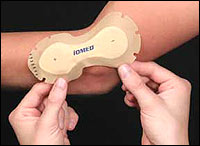
Anyway, I googled “steroid patches.” All the information I found referred to steroid patches being attached to a device that produces electrical charges. In a feat of scientific magic, the electricity drives the drug rapidly through the skin and deep into the tissues beneath it, where it does its own magic, drastically reducing the pain-causing inflammation present in the tissues. The process is called “iontophoresis.”

In my case, the tissues involved are the trochanteric bursae.

The advantage to this method of delivering the steroid is that it doesn’t involve the bloodstream, as it would if it were taken orally and (I’m conjecturing here, as I’m not sure) if it were injected directly into the bursae. Though the bursae have virtually no blood supply, some steroid can still leach into the blood.

In addition, with the patches, there’s no risk of infection or injury caused by the needle.

Generally, a steroid patch session lasts 20 to 40 minutes, depending on the amount of drug prescribed, but they can last up to three hours. And while the latest technology can allow patients to wear them away from a clinical setting, carrying the electronic source device in a pocket as it wirelessly transmits the signal that causes electric pulses in the patch, that technology is very expensive. It’s a lot cheaper to use the patches in the clinic. And the VA is, of course, all about fine health care at a reasonable cost.

I can live with that.

In other news, my nortriptyline prescription from the VA pharmacy finally arrived today. I’m looking forward to a much better sleep tonight and for the next month of nights. The bad news? The doc neglected to give me refills on this prescription, too, so I have to contact the pharmacy (and they, him) yet again for enough refills to last until my appointment in June. Sigh …

Overall, though, there is hope on the horizon. If the steroid patches work, I won’t need the sleep-aid anyway. Now that would be good news!

Nighters

It’s Tuesday night. I’m hoping for a good night’s sleep; I have an early physical therapy appointment in the morning, followed by a caregiving day with my aunt and uncle. I enjoy being with them, and the work isn’t difficult or stressful, but these work days tend to be very long. I try not to push myself too hard, but I usually end up worn down to a nub anyway.

Stupid RA. Stupid bursitis. Stupid osteoporosis. The combination is an energy leach, which is why my mind is on sleep tonight.

I’ve always tended to underestimate the importance of healthy sleep. When I was editing the newspaper, 12-to-15-hour-days at the office were my norm. When I finally got home at night I’d be so wound up that it would take me until midnight, at least, to relax enough to settle down and sleep. And then I was back up at 4:30 a.m. to start the whole thing over again, sometimes six days a week.

I loved it. I loved my work. It fulfilled me and gave me joy.

In hindsight, I know that my lack of sleep was self-destructive. Nuts, even. But at the time, I was proud of my toughness, my resilience. Unlike the rest of the human race, I really only needed four or five hours of sleep at night. I was SuperWren!

These days, when my pain levels are under control, I average six to seven hours of sleep each night. I say average, because I do occasionally sleep a full eight. The key, for me, is pain control. The hip bursitis pain I’ve been battling wakes me up and forces me to roll from my hip to my back to my other hip over and over again throughout the night. I drift back to sleep in between, but I never really get to sleep deeply. When morning comes, I’ve been laying down long enough that my body has become incredibly stiff and miserably achy. I get up with relief, but exhausted.

My rheumatologist prescribed nortriptyline, an antidepressant that has deep drowsiness as one almost universal side-effect. General pain relief is another. In my case, both are gifts. It took awhile (read months) to get the dosage to a therapeutic level, but once it was, the stuff worked beautifully. Finally, I was sleeping through every night! No more tossing around! No more laying there awake, aching, watching the clock, wishing that the opiate pain reliever I was taking would work like it used to so I could get some sleep. Nortriptyline saved me.

Well, until about a month ago, when I tried to refill my prescription for those magic capsules and discovered that Dr. McA had forgotten to renew it during my last appointment with him in December.

Oh well, no biggie, I thought. I’ll just get a request for renewal in to him. It won’t take long.

So that’s what I did. The first night I went to bed without my little white capsules, I was a wee bit apprehensive. Would I be able to sleep? To my pleasant surprise, I snoozed the night through without trouble in spite of my very sore hips and very sore RA hands. The same thing happened the next night. And the next. Great! thought I. Either I don’t need the stuff to sleep anymore, or (more realistically), there’s enough of the drug built up in my system to keep me going for a while.

I crossed my fingers that my reserves would last until the prescription was refilled and I had a bottle of the stuff in my hot little hands.

But a full week later, I still didn’t have a new prescription. I put another request in, feeling like a pest but getting kind of worried. And for good reason. A night or two after that second request, I resumed my miserable, ache-induced tossing and turning, losing the ability to sleep deeply and get well-rested. My magical, residual reserve of nortriptyline was totally tapped out.

And so it has been ever since. Dr. McA finally got my requests and refilled the prescription on Monday this week. Since I routinely receive my VA meds by mail, I should get it—hopefully—by Thursday.

I no longer believe that I can SuperWren through my days, handling whatever challenges that come my way on a mere four hours of sleep. I’m about 10 years older than I was when I did that for my job. My RA hurts and affects my bones and body now like it didn’t back then. I was still enjoying remission. And I didn’t have bursitis of the hips, or osteoporosis. I was tougher. And maybe I was a bit dumber, too.

So. Off to bed I toddle, hoping as usual for sleep, older and—I hope—wiser.

Pain as dread

I seem to be going through a sort of transition these days with my rheuma-dragon, that evil old beastie. Although the symptoms he causes have been frequently annoying over the last three or four years, and his grouchy, persistent cousin the bursitis-wyrm has had his sandpaper claws sunk into my hips for the last two, both of them have ratcheted things up during the last six months—and pushed them even higher in the last two weeks.

Yesterday, I endured the highest level of pain I’ve had yet since my 6-year RA remission ended in 2007. A good portion of the flare was in my hips, as usual, caused by the rheuma-related bursitis. But there was a more profound ache within it, centered deeper inside the hip than those small bursal sacs that lay between the ball-and-socket joints and the tendon-secured muscles that run down the sides of the hips to the knee. The worst pain felt like it was inside the joint, inside the bones themselves. If you have RA, you know the sensation—it’s deep, hot, malignant, throbbing and insistent. It’s impossible to ignore. When it’s really bad, it can make moving desperately painful. At times, any pressure on or movement of the affected joint is simply unendurable.

And yet I’m told by my doc that if the RA is really attacking my hips, I’ll feel the pain in my groin, not the joint. I guess I have to believe him (and recent x-rays bear him out), but my whole being is exclaiming “WTF??”

The ache in my hands intensified considerably yesterday, too. No bursitis to blame, there. The pain was pure RA, its dull knives concentrated in the large knuckles of both hands and radiating toward my wrists and fingertips.

And even as ugly and painful as it was yesterday, this flare was a mere shadow of the flares I used to get in the first decade following my diagnosis in the late 80s. Those were Flares with a capitol F. They were Red-Letter Flares. They were memorable.

And I do remember them—well—which I’m sure is part of my problem today. Yes, some of it is “in my head,” unfortunately. Pain as intense as I experienced yesterday raises a sort of creeping, anticipatory dread in the back of my mind. It’s like a black mist that permeates everything in my world. It was because of this insidious fear of once again experiencing that old agony that I sought out a rheumatologist when it became clear that the nasty rheauma-dragon was waking up again after his long hibernation. When it was clear that he was more than a little hungry—he was friggin’ ravenous. I knew I needed help.

My previous experience with RA drugs had been mostly limited to a profoundly ineffective spectrum of NSAIDs (Non-Steroidal-Anti-Inflammatory Drugs), most of which irritated my stomach to the point that I’d dread the awful, sick nausea each dose brought with it. They were Aspirin. Naproxin. Naprosin. And Etc. I finally stopped taking them entirely and turned my back on any further medical intervention. I was that disillusioned, convinced that the busy doctors and their drugs could do nothing for my RA because, frankly, after five years of trying, they hadn’t.

But over the later, remission years I read here and there about the new Disease Modifying Anti-Rheumatic Drugs (DMARDs) for rheumatoid arthritis. When my dragon finally woke again, I was so scared I was willing to try them. I’d heard of the seemingly miraculous Biologics, too. I wanted them all in my arsenal even though I had little hope that they could actually do any good.

And here I am today, roughly three years after consulting with a Veteran’s Administration MD about my RA. I have a terrific VA rheumatologist on my side—and an impressive array of pills. (Their collected bottles inspire a sort of awe in my family. Frankly, I’m awed, too.) I take three different DMARDs. No NSAIDs. I take vitamins and supplements like folic acid. And I have running prescriptions for two separate pain meds, one of them a narcotic. I keep those particular big guns stashed away in a high, dark cupboard. They’re my puny refuge when days like yesterday hit.

Because my daily medicinal cocktail has, until now, kept my RA dragon slow and sleepy and his knife-like teeth blunted, my faith in medical science has been mostly restored. And while I’m aware that alternative therapies, from copper bracelets to herbals and no-nightshade-plants diets to acupuncture and massage, are available, they’ve never worked for me with any surety. (Believe me, like most people with chronic pain and disability, I’ve tried them. I’d never discourage anyone else from trying them, either, since such things work in such an individualized way on this demented disease.) At this time in my life, I’m relying on medical science and the pharmaceutical companies. I’m convinced that the drugs they’re providing are keeping the worst symptoms and effects of my RA at bay, even though there are a few serious flaws in the armor.

Nevertheless, yesterday’s serious pain in my hands and hips (and briefly, both knees) was a heads-up. Over the last six months I’ve relaxed and let my weight creep back up, allowing yummy but less-than-nutritious foods back into my diet in less-than-healthy quantities. Part of that I wish I could blame on my mom’s menu preferences, but really, I don’t have to eat jelly beans, chocolate candy and cookies with her. I don’t have to eat fast-food burgers and fries or frozen lasagnas. (She can, does and always has eaten all of those things with abandon without gaining any weight or exhibiting any other noticeable side-effects. Grrrr…) The hard truth is that I know how to eat mindfully—I just have to do it.

Starting a fitness regimen a month ago at the gym was a step in the right direction (and one that has fallen by the wayside during the last couple of weeks, thanks to some increased pain and disability, and then some other, sort-of-overwhelming events). Still, I’d like to think the increased exercise had nothing permanent to do with my present RA and bursitis pain; that instead, starting it up again can only help. Now I need to revamp my diet and drop the extra 20 pounds I re-gained. The weight is probably a factor in my present condition, too. Excess strain on the joints, inadequate nutrition, more sugar than is smart or healthy …

It’s a challenge, keeping things in balance with this disease and the other conditions it spawns over time. And it’s one that will never really end, so part of being successful in meeting that challenge has to be accepting it. I’m working on it, trying hard to keep the dread away. I guess that’s all any of us can do.