Climbing Back Down From the Summit

I’m home from Boston*, back with Mom and our calculating cats.

I want to try to write about the Joint Decisions Summit while the whole incredible experience is still (sort of) fresh in my mind. But first, let me say this: flying from the West Coast to the East Coast of the United States and back—a journey of more than six thousand miles—over the space of a single weekend is not for wimps.

Well, I’m not one, thank goodness. And neither is my sweet new friend and fellow traveler Dina Neils, the Titanium Triathlete. She and I shared some empowering experiences along the way—but more about that later. Just let me say that by the time we landed back on our home coast after midnight last night, we were both spoonless.

But being spoonless is not the end. I know from long experience that somehow, we humans often find spoons in reserve when we’re pushed to our limits. I’m sure you’ve heard stories about the extraordinary—but usually ordinary—people who somehow lift automobiles off the trapped bodies of perfect strangers. It’s a phenomenon of superhuman strength, borne of adrenaline, called the “fear response,” according to an article in Scientific American.

Now, I certainly didn’t do anything superhuman last weekend. But I did keep going long after I thought I was all done in, and so did Dina. When my flight finally touched down in Sacramento, I’d been exhausted already for hours. But I still yanked my suitcase off the rotating carousel and hefted it, my carry-on bag, and my purse out to a shuttle bus headed for long-term parking. Then I found my car, tossed the luggage into it, and drove the final 36 miles** home.

Fortunately, at that time of night, there was almost no traffic.

And now, after about five hours of sleep? I’m still pretty tired, but not whupped. My batteries recharged some while I slept and will continue charging throughout the next day or two.

And I’m feeling OK, too. When I dragged my sorry self into the apartment in the wee hours of the morning, I’ll admit I felt like one gigantic ache. My hands throbbed, my feet throbbed … even my hair throbbed. I realized I’d been so busy and distracted during the travelling that I’d forgotten to take my usual pain-deadening doses of Tramadol during the day and evening. Well, no wonder I feel like angry trolls have used me as a punching bag, I thought. I took some with my other nighttime meds before finally allowing myself to tip over and drop into bed.

This morning I’m achy, but it’s manageable. My hands and feet remain stiff and swollen and my hips are grumbling under their breath at me. But you know, all that’s normal. I’m a lot tougher than I give myself credit for, sometimes.

I think it’s important that those of us who live with autoimmune arthritis take stock of just what we do routinely manage to accomplish each day. Because given what the disease takes away from us—normal, pain-free joints, energy, and overall well-being—we really are amazing. Even astonishing. And not just once in a lifetime, like the guy who lifts the 3,000-pound car off the hapless bicycle rider. We’re amazing every single day.

Which brings me back to the Joint Decisions Summit I participated in over the weekend: people who live with rheumatoid disease and other autoimmune diseases are, well, phenomenal.

“Now, Wren, my dear,” the negative little editor in my head murmurs into my ear, “isn’t ‘phenomenal’ just a little dramatic? Are you sure you really want to crow about how strong and brave you are when you know there are so many other people in the world who are far stronger and far braver than you? Really, now. Choose another word. Like ‘tough.’ ‘Tough’ just about covers it, don’t you think? Get me rewrite.”

Sometimes I just want to strangle my inner editor.

Nope. I meant just what I said. We really are phenomenal. We do things that the vast majority of ordinary people, who are like us in most other ways, could never do.

Take Dina, for example. During the Summit she told us—her 10 fellow autoimmune arthritis bloggers—about how rheumatoid disease destroyed her hip joints in just a few short years, stopping her from doing what she loved most in the world: running marathons. When she was diagnosed, her first rheumatologist told her she’d never run again; that in fact, she’d be in a wheelchair within a few years. Well, Dina fired that doctor—she simply wouldn’t accept such a thing. But her RD continued to erode her hip-joints, and eventually she had to have both replaced with titanium replicas. It took time, but she relearned how to walk—and then, to run. She entered some 5K races. And then some 10Ks. And then marathons.

Her doctors were really worried that she’d destroy her titanium joints, though, with all the pounding punishment marathons put them through, so finally, she compromised. She switched to competing in triathlons. You know, those crazy races where the contestants run, swim, and bike considerable distances, one right after the other, without resting in between. The latter two sports don’t jolt and jar and abuse the weight-bearing joints like running does, so Dina’s doctors reluctantly went along.

And you know what? Dina wins those races.

Is that not phenomenal?

And then there’s Mariah, who stopped taking the methotrexate that was keeping her RD under control so she and her husband could start a family. In severe, constant, sometimes disabling pain she carried her first son to term, gave birth, breastfed him, and—incredibly, courageously—became pregnant again. She gave birth to her second little boy a few months ago after a very, very painful pregnancy. With great reluctance she decide to wean her little guy more quickly this time so she could take methotrexate again and, with luck, be able to care for both her boys a little bit easier. She’s still in constant pain, but she hopes the MTX will start to work again soon. And if it doesn’t? She’ll try another drug, and another, until she finds one that finally helps to blunt and relieve her pain and slow the damage the disease is inflicting on her joints.

Mariah feels, right down to her toes, that the pain she endured over the last four years or so was worth it. She has the children she and her husband always wanted. And she’s determined to be the best Mom she can be, RD be damned. She writes about being pregnant and about being a mom with autoimmune arthritis on her blog, From This Point. Forward.

Phenomenal.

These were just two of the amazing stories I heard during the Joint Decisions Summit in Boston over the weekend. Here’s the thing: These incredible young women are bloggers who write about their personal experience of living with RD. They write about how they cope with the pain, the disability, the frustration, the sometimes crushing fatigue, and just get on with things as they pursue their dreams. They write hoping to help others like them live well in spite of the disease.

Because, you know, there are at least 1.2 million other Americans living with RD today. And almost all of them are also coping with it, living well in spite of it, and somehow managing to pursue their dreams. They aren’t all Moms and triathletes. They’re also guys who love motorcycles and guys who climb the Andes and businesswomen and dancers and journalists. They’re all … yes … ordinary, phenomenal people.

More about the Summit tomorrow. For now, this particular phenomenon needs to get some sleep.

*Janssen Biotech paid for my travel expenses for the summit, but all thoughts and opinions I’ve expressed here are my own.

**Heh. While googling the mileage from the Sacramento International Airport to my home just now, I discovered an alternate route that would have had me home in 19 miles (29 minutes vs. 45). Live and learn. 😉

Posted in RA

Joint Decisions Summit, Day 1 — Toastie Toes

Hi, all!

I’m in Boston at the moment — a long, long way from home but hey, everyoneJointDecisionsLogo2014 can use a change of scenery once in a while. And what scenery! I’m at a hotel near Faneuil Hall, with skycrapers and U.S. history everywhere I look. I’m a happy camper.

I’m also happy to be taking part in the Joint Decisions Summit*, a gathering of autoimmune arthritis blogger/advocates, members of the SqueakyJoints.org arthritis community, and Jannsen Biotech. The reason for the Summit? To discuss and brainstorm ways for patients, doctors, and others interested in helping people with RA and other autoimmune arthritis diseases to better communicate and work together for help in coping with the disease and come closer to finding a cure.

All this is taking place during the American College of Rheumatology’s Annual Conference, which opens today. We’re surrounded–literally–by rheumatologists from all over the world. Many of us bloggers will be attending the conference tomorrow afternoon as members of the press. I hope to bring back some new and exciting information for you.

And now, here’s the best part: my fellow bloggers. Last night I got to meet:

  1. Carla Kienast—Carla’s Corner
  2. Angela Lundberg—Inflamed:  Living with Rheumatoid Arthritis
  3. Amanda John—All Flared Up
  4. Cathy Kramer—The Life and Adventures of Catepoo
  5. Dina Neils—The Titanium Triathlete
  6. Leslie Rott—Getting Closer to Myself
  7. Mariah Leach—From This Point. Forward.
  8. Eduardo Flores—Rheumatoid Arthritis Guy
  9. Rachelle Crow-Hercher—Spoonless Mama
  10. Brittany Johnson—The Hurt Blogger

I’m sorry I don’t have links to all their websites, but I’ll repost them later, when I’ve got a little more time.

I can’t tell you how delighted I was–and am–to meet all these great people! For me, this is a truly special event. I’ve lived for 27 years with RA without ever meeting–in the flesh, that is–another human being who shared this disease with me. And now, suddenly, there are ten–count ’em–10 of them here with me, eager to talk, share notes, commisserate, and most of all, laugh. They’ve traveled here to Boston from all over the U.S.; Eduardo (RA Guy) arrived yesterday from La Paz, Bolivia, an amazing city nestled high into a canyon high in Andes mountains.

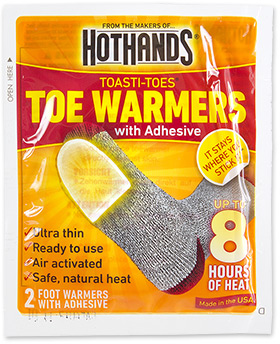
Incredible. Also incredible: how cold it is here in Boston. Our hosts kindly supplied us with a heaping handful of HotHands chemical hand- and foot-warmers. When I first saw them, I chuckled and thought to myself, “aw, how cute. I won’t need them.”

Heh. My achy, persnickety feet, in my new, low heeled pumps, just about froze HotHandstoe3solid this morning when I went out for a light breakfast and a cup of coffee. So when I got back to my room, I decided to try the foot-warmers.

OMG. They work!

Thanks, HotHands! Thanks, SJ/Jannsen. Wow! My tootsies will be nice and warm all day long. I stuck the handwarmers into my jacket pockets, too–so when my sore fingers feel bleh during the day today, I can just stick them in my pockets for a little therapeutic heat. Incredible.

OK, guys. Gotta go–the summit starts soon. I’ll write more–and post pictures–soon.

*Janssen Biotech paid my travel expenses for the summit, but all thoughts and opinions expressed here are my own.
Posted in RA

Remembering the gifts

For some reason, all my owies are on the right side of my body this morning. The ring finger of my right hand. My right elbow. The ankle and large toe of my right foot.

Why?

Who knows? Maybe I slept funny on that side during the night. The window in my room is on my right when I’m in bed; coolness flows in through the narrow slot I leave open for fresh air. Did the cold set into the joints? Not likely. And I use my right hand more, but that doesn’t explain why my foot hurts.

This is one of many baffling things about autoimmune rheumatoid disease: it causes pain in random places in the body from day to day, and sometimes even from hour to hour.

Fortunately, today’s discomfort is merely that: discomfort. It’s not disabling. As long as it stays muted at this low level, it won’t slow me down much, if at all. What it will do, however, is remind me constantly that I have this disease that won’t go away. It’ll make me vaguely apprehensive as the day goes on; with every sudden twinge or briefly amplified ache I’ll wonder if this is the one that signals the redwood shadowonset of a far more painful and disabling flare.

I’ve always tried to counter this low-level fear by going out of my way to notice the small beauties—the gifts—the world offers each of us every day. At the moment, for me it’s the delicious coolness of that draft of fresh air, and the shadow of the redwood tree’s branches the morning sun casts on the wall. The branches are moving gently in a light breeze, which is another gift. It’s been so unseasonably warm and still for the last week or so, a cool breeze that moves the air and tickles my skin is like ambrosia.

Noticing the gifts helps me keep things in perspective as I cope with my cranky dragon—and life’s other everyday problems. Noticing is a way to snap myself out of worry about the future (which I can’t predict or control anyway) and back into the present moment, the place I’m alive in here and now. Mindfullness—such an overused word these days, but a good one nonetheless—gives me a feeling of peace. And while it might not last for more than a few minutes or moments, I believe they make my life fuller and more rounded, and absolutely more joyful.

What gifts have you found today?

Posted in RA

Changing for the better

I had my hair tinted yesterday. Today I had it trimmed. Both days I found sitting in the stylist’s chair a miserable chore. Both my hips ached, the knuckles of both hands were nauseous, and both feet felt like they’d been whacked and battered with truncheons wielded by scowling, aggravated trolls for hours on end.

My stylist was a 20-year-old, about-to-graduate beauty school student. That’s why my new look took so long—six hours all together. But my hair looks great! She did a terrific job with the color, the weave, and her scissors—and she was friendly and professional and full of humor. Kudos to the Paul Mitchell School in Sacramento.

I wish dropping 30 pounds could be so easy!

I’m feeling a lot better about the changes I’m making to be healthier. Slowly, I’m getting my mind around resuming my low-carb, high-protein, high-veggie, low-sugar-and-salt diet. After all, it can only help.Change And while my blood sugar is great right now, that doesn’t mean it will stay that way without some vigilance on my part.

Slowly, I’m accepting that coffee is Not My Friend. I’ve almost gotten to the point where I can drink just two, 8-ounce cups of joe a day without getting a horrid caffeine-withdrawal headache. I took a 45-minute walk the other day while Mom was at her physical therapy appointment—and I enjoyed it. So I’m working myself up to daily exercise, too. There are nice neighborhoods all around our new home that’ll be really pleasant for walking in. And our fitness room here at our new home should be finished and ready to use any day now.

What I haven’t managed, yet, is to talk myself into liking all these changes. Yes, I want to drop some weight. Yes, I really, really want to avoid a heart attack or stroke. Yes, I would prefer not to get type 2 diabetes, and yes, I want my muscles to be stronger so they can support my RA-compromised joints better.

I know my success in these things hinges on my attitude and my mind-set. What I’ve discovered about myself, though, is that I can’t force either to do like I want them to. It’s like my brain has to work it out subconsciously before it clicks over into “go” mode. Still, I’m trying.

Moving Mom took a lot of oomph out of me. I turned 58 in late October, and for the first time, I felt my age (even as I threw a childish tantrum and pity-party over my health). But I’m recovering. I keep telling myself how nice it will be to fit into my size 14 pants—I’ve got a closet full of them, most only worn a few times—and how nice it will be to tone up all the flab that’s built up everywhere over the last two years or so.

And I hope that making these changes will also have a positive effect on my RA. Actually, I know they will, even if achieving them won’t cure it or even necessarily send it into remission. If I feel better about myself, my RA will feel better, too.

Maybe change isn’t so bad, after all. 😉

Posted in RA

Searching for my smile

I haz the sad.

I haz the sad.

I’ve now taken two doses of Humira—a month’s worth—but my rheuma-dragon continues to bite and gnaw the joints of my hands, ankles, and feet with undiminished enthusiasm, like a dog with a well-loved bone. If I hadn’t actually injected the stuff myself, I’d never believe I’d even taken it.

Yes, I’m disappointed that I don’t feel better. Yes, I know this stuff can take quite some time to show results—if it’s going to. I’ve studied up on Humira and the other biologics, and I’ve read what many other bloggers who’ve taken it or are taking it have written about it. I know that biologic DMARDs, like their cousins, the chemical DMARDs, are fey and fickle. Some people get immediate results. Some get results only after a longish “waiting period” has passed. And for some people, these drugs never work at all—in which case, they have to try another one, going through the whole waiting process again. And maybe again … and again …

I’ve told myself to be realistic and not expect anything. But you know how it is. Deep down inside, I was hoping I might be one of those lucky souls who sees quick and dramatic results.

Seems I’m not. Still … maybe soon. In the meantime, I’m sucking it up.

And now, a new health challenge. About a month ago, just before my lady-parts exam, the nurse took my vitals. Blood pressure, weight, temperature, the usual. My blood pressure was sky-high, even after waiting for a while and taking it a second, then a third time. After my exam, they sent me straight to my primary care doctor.

At the primary care clinic, my blood pressure remained so high my doctor stuck a monitor on me, made me sit in a wheelchair, and had me trotted right over to the emergency room. And there I stayed for the next three hours, following the ER doc’s instructions—“Be calm. Think happy thoughts. Take a nap.”—and hooked up to monitors. Eventually, my BP came down. It was still higher than it was supposed to be, but I wasn’t in imminent danger of a stroke anymore. (Wow. I felt just fine, too!) They sent me back to my primary care doctor.

She gave me an injection to bring my BP down further—she felt it was still uncomfortably high and wasn’t very happy with the ER doc. She had me wait in her clinic for another hour and a half while the medicine made my BP drop. Finally, she felt it was low enough that I could safely leave. Before I did, though, she prescribed a daily blood pressure medication.

I saw her again today for another follow-up. She adjusted the BP med dose for the second time. Seems my blood pressure is still higher than it should be. In the meantime, I’m slowly cutting back on coffee (which I’ve already done over the last couple of years—this is even more). I’m down to just a couple of cups a day, but as my doctor reminded me, the goal is no coffee at all. That’s not going to be easy for me. I get horrible caffeine withdrawal headaches every time I decrease how much I drink. That’s ugly enough, but you know what? I don’t want to give my coffee up entirely. I’ve been drinking it since I was 16 years old. I love coffee.

Why is it we always have to nix the good stuff? Why can’t I give up Brussels sprouts instead?

Other changes I’ve got to make because of blood pressure: cut even more salt out of my diet, and go on a diet. Again. I guess I might as well. Without any salt, my food’s going to taste like kaka, anyway. And of course, I must exercise. Which, I remind myself, is also good for the RA. Sigh.

I’m feeling sort of low these days, but I’m searching for my smile. It’s out there somewhere.

Posted in RA

Ebola and RA: Should You Worry?

Well, sure.

Both are unpleasant, both can make you feel awful, and both are potentially deadly. But rheumatoid arthritis is a chronic autoimmune disease and Ebola is a virus, a relative of the bug that causes the common cold.

But how about this: if you have rheumatoid arthritis, should you be more

Ebola virus

The Ebola Virus

concerned about catching the Ebola virus? Are you more susceptible to it? Should you be scared?

No, maybe, and no.

Unless you’re a health care provider working directly with an Ebola patient, or you’ve recently visited the African countries Liberia, Sierra Leone, Guinea, or you’ve come into direct contact with the bodily fluids of an Ebola patient, your chances of actually catching Ebola are about the same as your chances of traveling to the moon tomorrow morning. You shouldn’t be in the least concerned, not even if you’re taking disease modifying anti-rheumatic drugs (DMARDs) that suppress the immune system. They might make it harder for your body to fight the virus off if you’re exposed, but (see above) you probably won’t be.

Want to know what you should be scared of? The flu.

That’s right. Influenza. It’s also a virus, just like the common cold (rhinovirus) and Ebola. Unlike Ebola, though, the flu virus is everywhere. It’s all over the world, and it’s seasonal—it thrives and passes easily from person to person in cool and cold weather. In the Western Hemisphere, autumn is well underway—and flu season has arrived. It’ll be with us until spring.

Between April and October of this year, Ebola killed 4,555 people, the vast majority of them living in the three African countries mentioned above.

The Flu Virus

The Flu Virus

In the last 10 years, the flu killed an average of 32,743 people each year in the U.S. alone. Some years more people died, some less. It depends on several factors: which flu strain is dominant (some are more deadly than others), the weather, the efficacy of the flu vaccine in any given year, and whether people actually take the vaccine.

And that’s the thing. There is no vaccine (yet) for Ebola. But there is for influenza. Every year, medical science makes an informed, educated guess about which strains of flu will dominate in the coming year and develop a vaccine against it. And every fall, the vaccine is available to anyone who wants to get it.

To clear up a silly myth: You can’t get the flu from the flu vaccine. Although the virus in the vaccine is dead, it still stimulates your body to create antibodies to attack the live virus, should you contract it. Those antibodies will seek it out and destroy the bug, and you won’t get sick. Some people might get some flu-like symptoms after receiving the vaccine, but they’ll be mild and will go away within a day or two. Others might develop redness, tenderness, or swelling at the vaccine site, but that will go away within a couple of days, too.

Another myth: getting the flu shot will make your RA flare. Um, no. It won’t. There are a million different reasons your RA might flare up—stress, weather changes, fatigue, you’re wearing blue today—but getting a flu shot isn’t one of them.

Once you’ve taken the vaccine, your body needs about two weeks to build up a strong immunity to the flu strains the vaccine fights. During that time you can still catch the flu. And you can still catch any other strains of flu that aren’t in the vaccine at any time during the season.

If you have rheumatoid arthritis, should you get a flu shot?

Oh, absolutely. RA affects the immune system, making it harder for you to fight off any type of infection, including from the flu. And if you take chemical or especially biologic DMARDs—disease modifying anti-rheumatic drugs—to control the progression of your RA and its symptoms, your immune system is

The Flu Shot

The Flu Shot

even further compromised. You’re more susceptible to the flu, may get a more severe case of it, and may be more susceptible to further complications, such as pneumonia.

If you have RA or other forms of inflammatory arthritis, getting the flu vaccine is one of the smartest things you can do every year.

The Centers for Disease Control and Prevention recommends that everyone 6 months old and older get the seasonal flu vaccine that’s injected into the muscle of the upper arm.

The flu vaccine is also available as a nasal mist. People with RA or other types of inflammatory arthritis should not take the vaccine in this form.

Getting the flu shot doesn’t mean you can’t pass the flu on to others. Flu is transmitted by person-to-person contact. If you touch something that someone who’s contagious with the flu has touched, you can easily pick up the virus and pass it on to someone else. Avoid this by:

  • Washing your hands frequently with soap and water. If they’re not available, use an alcohol-based hand-rub.
  • Avoid contact with people who have the flu if you can.

Flu symptoms include:

  • Fever/Chills
  • Cough
  • Sore throat
  • Runny or stuffy nose
  • Body aches
  • Headache
  • Fatigue

If you feel like you might have the flu, contact your doctor immediately. He or she will decide if you need to take an antiviral medication or stop taking your RA medication.

The fear-mongering media has whipped up a fear-and-loathing frenzy over Ebola, a deadly virus that has almost no chance of becoming epidemic in the U.S. or any other developed nations. We really have nothing to fear from it.

The flu, on the other hand, can and will kill tens of thousands of Americans this year—but somehow, that’s not as exciting or sexy as Ebola, so it doesn’t get much mention. Thank goodness we can protect ourselves from the flu with a vaccine.

Maybe someday they’ll have one for Ebola, too, so that no one—anywhere in the world—can suffer terrible illness and death from it ever again.

References:

Posted in RA

Dragon

Black-DragonHe’s awake.

Sure, he’s still sleepy. He’s clumsy, a little disoriented, his dreams only partly shredding away as he stretches his limbs and slowly uncurls his long, spiky tail, which he switches back and forth like a cat when he’s alert and hunting.

He has outrageous morning breath. Dragon-breath. It burns.

The dragon yawns. Snaps his jaws. A hot bolt flashes through my knee, causing me to cry out in pain and surprise. Then, just like that, the pain is gone. I flex the joint, shake my head and go about my business, and I soon forget the incident. But in the back of my mind, a few levels down and out of sight, I’m wary. Once upon a time, a long time ago, I’d have blithely gone on my way, carefree and unaware of the danger ahead. When the dragon ambushed me and attacked, I’d fight him and come out alive but wounded.

See, I’ve been this way before. Here there be dragons.

Am I being childish, giving my rheumatoid arthritis a tangible form, however imaginary? Maybe so, but it helps me cope with the fear, reducing this incurable, dreadfully painful and disabling disease down into a monster of more reasonable, less frightening proportions. Today, when the rheuma dragon tries to bite, I’m ready. I’m wearing a fine, strong coat of mail made of interwoven molecules of adalimumab, leflunomide, plaquenil, and sulfasalazine. Over it I wear the hardened armor of knowledge. My sword is light and strong, forged out of hard-won experience.

But most important, my spirits are high. I’ve streaked my face and body with the woad of hope, mixed liberally with laughter. There is no better weapon against the rheuma dragon than this. It’s the first defense—and the last. As long as I wear my blue woad, he cannot penetrate the stone castle of my body.

Yes, the dragon can hurt me. He can scar my ramparts and dig at my foundation with his thick, sharp claws, but he cannot get in, ever, unless I lose my hope and quell my laughter.

Posted in RA

Moving Mum

The weeks following my return from Philadelphia were a chaotic combination of hurrying, scurrying, and worrying. With the sale on Mom’s condo finally closed, we needed to find a new home. So we looked and looked–way down the hill in Sacramento.

She had definite ideas about the kind of place she wanted—it had to be safe, have a washer and dryer, be in a good neighborhood, be close to stores, shopping, doctors and friends, and allow pets. And it had to fit her budget, which was not flexible. It left me with a real conundrum.

Mom decided a two-bedroom apartment would be just right. One bedroom would be hers, she said, and the other would serve as the guest room, just as it had at her old place. I would use the guest room unless we actually had a guest—in which case I’dmoving_grandma just move into her room with her during their visit.
But apartments, we discovered, were both expensive and tiny, depending on where they were located and how old they were. The newer, more modern places were downright miniscule—but still very pricey. And although we’d spent much of the summer downsizing Mom’s lifetime collection of possessions, when it came right down to it, she still had a way too much.

And then, there was this: I’ve lived in Mom’s guest room, now, since October 2010. Her overall health is better now than it was then—she was really sick—but she still has frequent down days. She has heart problems, mild COPD, and stomach problems, and she’s become progressively more and more forgetful. She has trouble with her balance–even on good days–and tires very quickly. She wants to drive, but shouldn’t, so I’ve taken on the role of chauffeur/companion whenever she wants to go out.

Mom simply can’t live alone anymore, but she also can’t afford an assisted living facility. She’s too mobile and independent for a nursing home—and she’s not quite sick or enfeebled enough to need one, anyway. My sister and I don’t want her in one of those places unless—or until—there’s just no other choice. So, because I was unemployed, had time on my hands, and lived nearest to Mom—my sister lives in New Mexico—I stepped up to the plate, figuring at the time that it would be temporary. That was four years ago this month. I left everything of my own behind at my little house in the mountains.

Anyway, with this major move, what I really wanted—and don’t laugh, now—was just a room of my own. A room I could decorate the way I like, with my own furniture from home. A room I could be at home in, instead of always feeling like a long-term guest. I wanted a quiet, private space where I could write and work—a room with a desk and a door. And I wanted a room I could put a drawing table in, so I could do my artwork without having to put it all away every day to keep Mom’s still dynamic inner-neatnik happy. (Of course, doing art doesn’t work like that. It needs to be out and handy, ready to pick up whenever there’s a free moment or the creative urge hits. Mom. Doesn’t. Get. It. She never did.)

But having a room of my own meant finding a place with a third bedroom—and it somehow had to fit into Mom’s budget. She wasn’t happy. She kept saying no.

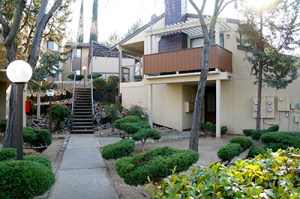
So we looked and looked. Finally, we found an older apartment with three decent-sized bedrooms. The complex was safe, but it wasn’t in the really nice, upper-class neighborhood Mom wanted. Instead, it’s not far from the local community college and caters to students and middle class working folks. It’s in the middle of the suburbs, surrounded by all the shopping and conveniences anyone could ever need or want, and there’s even a large hospital (and ER) just a couple of miles away. They allow pets. The apartment has a washer-dryer combo

Our new home.

Our new home.

inside. It has a pool, a sauna, a hot-tub, and a fitness room. (I like all that. A lot.) And it’s in a neat, clean, nicely landscaped, well-maintained, gated and patrolled, attractive apartment complex.

But it’s still far smaller than Mom envisioned—any apartment would be—and with the third bedroom, it simply didn’t fit her budget. She dug her heels in. An extra bedroom, she said, was just an extravagance. We didn’t need it.

Well, she didn’t, but I did. So I told her I’d rent the room from her, making up the difference in cost so her budget would be intact. And I’ll admit it—I pushed. I really wanted my room, but the truth was, we were also running out of time. We had to be out of the condo within two weeks.

The week before we moved we were still trying to get rid of several large pieces of furniture, none of which would fit in the apartment. In the end, the woman who bought Mom’s house bought them all from us—it worked out just great, and Mom got a nice little stash of cash. Selling it was hard on her, though. Each piece of furniture—the giant china cabinet, the tall, open shelves, the beautiful dining room table and chairs—was laden with memories of Mom’s life with my Dad. And she had to give them up.

It was heartbreaking.

And then, the Friday afternoon before Labor Day—just four days before Moving Day—Mom got her feet tangled as she got up from the couch to answer the door, fell, and broke the humerus bone in her arm near the shoulder. She’s had osteoporosis for years, so no big surprise. In fact, one of the reasons we moved—along with financial considerations—was to get her into a ground-floor apartment or condo so she wouldn’t need to climb up and down stairs anymore. They ones at the old place were broken bones just waiting to happen.

Well, the broken arm really threw a wrench into Mom’s works. Because of where the break was, they couldn’t put a cast on it, but she has to wear a sling to keep the arm immobilized so it can heal. It was (and still is) painful, of course, which meant she needed painkillers. (It’s healing nicely, now, but still hurts if she forgets and tries to use it too much.) Mom’s balance was already dicey, but with one arm stuck to her side, useless, it got even worse. Now add narcotics, stress, consternation, frustration, and exhaustion, and you have a pretty good idea how the move went.

Thank the gods and all the angels that my sister and I were able to convince her to hire professionals to pack and move her. She fought us on that, not wanting to spend the money, but I used the RA card while my sister reminded her frequently that she was becoming too frail to do it all herself like she used to.

Whew.

So we’re here, finally. Things are mostly put away—but there’s still a mountain of boxes and a couple of old recliners. The boxes are full of fragile breakables from Mom’s gigantic china cabinet; close to 60 years of Christmas stuff; and a lifetime of small things that she just couldn’t bring herself to part with. And the mountain of boxes is in—you guessed it!—my room.

At least it is until we can get a storage space rented here at the apartment complex. Fortunately they do have them, so it’s just a matter of… well… moving all those boxes to one and ponying up the monthly fee. Mom is digging her heels in again on that. Sigh.

So, at the moment, I’m still in the guest room. But that’s temporary, right?

In other news, my RA has gotten progressively worse. I saw my rheumatologist a couple of weekends ago, and after some discussion, we decided I’d start Humira. humirapen_cartonleaningpen_303697_303698The self-injecting pens arrived a couple of days ago, and today—ta-da!—I did my first injection. Did it all by myself! Fortunately, Terry, who writes the blog “RA Adventure Rider”  just published a funny post about his own recent injection of Humira. After years of using the stuff, he’d forgotten to ice the injection site before injecting—and suffered a brief, raging bonfire in his leg. He wrote about it with humor as a gentle warning to us newbies, and man, am I glad he did. As he suggested, I let the pen come to room temperature and used an ice-pack on the injection site before taking a deep breath and pressing the button. And hey! Done! Almost no pain. Thanks, Terry. Really.

I hope Humira will play Stomp the Dragon with my rheuma. I could really, really use a break.

Posted in RA

I’m Ba-a-a-ack …

Wow! It’s hard to believe that the last time I posted was August 11. Normally, I’d feel a bit guilty about abandoning RheumaBlog for so long, but this time, I have a good excuse.

I’ve been swamped. Totally, completely, overwhelmingly. And, to be honest, it felt pretty good to be so busy, at least most of the time. I’d almost forgotten what it felt like to have my days so filled up with activity.

So, what have I been up to?

Well, I did go to Philadelphia for Healthline, as I talked about in my last, longago post. And, as I expected, I really enjoyed my three days away from home in completely new, fascinating, unfamiliar surroundings. The flight there on the

Rittenhouse Square

Rittenhouse Square

first day was good: my only white-knuckled moments were during the several take-off’s and landings, which is normal for me, craven chicken that I am. And the great city of Philadelphia—at least, the part I was able to see—was beautiful. My room at the Raddison Blu Warwick Hotel near historic Rittenhouse Square was fabulous—and one of the city’s oldest hotels. Unfortunately, I didn’t have much

Radisson Blu Warwick Hotel

Radisson Blu Warwick Hotel

time for sightseeing on the second day, but I did get to spend some time strolling around the square in the bright, moist-warm sunshine. I treated myself to a delectable lunch at a restaurant called Rouge and later on, joined my fellow patient-panelists and the Healthline staffers for a meet-up dinner that evening. I tried the Philadelphia cheesesteak. Because, well, Philadephia.

Healthline’s Thought Leadership ePatient event on the third and last day went

Rouge restaurant

Rouge restaurant

really well. I thought I’d be nervous, speaking to a large group of total strangers, but I wasn’t. The audience, about 40 young advertising experts, was casual, interested, and friendly. I talked about how I’d discovered I had rheumatoid arthritis, how I’ve treated it over the years and how I’ve lived with it, and then, spoke about the subject more important to them: what I think of the current advertising for the biologic DMARDs that treat RA (which is what they create). Using the comments several of you sent to me, I told them that

The view from my hotel window.

The view from my hotel window.

future ads should be more realistic in terms of how well these drugs actually work, etc. Afterward, we broke up into small groups to answer disease-specific questions. The whole event was fascinating—and fun. And it was great to have the opportunity to meet—in person!—several of the Healthline.com editors and other staffers I’ve worked with or met via email.

Then it was time to go back to the airport and fly home. Healthline had arranged for a local car service to pick me up, then return me to the airport. The driver of my Lincoln Town Car was appalled that I hadn’t been able to do any sightseeing, so he took me on a quick ride around town on the way, pointing out the more famous sights. He took particular delight in showing me the famous “Rocky” steps that were Rockyfeatured in the movie, and the statue of Sylvester Stallone as Rocky Balboa, his muscle-y arms raised in exhausted triumph over his head.

We arrived at the airport—and that’s when it all went downhill. I wanted to give my driver a good tip for being so nice, so I dug into my carry-bag for my wallet. It was gone.

We did a frantic search through the Town Car’s trunk—where I’d put the carry-on and my suitcase—and then the back seat. And it wasn’t there. I apologized to the driver—he was very upset that I’d lost my wallet and was quite understanding—but he had to leave, as another customer was waiting. Trying to stay calm, I went inside and called the hotel.

Just before leaving, I’d purchased a cup of coffee in the ground-floor café, then

Warwick Hotel lobby

Warwick Hotel lobby

made a quick stop in the ladies. I asked the hotel to please look around for my wallet, which I thought must have somehow dropped out of my bag. No one had come close enough to me as I waited for my car to steal it from me. (Note: I am aware of how easily—and sneakily—thieves steal wallets. I was pick-pocketed once in Cologne, Germany many years ago…)

Hotel security couldn’t find my wallet. My flight was due to leave in 90 minutes. I needed to get my ticket (which, thank the gods, I’d arranged via computer the night before; I just needed to check my suitcase and get the paper ticket). The trouble was I had no identification. Without it, I couldn’t do either. Visions of being stuck at the Philadelphia airport without any ID, money, debit card or credit cards started running through my mind. How in the world was I going to get home if I missed my flight?

Stay calm, I told myself. Just. Stay. Calm. After talking to a couple of different airline clerks, who had no good suggestions and were clearly too busy to care, I

Another view of the Warwick

Another view of the Warwick

went to the TSA officer at security and threw myself at her mercy. I explained what had happened. My flight was already purchased and confirmed, I said, but now I had no ID and couldn’t get a boarding pass. Please, I said. I can’t miss this flight.

Thanks to the fact that I’d put my checkbook (for some reason… I have no idea why I did that) and a bottle of prescription pills with my name on it in my suitcase, I was allowed to board my flight. Of course, I had to go through the whole security thing: the whole body x-ray, then the whole body pat-down, and then having my suitcase, carry-on, and laptop case searched for explosives and potential weapons. And then, with my RA flaring in my hands, feet, and hips, I ran through that airport carrying and dragging all three.

Once on the plane, I had no way to buy snacks or a meal. And once back in Sacramento, I was only able to get my car out of long-term parking by writing the city a check. I drove the hour and 10 minutes home, totally exhausted and aching. And the next day, started the long process of replacing everything I’d lost. Except the cash, of course. Sigh.

Next up: Moving Mum

Posted in RA

Philadelphia, here I come …

I’m flying (!! flying!! Ack!!) to Philadelphia tomorrow to participate in Healthline’s Thought Leadership ePatient event, which takes place on Thursday. It brings a few patients, like me, and the people who create pharmaceutical advertising together to meet and talk about what’s working–and what’s not in their efforts to make us comfortable with their products. I’ll be one of a panel of four patients. My specialty is, of course, rheumatoid disease.

PhillyMontage

The idea, as I understand it, is to help pharmaceutical advertisers understand the “patient’s journey” and patient’s needs, taking into consideration what types of technology we use–TV, Internet, tablets, apps, and through which media (blogs, pharma websites, health websites like Healthline)–and how they can reach us more effectively.

I’m looking forward to the event. I think it’ll be really interesting–and educational–on both sides of the room. And Healthline, too.

And, since I’m just one little patient with one little blog, I thought I’d toss some questions out to you, too. They’re pretty much the same one Healthline asked me as we were preparing for the event. I’d love to hear your answers, and I’d really like to share them with the pharma group on Thursday. You can either pipe up here in comments or email me: bluewren56@gmail.com

The questions:

1. What suggestions might you make to pharmaceutical marketers/advertisers who market autoimmune arthritis drugs? How could they do it better?

2. Have you ever visited drug brand websites to get information? If so, when? During what part of your journey? During Symptoms, Diagnosis, Treatment research?

3. Do you use social media for health information or management support? If so, when and how?

4. Do you feel there is a gap between patients and doctors? Can pharmaceutical marketers help bridge that gap or would you rather get information from a third party, such as Healthline, so you can make more informed treatment decisions?

Thanks, everyone. I think this is going to be a blast. I’ve never been to Philadelphia before, and I may have some free time on Wednesday to do a little sightseeing. I’m bringing my camera so I can do some touristy things. And of course, I’ve gotta try a beer and a cheesesteak.

And while I’m a bit nervous about public speaking–each patient has to give a 10-minute introductory talk about their illness “journey”–I’ve done it before.  I’ll just have keep a bottle of water handy for afterwards, because I always seem to have a ferocious dry-throat-tickle-coughing attack directly after I sit down. Nerves, I think.

Wish me luck! And please do tackle some of those questions, if you would. I’d like to know what you think.


Posted in RA